
The 'Granularity Paradox': Why Finer Time-Series Data Can Make Forecasts Worse
The Core · TL;DR
- A new arXiv paper identifies a 'Granularity Paradox': finer time intervals (e.g., daily vs. monthly) improve in-sample metrics but often worsen real-world forecast accuracy due to recursive error compounding.
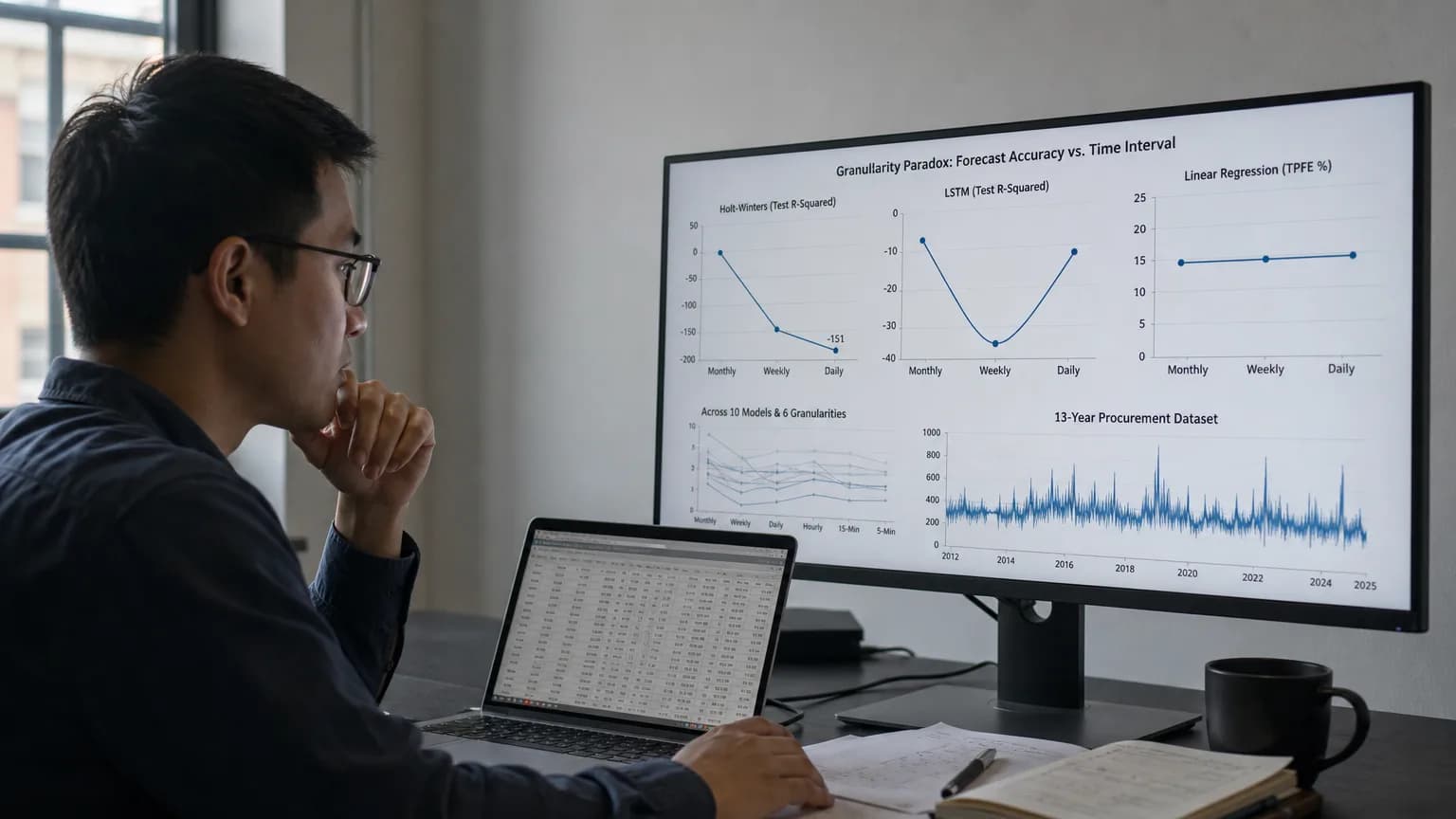
- Across 10 models and 6 granularities tested on a 13-year procurement dataset, Holt-Winters collapsed at daily resolution (Test R-squared of -151), while LSTM showed a U-shaped error curve, improving sharply at the daily level.
- Linear Regression stayed stable (16.3-17.0% TPFE) across all granularities, suggesting the paradox stems from recursive forecasting structure rather than model complexity.
- The authors propose a consensus-dissensus diagnostic to catch models whose standard metrics hide systematic error propagation.
A model that looks better on paper can quietly get worse in production, and a new study pinpoints exactly why this happens in time-series forecasting. Researcher Hugo Moreira, in a paper submitted to arXiv on July 5, 2026, documents what he calls the "Granularity Paradox": breaking data down into finer time intervals, say from monthly to weekly or daily records, improves in-sample diagnostics and gives models more data points to train on, yet it systematically degrades real-world, out-of-sample accuracy.
The mechanism behind this isn't model complexity. It's recursive error compounding. When forecasts are generated step by step at high frequency, each prediction feeds into the next, and small errors accumulate and amplify across the recursive chain. The finer the granularity, the more forecasting steps are needed to cover the same time horizon, giving errors more opportunities to compound.
Testing Ten Models Across Six Granularities
To validate the paradox, Moreira benchmarked ten forecasting approaches, spanning naïve baselines, statistical methods, machine learning, and deep learning architectures, across six different levels of temporal granularity. The testbed was a 13-year public procurement dataset, chosen for its long history and real-world irregularity.
The results are stark. Holt-Winters, a classical statistical method, collapses at the Daily grain, posting a Test R-squared of -151 and a total percentage forecast error (TPFE) of 425.85%, numbers that indicate the model is performing far worse than simply guessing the average. That kind of failure would likely be invisible if a team only evaluated the model on coarser, monthly aggregates.
LSTM networks tell a more counterintuitive story. Their error follows a U-shaped curve: performance worsens moving from Monthly (19.66% TPFE) to Bi-Weekly (35.94%), but then sharply improves at the Daily level, where TPFE drops to 4.35% and R-squared reaches 0.66. In other words, the paradox doesn't apply uniformly. Some architectures actually benefit from higher-frequency recursion once given enough sequential structure to learn from.
Linear Regression, by contrast, stays remarkably flat across every granularity tested, holding between 16.3% and 17.0% TPFE regardless of how the data is sliced. Moreira argues this stability is the key clue: since a simple linear model doesn't suffer from the paradox while more complex ones do or don't depending on architecture, the real driver isn't how sophisticated a model is, but how its forecasting process is structured, specifically whether it relies on recursive, multi-step feedback loops.
A New Diagnostic for Hidden Failures
Because standard accuracy metrics can look acceptable in-sample while masking this compounding effect, the paper introduces a consensus-dissensus diagnostic. The idea is to flag models where multiple evaluation signals disagree with each other, a sign that a model's apparent accuracy is not to be trusted at a given granularity.
For teams building forecasting pipelines, particularly in operations, supply chain, and procurement, the takeaway is direct: choosing a finer time grain because it "gives the model more data" is not a free upgrade. Granularity itself needs to be tested as a design decision, not assumed as a default.
Original reporting and research used to synthesize this article.
WAKIB Editorial Team
This review was prepared and summarized by the WAKIB AI intelligence engine and vetted by our editorial board for accuracy and reliability.
Subscribe to Newsletter
Get a weekly summary of the most promising AI research and tools delivered to your inbox.
Telegram Channel
Join our active community on Telegram for real-time tracking of AI models and trends.