
Anthropic Adds Invisible Watermarks to Claude's Text Output
The Core · TL;DR
- Anthropic detailed Claude's new text watermarking system on August 17, 2026, built to comply with the EU AI Act's mandate on labeling synthetic content.
- The system, based on Google DeepMind's open-source SynthID-Text approach, subtly biases interchangeable word choices to create an invisible but detectable pattern.
- The watermark carries no identifying data, adds no cost or extra tokens, and won't be reliably detectable after a full rewrite or in code due to limited word-choice flexibility.
- Anthropic plans a public detection API, and other Code of Practice signatories are expected to roll out similar watermarking across their own models.
Claude will soon leave a fingerprint in every response it generates, one that no reader will ever notice but that Anthropic can detect with the right key. The company detailed the system on August 17, 2026, framing it as a direct response to the European Union's AI Act.
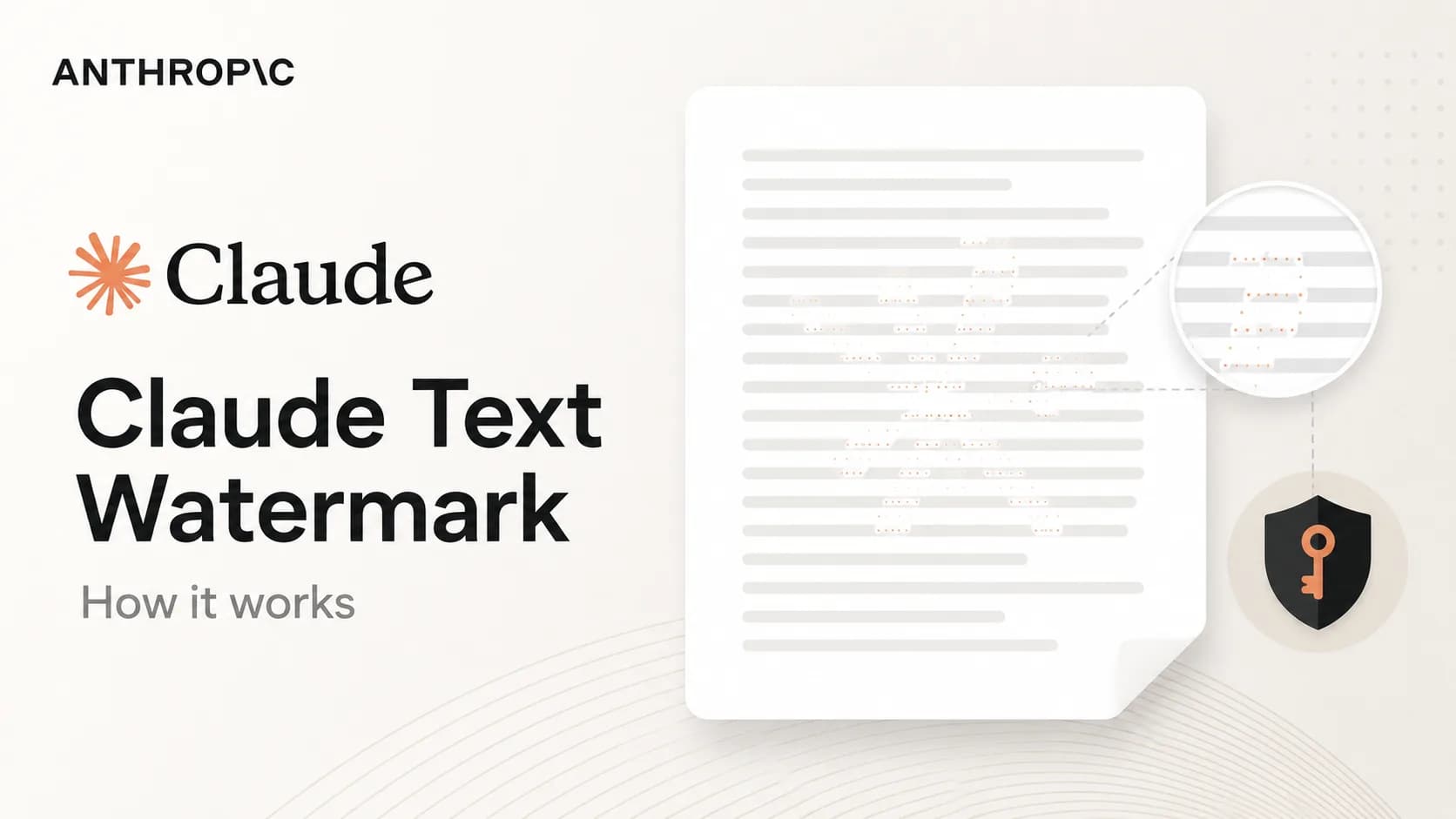
The mechanism is subtle by design. Whenever Claude has multiple word choices that preserve the same meaning, such as "overcast" versus "grey", the model consistently favors one option in a way that encodes a pattern. Repeated across a long enough passage, that pattern becomes machine-detectable even though it looks like ordinary writing to a human.
Anthropic is explicit that this isn't a tracking tool. The watermark carries no metadata tying text back to a specific user, account, or conversation, and it adds no hidden characters, extra tokens, or visible markers to the output. The company also says it introduces no added cost or measurable change to response quality.
Anthropic isn't building this from scratch. The system is Claude's version of SynthID-Text, the watermarking approach Google DeepMind published in 2024 and which Google's own Gemini has used since that year. Other model developers that signed onto the EU's Code of Practice are expected to roll out comparable watermarking of their own, suggesting this could become a shared baseline across major chatbots rather than a Claude-specific feature.
Limits of the approach
The watermark isn't bulletproof. Anthropic acknowledges that a full rewrite, replacing essentially every word, would likely strip it out entirely, while lighter edits probably leave enough of the pattern intact to survive detection.
Code generation poses a separate challenge. Because programming languages constrain word and syntax choices far more tightly than natural language, Anthropic says watermarks embedded in code will be harder to detect reliably than those in prose.
The watermarking system adds no visible text, hidden characters, or extra tokens to generated text.
Anthropic plans to ship a detection API so that outside parties, not just Anthropic itself, can check whether a given passage came from Claude. The rollout also pairs with C2PA support for images Claude processes, extending the same EU compliance push beyond text.
The regulatory driver is concrete rather than voluntary. Since August 2, the EU has required any AI provider serving its market to label AI-generated content, covering text, audio, image, and video. For law firms, publishers, and other sectors where provenance of AI-assisted writing carries legal weight, this could reshape how Claude-generated drafts are reviewed and disclosed.
Original reporting and research used to synthesize this article.
WAKIB Editorial Team
This review was prepared and summarized by the WAKIB AI intelligence engine and vetted by our editorial board for accuracy and reliability.
Subscribe to Newsletter
Get a weekly summary of the most promising AI research and tools delivered to your inbox.
Telegram Channel
Join our active community on Telegram for real-time tracking of AI models and trends.