
Soft Prompts Give Crystal-Predicting AI a Memory Boost, No Retraining Required
The Core · TL;DR
- A new soft prompt learning framework, accepted at UAI 2026, boosts state-of-the-art GNN accuracy on crystal property prediction by 3-15%
- The method uses node-level prompts for local atomic chemistry and graph-level prompts for global crystal symmetry, without needing hand-crafted features
- It's designed to be lightweight and to plug into any existing GNN encoder rather than requiring a new architecture
- Learned prompts also enable cross-property knowledge transfer, potentially reducing the need for separate models per material property
Graph neural networks have become the workhorse of computational materials science, predicting properties like band gaps and formation energies directly from a crystal's atomic structure. A new framework accepted at UAI 2026 tries to make these models smarter without touching their underlying architecture, by borrowing an idea from large language models: prompting.
The method, described in a paper submitted to arXiv on July 9, 2026, introduces soft prompt learning for crystal property prediction. Rather than feeding a GNN more raw data or retraining it from scratch, the researchers attach learnable prompt vectors that sit alongside the model's existing inputs. These prompts are "soft" in the sense that they aren't hand-crafted text instructions like the prompts used with chatbots. Instead, they're continuous, trainable parameters that get optimized to surface latent structural patterns the base GNN might otherwise miss.
Two Levels of Context
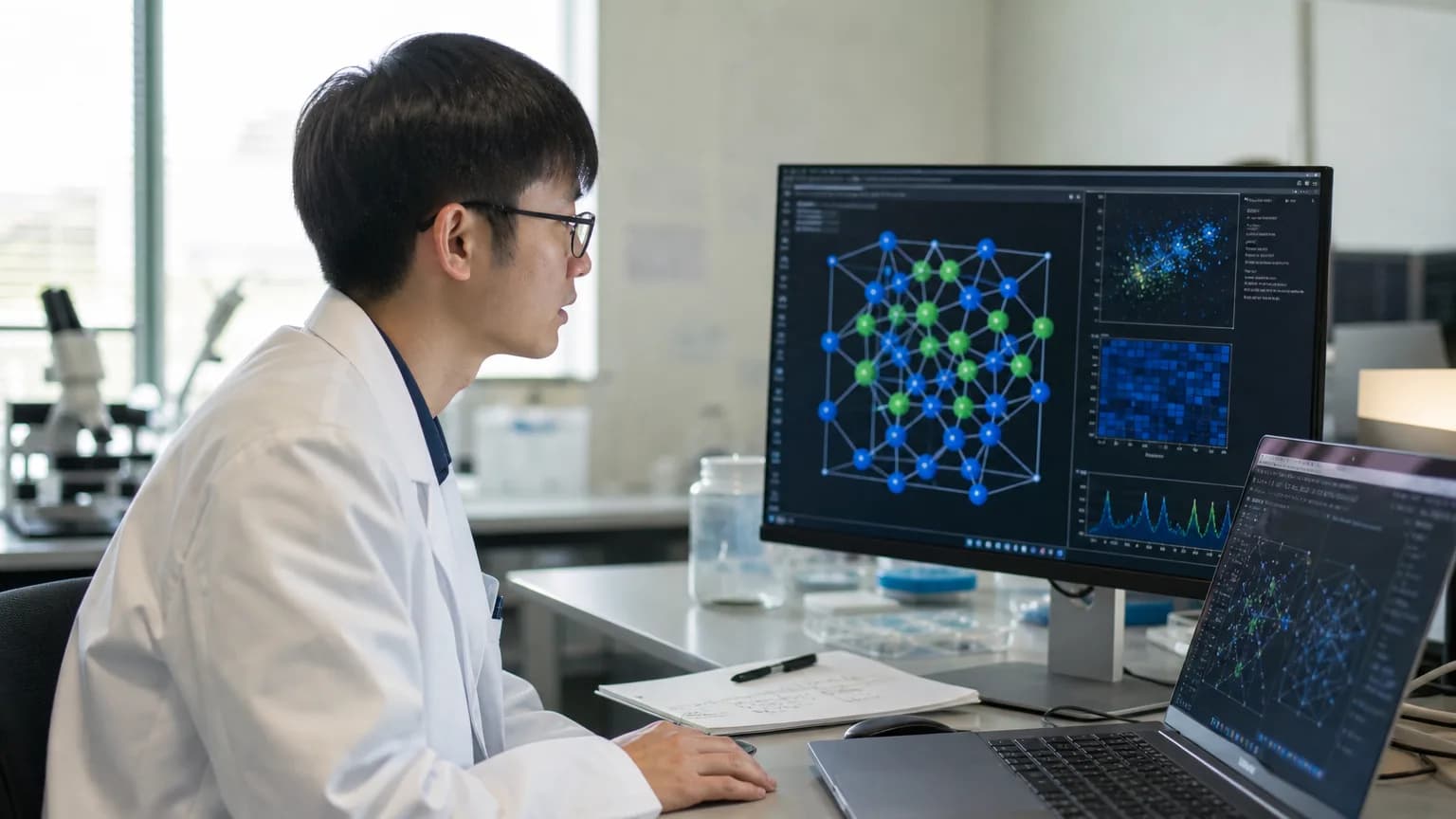
The framework operates at two distinct scales. Node-level prompts are tuned to capture local chemical semantics, essentially encoding how individual atom types behave within a crystal lattice. Graph-level prompts work in parallel to encode the broader structural symmetry of the entire crystal graph, capturing patterns that span the whole material rather than a single atomic site.
This dual structure lets the model reason about chemistry at the atom level while still respecting the geometric and symmetry constraints that govern how crystals are organized. Because the prompts are learned rather than manually specified, the system can pick up on latent features without anyone needing to explicitly define what those features should look like.
Plugging Into Existing Models
One of the more practical claims in the paper is architectural flexibility. The authors describe the prompt learning framework as lightweight and compatible with any existing GNN encoder, meaning labs already running established crystal-prediction pipelines could potentially bolt this on rather than swap out their models entirely.
The reported gains are notable for a field where incremental accuracy improvements often require substantially larger models or datasets. Across a range of state-of-the-art GNN baselines, the soft prompt approach delivered performance improvements ranging from 3% to 15% on crystal property prediction benchmarks. That's a wide spread, suggesting the benefit varies depending on which base model and which property is being predicted, but even the lower end represents a meaningful jump for tasks where researchers typically fight for fractions of a percentage point.
The paper also highlights cross-property knowledge transfer as a byproduct of the learned prompts. Because the soft prompts encode general structural and chemical patterns rather than being tied to a single prediction target, the same learned representations can potentially inform predictions across different material properties, reducing the need to train separate specialized models for each one.
For materials discovery pipelines that lean on GNNs to screen candidate compounds before expensive lab synthesis or simulation, a plug-in accuracy boost that doesn't require re-architecting existing systems could shorten the path from computational prediction to experimental validation.
Original reporting and research used to synthesize this article.
WAKIB Editorial Team
This review was prepared and summarized by the WAKIB AI intelligence engine and vetted by our editorial board for accuracy and reliability.
Subscribe to Newsletter
Get a weekly summary of the most promising AI research and tools delivered to your inbox.
Telegram Channel
Join our active community on Telegram for real-time tracking of AI models and trends.