
Two New Preprints Tackle Oncology AI's Blind Spots: From Tumor Scoring to Hospital-Ready Orchestration
The Core · TL;DR
- A June 2026 preprint (arXiv:2606.27579) introduces a two-stage MIL framework using zero-inflated beta modeling to predict tumor proportion scores in lung cancer pathology slides, outperforming standard regression baselines.
- A July 2026 preprint (arXiv:2607.06531) proposes the Large Cancer Assistant (LCA), a model-agnostic orchestration framework that standardizes multimodal patient data and isolates AI execution from hospital IT systems.
- LCA's proof-of-concept achieved 100% recall in flagging data anomalies via its Supplementary Data Request mechanism across four test scenarios.
- Both papers remain unpublished preprints and address practical deployment gaps in oncology AI rather than proposing entirely new diagnostic capabilities.
Two arXiv preprints published within two weeks of each other are converging on the same underlying problem in cancer AI: getting models that perform well on curated datasets to actually function inside the messy, fragmented reality of clinical practice.
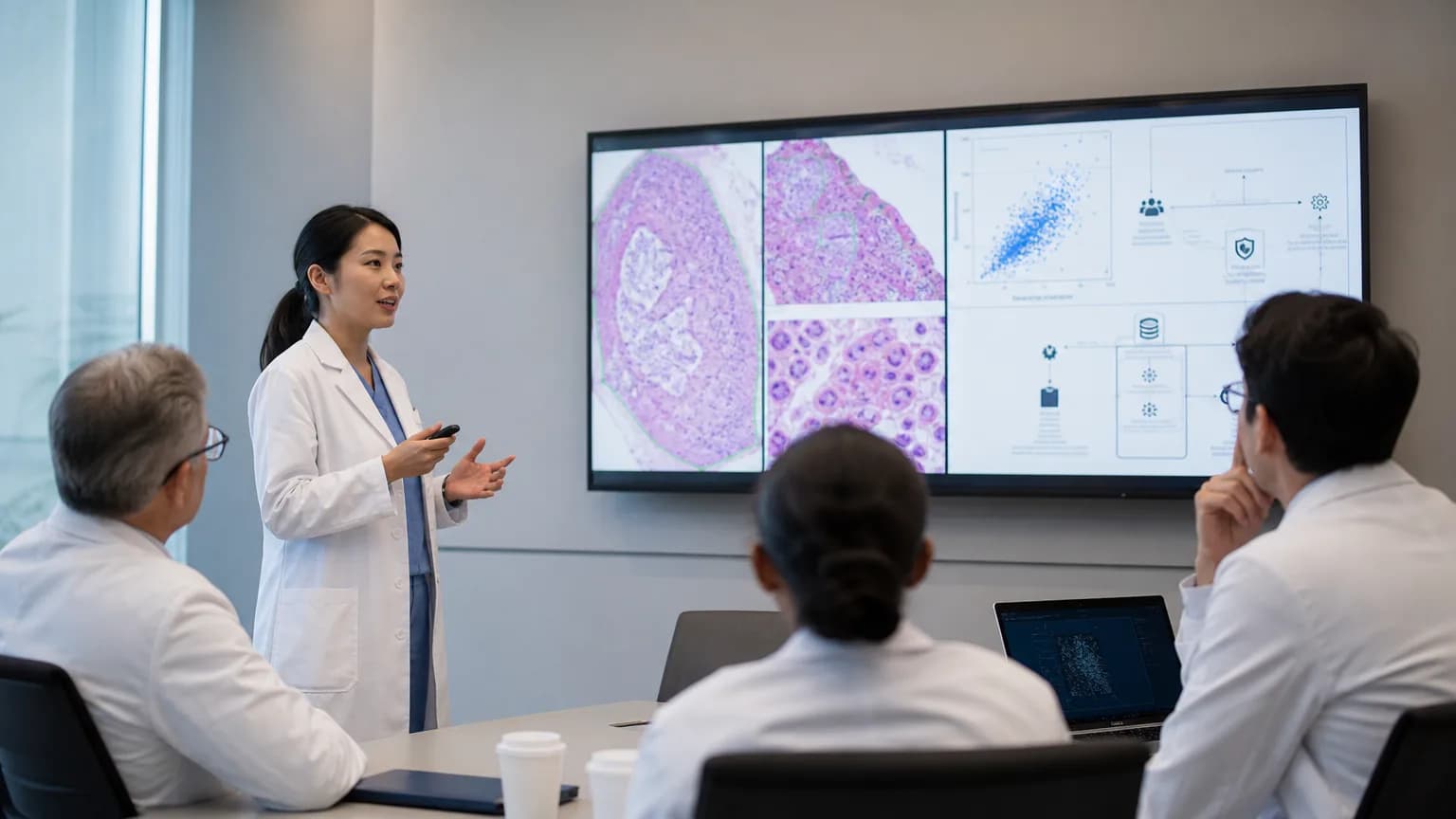
The first, submitted by Witold Dyrka on June 25, 2026 (arXiv:2606.27579), focuses on a narrow but clinically significant task: predicting the Tumor Proportion Score (TPS) in non-small cell lung cancer (NSCLC) directly from whole-slide pathology images. TPS determines whether a patient qualifies for certain immunotherapies, so getting the number right at scale matters. The paper builds on multiple instance learning (MIL), an approach already known to work well for slide-level predictions, but adds a twist. Rather than treating every image patch as equally informative, the framework splits the task into two stages: a network that extracts patch-level embeddings and classifies tissue into multiple categories, followed by a MIL model that aggregates those patches into a final TPS estimate using a zero-inflated beta (ZIBeta) distribution.
That distributional choice is the paper's core contribution. TPS scores are bounded between 0 and 1, but a large share of tumor patches show no expression at all, a "zero class" problem that standard regression models handle poorly. By explicitly modeling the excess of zero values alongside the continuous distribution of positive scores, the ZIBeta approach reportedly outperforms baseline linear and ridge regression methods by a wide margin. Just as importantly, the system needs only slide-level TPS labels to train, avoiding the costly patch-by-patch annotation that many pathology AI pipelines depend on.
Orchestrating AI Across Hospital Systems
The second paper, submitted July 7, 2026 (arXiv:2607.06531), operates at a different altitude entirely. Rather than proposing a new predictive model, it introduces the Large Cancer Assistant (LCA), a framework designed to sit above existing oncology AI tools and coordinate them without being tied to any one hospital's infrastructure.
LCA is formalized as a seven-tuple architecture built on what the authors call Algorithmic Impermeability, a design principle meant to keep the orchestration layer from being locked into specific hospital IT systems. Its "Entry Theory" component uses Geometric Deep Learning to normalize multimodal patient data (imaging, records, lab results) along consistent structural and clinical axes before a Cancer Switching Module routes it to the appropriate downstream model. The output, a Standardized Intermediate Payload (SIP), acts as a buffer that isolates AI execution from the underlying hospital systems, an architectural choice aimed at easing deployment across institutions with wildly different data formats.
The 22-page paper, which includes six figures, eight tables and nine appendices, reports a proof-of-concept test across four technical scenarios. When researchers deliberately injected anomalies into patient data, the system's mechanism for flagging missing or suspect information, its Supplementary Data Request function, caught every single case, a 100% recall rate.
Neither paper claims clinical deployment yet. Both remain preprints, meaning peer review is still pending. But together they sketch a two-layer vision for oncology AI: sharper statistical models for specific biomarkers like TPS, wrapped inside orchestration frameworks built to survive contact with real hospital infrastructure rather than just benchmark datasets.
Original reporting and research used to synthesize this article.
WAKIB Editorial Team
This review was prepared and summarized by the WAKIB AI intelligence engine and vetted by our editorial board for accuracy and reliability.
Subscribe to Newsletter
Get a weekly summary of the most promising AI research and tools delivered to your inbox.
Telegram Channel
Join our active community on Telegram for real-time tracking of AI models and trends.