
Researchers Turn V-JEPA's Video Understanding on the Ocean, With Mixed Results
The Core · TL;DR
- A new framework applies Meta's V-JEPA video transformer, paired with a SlowFast temporal encoder and optical flow, to estimate coastal wave parameters from video.
- Trained on only six annotated scenes, the model achieved Pearson correlations ranging from 0.451 (wave height) to 0.832 (wave direction), but a maximum R2 of just 0.246.
- The paper, submitted to arXiv on July 13, 2026, frames the work as an early proof of concept that generalizes to new coastal sites despite limited training data.
- The gap between moderate correlation scores and weak R2 values suggests the model captures general trends but lacks precision for practical wave forecasting yet.
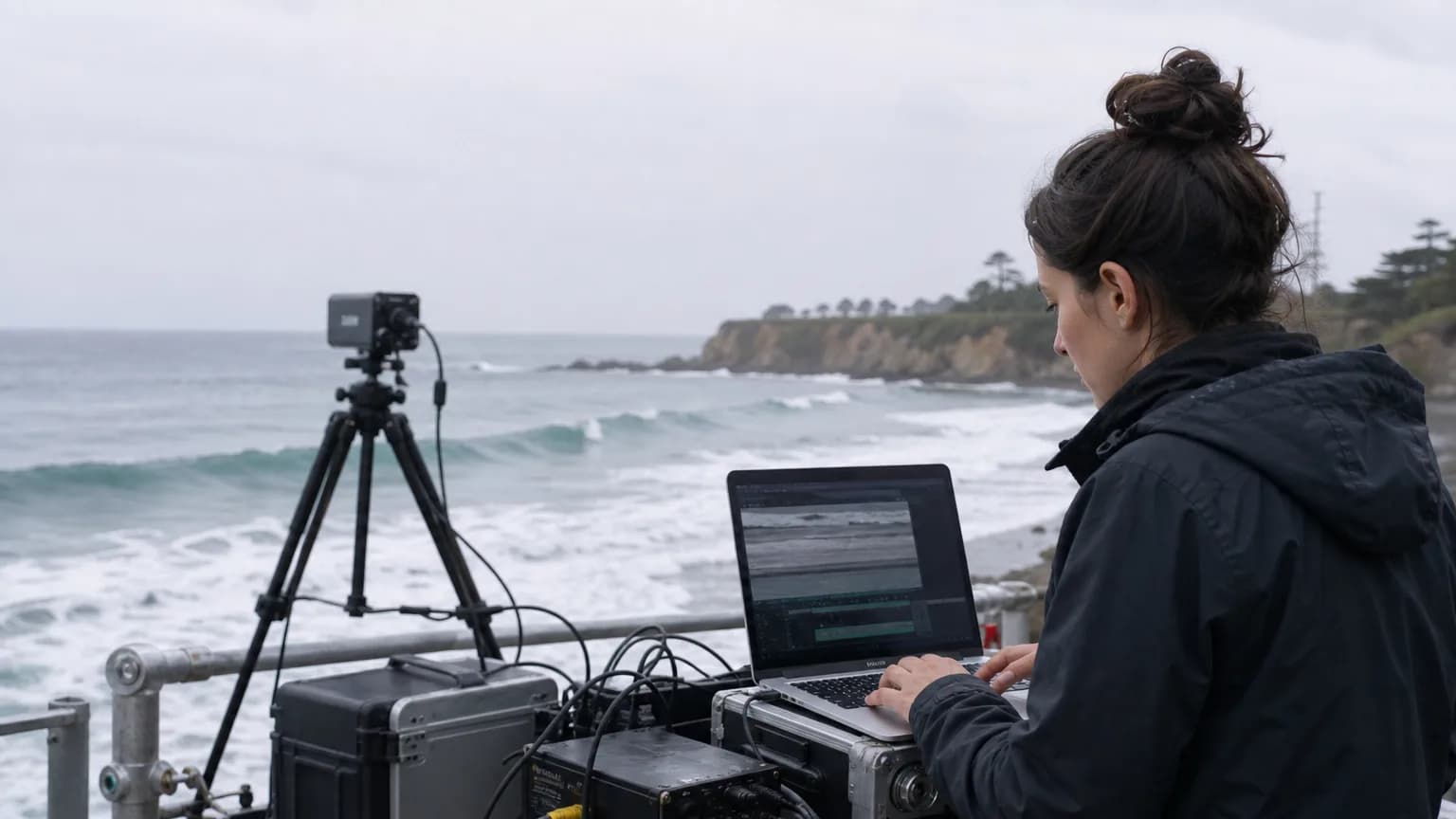
Six annotated coastal scenes. That is the entire training set behind a new framework attempting to estimate wave height, period, and direction directly from video footage, using Meta's self-supervised V-JEPA vision transformer as its backbone. The approach, detailed in a paper submitted to arXiv on July 13, 2026, is less a finished product than a proof of concept: it shows that a model built for general video understanding can be repurposed for a narrow, physically grounded measurement task, even when there is almost no labeled data to learn from.
Coastal wave monitoring typically relies on buoys, radar, or specialized sensor arrays, all of which are expensive to deploy and maintain at scale. Video cameras are already ubiquitous along many coastlines, which makes extracting wave parameters straight from footage an appealing alternative if the accuracy holds up. The researchers combined V-JEPA's self-supervised representations with a SlowFast temporal encoder and optical flow, aiming to capture both the fine-grained motion of individual waves and the slower rhythm of swell patterns over time.
What the numbers actually show
The framework targets five parameters: significant wave height (Hs), maximum wave height (Hmax), peak period (Tp), zero upcrossing period (Tz), and wave direction (theta). Results are uneven. Wave direction was estimated with a Pearson correlation of 0.832, a fairly strong signal suggesting the model reliably picks up on the directional flow patterns visible in video. Zero upcrossing period followed at 0.680, and peak period at 0.643. Significant wave height, arguably the most commonly used metric in marine forecasting and safety applications, lagged behind at 0.451, with maximum wave height at 0.578.
The R-squared figures tell a more sobering story. The best R2 achieved across the five targets was just 0.246, meaning the model explains only a modest fraction of the variance in the actual measurements. That gap between a respectable correlation coefficient and a weak R2 is a familiar signature of models that capture general trends without nailing precise magnitudes, which matters a lot for a quantity like wave height where small errors carry real consequences.
Why the data constraint matters
The training regime explains much of this. Six annotated scenes is an extremely thin dataset for a task involving continuous physical measurements across variable coastlines, weather, and camera setups. The researchers trained on an NVIDIA DGX A100 cluster and applied early stopping at epoch 31, a sign the model began overfitting quickly given how little labeled data it had to work with.
Despite the constraints, the team reports that the framework generalizes across geographically diverse test sites, which is the paper's central claim: that a video-native, self-supervised backbone like V-JEPA can transfer coastal wave estimation capability to locations it wasn't explicitly trained on, even in a data-scarce setting. That generalization, more than the raw accuracy numbers, is what positions this as an early-stage proof of concept rather than a deployable monitoring tool. Scaling up the annotated dataset is the obvious next step before these correlation and R2 figures can close the gap needed for operational use.
Original reporting and research used to synthesize this article.
WAKIB Editorial Team
This review was prepared and summarized by the WAKIB AI intelligence engine and vetted by our editorial board for accuracy and reliability.
Subscribe to Newsletter
Get a weekly summary of the most promising AI research and tools delivered to your inbox.
Telegram Channel
Join our active community on Telegram for real-time tracking of AI models and trends.