
New Minimax Bound Settles the True Cost of Fairness in Multi-Armed Bandits
The Core · TL;DR
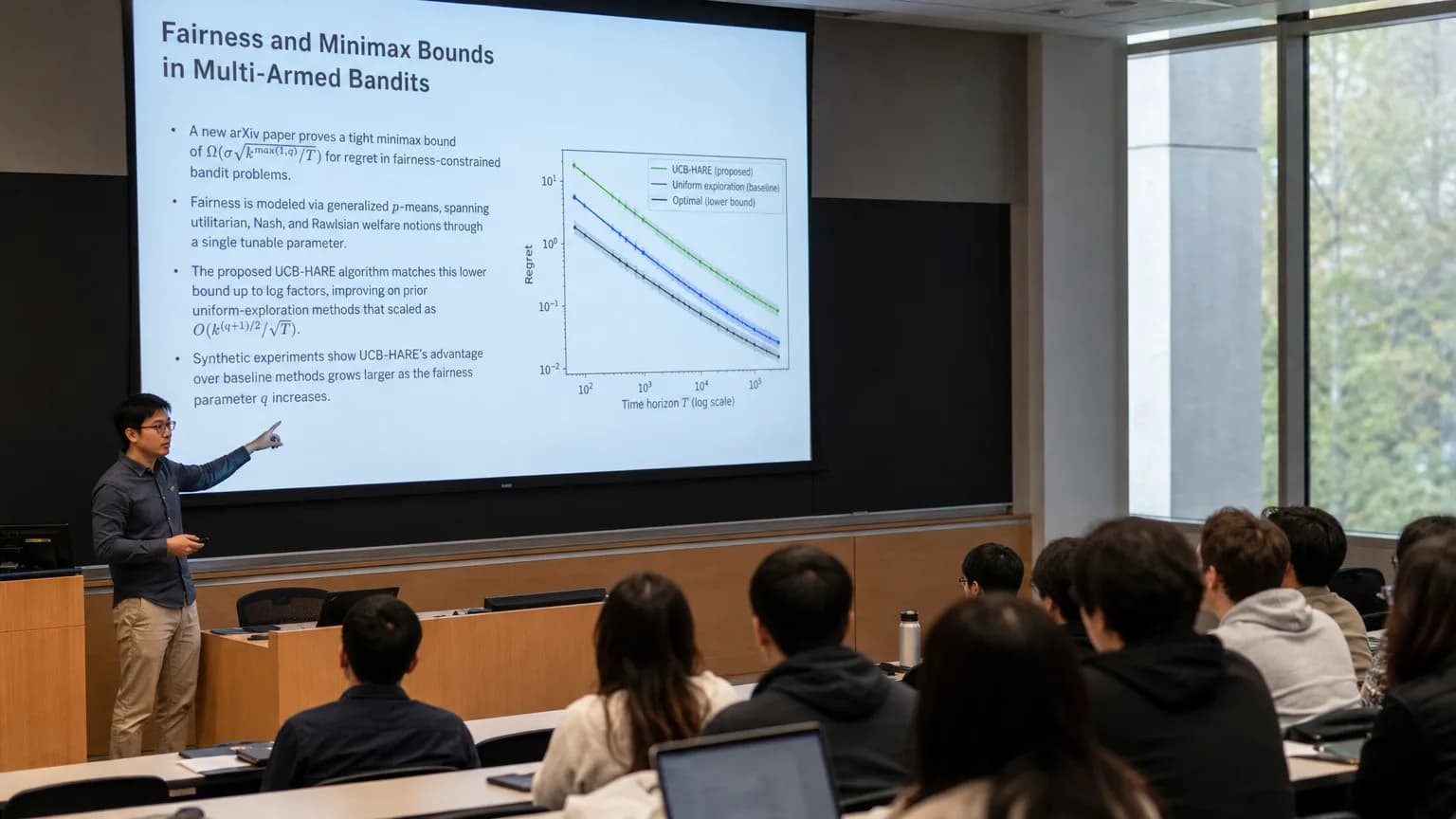
- A new arXiv paper proves a tight minimax bound of Ω(σ√(k^max(1,q)/T)) for regret in fairness-constrained bandit problems.
- Fairness is modeled via generalized p-means, spanning utilitarian, Nash, and Rawlsian welfare notions through a single tunable parameter.
- The proposed UCB-HARE algorithm matches this lower bound up to log factors, improving on prior uniform-exploration methods that scaled as O(k^((q+1)/2)/√T).
- Synthetic experiments show UCB-HARE's advantage over baseline methods grows larger as the fairness parameter q increases.
A regret bound of Ω(σ√(k^max(1,q)/T)) now marks the point past which no fair bandit algorithm can improve, according to "Price of Fairness in Bandits: A Tight Minimax Characterization," submitted to arXiv on July 15, 2026. The paper closes a long-standing gap between theory and practice for algorithms that must balance reward maximization against equitable treatment across arms.
Multi-armed bandit problems are the standard testbed for sequential decision-making under uncertainty: an algorithm repeatedly chooses among k options ("arms") to maximize cumulative reward while learning which arms perform best. Classic bandit theory optimizes purely for total reward, but that objective can systematically starve some arms of exploration, a real concern when arms represent people, groups, or resources competing for allocation.
To formalize fairness, the authors evaluate rewards using generalized p-means, a single mathematical family that interpolates between three familiar notions of welfare depending on the parameter p. Setting p=1 recovers standard utilitarian welfare (maximize the sum of rewards), letting p approach 0 yields Nash welfare (a balance between efficiency and equality), and pushing p toward negative infinity produces Rawlsian fairness, which optimizes for the worst-off arm. This lets the paper study fairness not as a binary constraint but as a tunable spectrum, parameterized through a related quantity q.
Quantifying the Price of Fairness
The paper's central contribution is a matching pair of bounds. On the lower-bound side, it proves that any algorithm respecting fairness constraints must incur regret of at least Ω(σ√(k^max(1,q)/T)), where σ captures the sub-Gaussian noise of the reward distributions, k is the number of arms, and T is the time horizon. Critically, for q>1 this shows the extra k^(q/2) penalty compared to the unconstrained case is not an artifact of weak algorithms. It is information-theoretically unavoidable, meaning no clever algorithm design can escape it.
On the upper-bound side, the authors introduce UCB-HARE (Harmonic Anchored Rank Exploration), an algorithm that achieves regret of Õ(σ√(k^max(1,q)/T)), matching the lower bound up to logarithmic factors. That closes the theoretical gap left by prior approaches, which relied on uniform early exploration phases and only managed regret of O(k^((q+1)/2)/√T) for σ-sub-Gaussian rewards, a strictly weaker guarantee as q grows.
Synthetic experiments back up the theory: UCB-HARE consistently outperforms uniform-exploration baselines, and the margin widens as q increases, meaning the benefit of smarter exploration becomes more pronounced the stricter the fairness requirement gets.
Why the Bound Matters
For practitioners building bandit-based systems in domains like resource allocation, recommendation, or clinical trial design, this result offers something rare in fairness-aware machine learning: a hard, provable limit on how much fairness costs in terms of performance. Rather than guessing whether a better algorithm might close the gap further, engineers now have a benchmark to test against. UCB-HARE gives them an algorithm that reaches that benchmark up to log factors, turning an open theoretical question into a solved one, at least within this p-mean fairness framework.
Original reporting and research used to synthesize this article.
WAKIB Editorial Team
This review was prepared and summarized by the WAKIB AI intelligence engine and vetted by our editorial board for accuracy and reliability.
Subscribe to Newsletter
Get a weekly summary of the most promising AI research and tools delivered to your inbox.
Telegram Channel
Join our active community on Telegram for real-time tracking of AI models and trends.