
Legal Exits, Cheaper Rides: New Framework Cuts Rail Fares by Exploiting Fare-Rule Loopholes
The Core · TL;DR
- LegalFarePlan is a label-setting framework that models legal exit-and-reentry maneuvers as auditable constraints to reduce urban rail fares under non-additive pricing rules
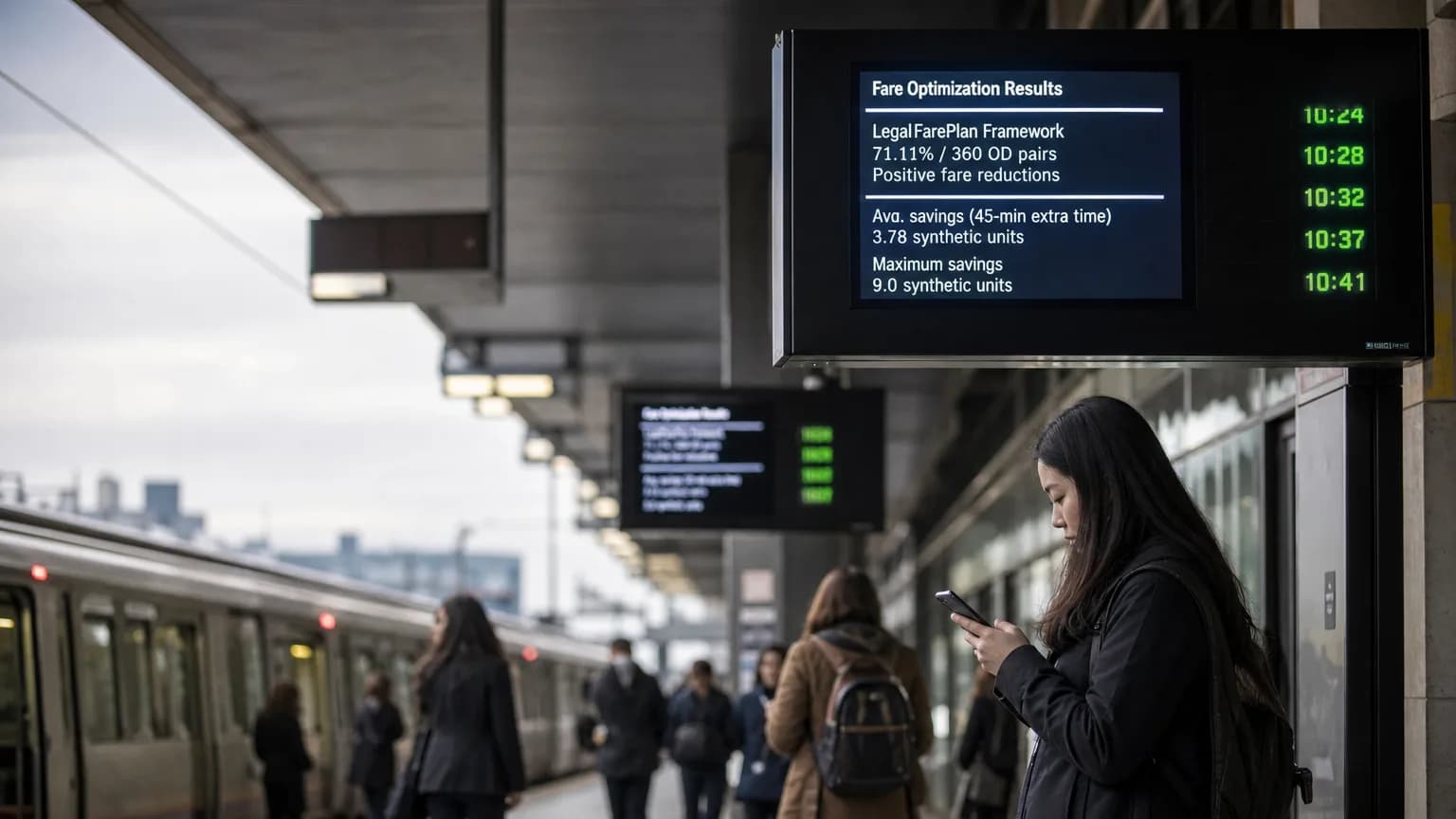
- Bounded exact label-setting search found positive fare reductions for 71.11% of 360 origin-destination pairs on a 57-station semi-synthetic benchmark
- Under a 45-minute extra-time budget, average fare savings reached 3.78 synthetic units, with a maximum of 9.0 units
- The paper, submitted to arXiv on July 5, 2026, also benchmarks Dijkstra shortest-time, direct route-planner, greedy split heuristic, and Pareto-frontier baselines
A route planner that treats fare rules as puzzles to be solved, not fixed prices to be accepted, is the core idea behind LegalFarePlan, a framework detailed in a paper submitted to arXiv on July 5, 2026. Its premise is straightforward but underexplored: urban rail fares are rarely additive, and the gaps between how transit systems price journeys and how they actually calculate fares can be exploited, legally, to save riders money.
The system's key mechanic is modeling "exit-and-reentry" moves, tapping out of a station and back in, as explicit constraints inside a route-planning search. Rather than treating these maneuvers as edge cases or exploits to patch over, LegalFarePlan formalizes them as legitimate, auditable operations within its optimization pipeline. That framing matters because it turns fare-gaming from a gray-area trick into a transparent, verifiable planning decision that a transit rider or auditor could inspect after the fact.
How the search actually works
LegalFarePlan isn't a single algorithm but a suite of route-planning strategies benchmarked against each other. The paper describes Dijkstra shortest-time and direct route-planner baselines as the conventional comparison points, then layers in three more sophisticated approaches: a greedy split heuristic, a bounded exact label-setting method, and a Pareto-frontier search that balances competing objectives like time and cost. This range lets the researchers show not just that fare reductions are possible, but how much computational effort different methods require to find them.
The bounded exact label-setting approach turned out to be the most effective at surfacing savings. When tested, it found positive modeled fare reductions for 71.11% of origin-destination (OD) pairs in the benchmark, a strong signal that non-additive fare structures leave real money on the table for a majority of trips, not just isolated corner cases.
Measuring the savings
To evaluate the framework, the team built a 57-station semi-synthetic benchmark spanning 360 OD pairs, a scale large enough to capture varied trip patterns without requiring access to a live, proprietary transit fare engine. Under a constraint of 45 extra minutes of travel time, the average fare reduction across successful cases was 3.78 synthetic fare units, with the best-case scenario reaching a 9.0-unit reduction.
Those numbers are modeled on synthetic fare units rather than real-world currency, so they should be read as a proof of concept rather than a guaranteed savings figure for any specific transit system. Still, the pattern is clear: trading a bounded amount of extra travel time for a legally structured exit-and-reentry sequence can meaningfully lower what a rider pays, at least within the fare logic the benchmark was designed to mimic.
The broader contribution here isn't a single trick but a formal search framework that transit agencies, fare-system designers, or app developers could adapt to audit their own pricing rules for exploitable non-additivity, or to build consumer-facing tools that plan legally optimal, fare-transparent routes automatically.
Original reporting and research used to synthesize this article.
WAKIB Editorial Team
This review was prepared and summarized by the WAKIB AI intelligence engine and vetted by our editorial board for accuracy and reliability.
Subscribe to Newsletter
Get a weekly summary of the most promising AI research and tools delivered to your inbox.
Telegram Channel
Join our active community on Telegram for real-time tracking of AI models and trends.