
Gulf AI Data Centers: The Gap Between Announced Figures and Research Estimates on Power and Water Consumption
The Core · TL;DR
- The only near-confirmed official figure is Saudi Arabia's target of 6 gigawatts of data center capacity by 2034 with 29% CAGR in power demand, while regional water consumption estimates for 2030-2031 range from 426 to 535 billion liters depending on the research source.
- Direct liquid cooling cuts direct water consumption by 90-98% versus traditional evaporative cooling, but roughly 60% of the actual water footprint originates in power generation rather than inside the facility, doubling the cost of every liter in a desalination-dependent economy.
- No official data has been disclosed by operators like Stargate UAE or HUMAIN on their actual water or electricity consumption, prompting institutional investors and ESG funds to begin demanding detailed disclosures before financing new projects.
Saudi Arabia and the UAE are racing to build massive AI data center infrastructure in projects measured in gigawatts and billions of dollars. Yet behind the official announcements of compute capacity, the actual figures for electricity and water consumption, the two most sensitive resources in the Gulf climate, remain undisclosed by the operators themselves. This report separates what is officially announced from what is independent research estimation, and examines the cooling technologies actually deployed and their real water cost.
Officially Announced Figures: Power Capacity First
Saudi Arabia's AI ecosystem plan targets data center capacity of up to 6 gigawatts by 2034, the only near-confirmed official figure on planned long-term capacity. Alongside this, estimates indicate that power demand from Saudi data centers will grow at a compound annual growth rate (CAGR) of 29%, a rate that far exceeds conventional electricity demand growth in any other economic sector in the Kingdom.
In contrast, the major operators, such as the UAE's "Stargate UAE" project or Saudi Arabia's "HUMAIN," have not issued any public data on their current or projected actual electricity consumption per individual facility. The figures available so far are planning-level numbers at the national portfolio scale, not Verified Operational Data at the single-facility level, a fundamental distinction for any comparative analysis between countries.
Water: Sharp Divergence Between Estimate Sources
Unlike electricity, there is no single agreed official figure for water consumption in the Gulf AI sector, but rather a set of research estimates that vary significantly depending on the time horizon and methodology used:
UAE specifically: By 2030, the AI sector alone may require roughly 61 billion liters of water annually, according to a research estimate dedicated to the UAE market.
Middle East and Africa (MEA) region as a whole: Data center water consumption in the region reached 119.34 billion liters in 2025, and is projected to jump to 426.31 billion liters by 2030, according to one research source.
An alternative estimate for the same region: Another research entity raises the ceiling to 535.71 billion liters by 2031, starting from roughly the same baseline (119.34 billion liters in 2025).
The gap between the last two estimates (426 versus 535 billion liters), despite a similar base year, reflects how sensitive these models are to growth-rate assumptions and adoption rates of water-saving cooling technologies. For any strategic planning body in the Gulf, this divergence means the uncertainty range in water demand estimates exceeds 100 billion liters annually by the end of the decade, an extremely large margin of error for planning around already-limited water resources.
What remains constant across all these estimates is the absence of any actual consumption figure disclosed by the operating companies themselves. Neither "Stargate UAE" nor "HUMAIN" has published any operational metric such as Water Usage Effectiveness (WUE) at the facility level, the standard benchmark adopted globally by major companies like Google and Microsoft to disclose their water efficiency.
Actual Cooling Technologies and Their Hidden Water Cost
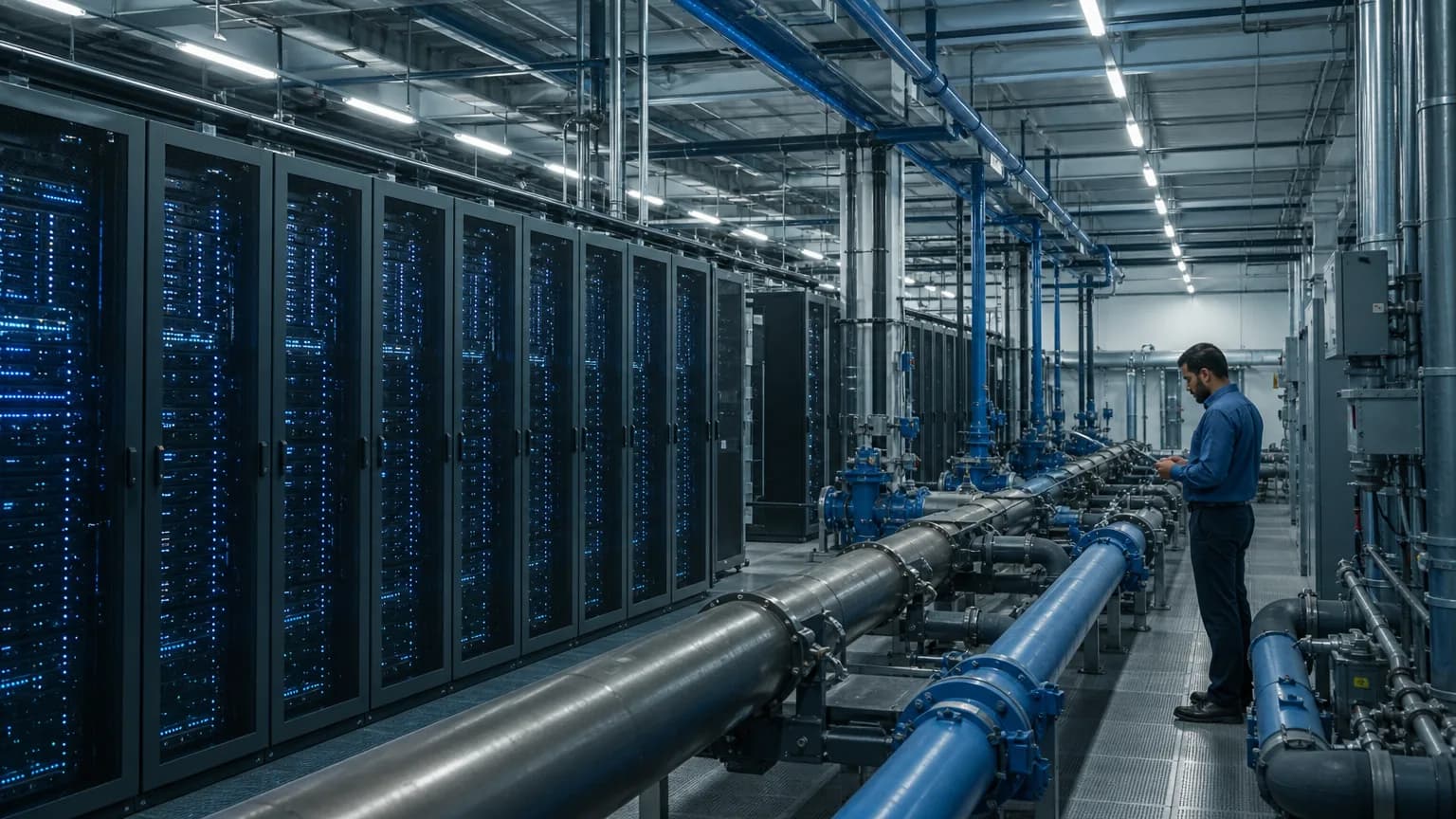
The shift from air cooling with evaporative cooling towers to Direct Liquid Cooling (DLC) is the dominant technical trajectory currently in high-density AI facilities. Research indicates that DLC reduces direct water consumption by 90% to 98% compared to traditional evaporative systems, a decisive difference for any facility built in a water-scarce environment like the Gulf.
On the next-generation hardware front, NVIDIA announced (June 2026) that its new "Rubin" chip class will adopt 100% liquid cooling, with all chips and components cooled within a fully closed-loop system that theoretically requires no continuous replenishment of water lost to evaporation. However, most large data centers currently operational, including likely the Gulf facilities under construction, still run on hybrid systems combining chilled water loops, cooling towers, and direct air cooling supported by evaporative chillers. In other words, full transition to 100% closed-loop systems remains a gradual rollout, not the current standard.
The deeper technical problem, often overlooked in surface-level comparisons, is that roughly 60% of a data center's total water footprint does not originate within the facility itself, but at the power plant feeding it, whether gas-fired, nuclear, or even renewable sources that require cooling water in certain technologies. This means comparing cooling efficiency within the server hall alone (facility-level WUE) conceals the larger part of the actual water impact, which is measured by a broader indicator: Source WUE.
In the Gulf context specifically, an additional layer of complexity is added: a significant portion of water supply already comes from desalination, an energy-intensive process. In practical terms, every liter of water used to cool a Gulf data center may carry a "double energy cost": once for desalinating it via reverse osmosis or thermal distillation plants, and again for operating and cooling the facility itself. This double loop between energy and water renders any simplified calculation of cooling efficiency incomplete unless desalination cost is factored into the overall equation.
Summer Peak Demand and Grid Stress Testing
Extreme summer heat constitutes an annual stress test on Gulf infrastructure, with electricity consumption in some regions reaching double its winter levels, while water demand rises and the margin between electricity supply and demand narrows at the very moment data centers face their greatest technical cooling challenge, due to elevated ambient air temperature, which serves as the final medium for heat dissipation even in closed liquid systems.
At the regional level, the International Energy Agency estimates that Gulf states may need to double their electricity generation capacity by 2030 to support both AI infrastructure and the desalination required to cool it and supply it with water, placing the two sectors, energy and water, on a coupled rather than separate growth trajectory, contrary to how investment announcements typically present them.
These regional figures come against a backdrop of already accelerating global demand: data centers worldwide consumed 448 terawatt-hours of electricity last year, with AI accounting for roughly a fifth of that, and annual consumption is projected to double to 945 terawatt-hours by 2030. On the water side, data centers globally consumed 4.5 trillion liters, a figure that places the projected Gulf share (426 to 535 billion liters by 2030-2031) in relative context as a growing portion of an already massive global total.
Disclosure Gap and Financial Markets Stepping In
To date, none of the Gulf's major operating companies, whether "Stargate UAE," "HUMAIN," or other operators, has disclosed its actual water or electricity consumption figures at the facility level. This disclosure vacuum has begun drawing the attention of financial markets: reports indicate that some institutional investors are now requesting detailed water-use disclosures before committing to fund technology projects in the Gulf, while investment funds oriented toward Environmental, Social, and Governance (ESG) criteria, which collectively control trillions of dollars in managed assets, increasingly view water sustainability as a primary rather than marginal valuation indicator.
The practical takeaway for decision-makers and specialists is that the gap between the stated ambition (6 gigawatts in Saudi Arabia, 29% annual growth in power demand) and actual operational transparency remains wide. Independent research estimates, despite their significant internal divergence, agree on one direction: water and electricity growth far exceeding conventional growth rates in other sectors, in an environment already dependent on desalination as a primary source of fresh water. Unless regulators require operators to disclose standardized metrics such as WUE and Source WUE at the level of each facility, precise comparisons between announced figures and operational reality will remain hostage to conflicting research estimates.
WAKIB Editorial Team
This review was prepared and summarized by the WAKIB AI intelligence engine and vetted by our editorial board for accuracy and reliability.
Subscribe to Newsletter
Get a weekly summary of the most promising AI research and tools delivered to your inbox.
Telegram Channel
Join our active community on Telegram for real-time tracking of AI models and trends.