
Can LLMs Fake Consumer Psychology? New Study Tests AI Against Human Focus Groups
The Core · TL;DR
- A new arXiv paper (2607.05761, posted July 7, 2026) tests whether LLMs can replicate human responses in projective consumer research techniques.
- Researchers compared AI-generated and human responses from a real study on city tourism perceptions across multiple models, prompts, and temperature settings.
- LLM outputs matched humans well on broad themes and associations, but diverged in linguistic style, structure, and response diversity.
- Findings suggest LLMs could support early-stage market research but aren't yet a full substitute for human focus groups in projective studies.
A team of researchers set out to answer a question that marketing departments have quietly been asking for months: can a language model stand in for a real focus group? A new paper, posted to arXiv on July 7, 2026 under the identifier 2607.05761, offers the most detailed comparison yet between synthetic and human responses in projective research techniques, the qualitative methods marketers use to surface consumer associations, emotions, and unspoken needs.
Projective techniques rely on indirect prompts, word associations, image reactions, and open-ended storytelling exercises, to get past the polished answers people give in direct surveys. They are a staple of brand research precisely because they're hard to fake convincingly. That makes them a demanding benchmark for generative AI, and the study's authors used exactly that difficulty to their advantage.
The setup
The researchers drew on a real consumer research study focused on how people perceive city tourism destinations, then attempted to reproduce those human responses using several large language models. They varied the prompting strategies and temperature settings across runs, generating a wide spread of synthetic outputs to compare against the original human data. Rather than relying on a single similarity score, the team applied a battery of linguistic measures, diversity and concentration metrics, topic modeling, and top-term frequency analysis to see where the AI-generated responses matched human ones and where they diverged.
Where the overlap holds, and where it breaks down
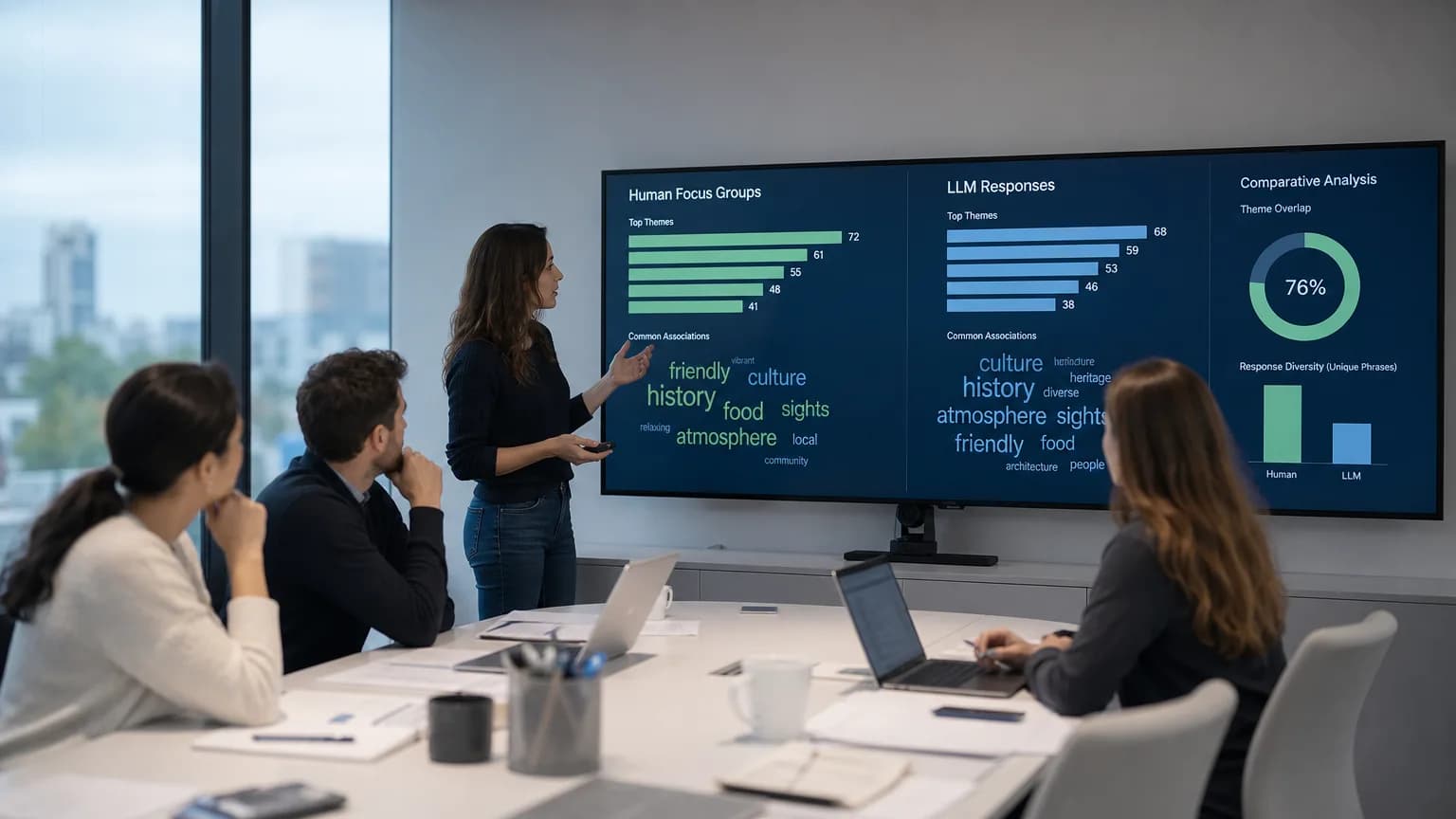
The headline finding is a split verdict. At the level of broad themes, the LLM outputs tracked human responses closely: the same general associations, sentiments, and thematic clusters about tourist destinations showed up in both datasets. For anyone hoping to use AI to quickly scope out consumer sentiment before committing to expensive fieldwork, that's a meaningful signal.
But the resemblance thinned out under closer inspection. The study found real gaps in writing style and linguistic structure between human and machine text, along with differences in how much diversity each source generated. Human respondents tended to produce a wider, messier range of phrasing and idiosyncratic detail, the kind of noise that reflects lived experience rather than statistical pattern-matching. LLM outputs, by contrast, showed more concentration around certain phrasings and topics, a tendency that likely stems from how these models are trained to produce fluent, generalized text rather than idiosyncratic personal reflection.
Why it matters for market research
The implications cut both ways for the market research industry. On one hand, the topical overlap suggests LLMs could plausibly serve as a fast, low-cost supplement for early-stage exploratory research, helping teams pressure-test question design or generate hypotheses before running costly human studies. On the other, the structural and diversity gaps are a caution against treating synthetic respondents as a full substitute for real ones, particularly in projective work where the whole point is capturing the unpredictable, emotionally textured language that real people produce and machines tend to smooth over.
The paper doesn't propose a fix for that diversity gap, leaving it as an open problem for future prompting strategies or fine-tuning approaches to address.
Original reporting and research used to synthesize this article.
WAKIB Editorial Team
This review was prepared and summarized by the WAKIB AI intelligence engine and vetted by our editorial board for accuracy and reliability.
Subscribe to Newsletter
Get a weekly summary of the most promising AI research and tools delivered to your inbox.
Telegram Channel
Join our active community on Telegram for real-time tracking of AI models and trends.