
AI in Medical Diagnosis at Arab Hospitals: How Far Has It Actually Gone?
The Core · TL;DR
- Hospitals in the UAE and Saudi Arabia are already using AI in radiology, with advanced algorithms cutting image-interpretation time by 40% in Saudi hospitals as of December 2025, while other tools like Al Qassimi Hospital's eye-print detection device in the UAE are still slated for launch in 2026.
- A Harvard University study found AI diagnostic accuracy reached 82% versus 70-79% for doctors when given additional detailed information, while a 2020 review in The Lancet Digital Health found a median accuracy of 87% across multiple diseases, though researchers stress rigorous clinical trials are needed before generalizing these results.
- No clearly published, specific Arab regulatory approvals exist yet for the clinical certification of these AI tools, even as a 2022 survey found that 92.4% of medical students across nine Arab countries had received no formal AI training.
AI-generated voice
Hospitals in several Arab countries, led by the UAE and Saudi Arabia, have begun introducing artificial intelligence (AI) tools into radiology departments and early-disease-detection clinics. But a closer look reveals a more complicated picture: some of these tools are already in active use, others are still being launched or tested, published studies show accuracy that varies significantly by disease and context, and there is a clear absence, so far, of specific Arab regulatory approvals for these technologies.
Where Is AI Actually Being Used in Radiology?
In January 2026, RapidAI announced a partnership with Health Holdings Company to deploy AI technologies across 20 hospital groups, aiming to improve detection of strokes and brain aneurysms through smarter imaging workflows, according to both companies.
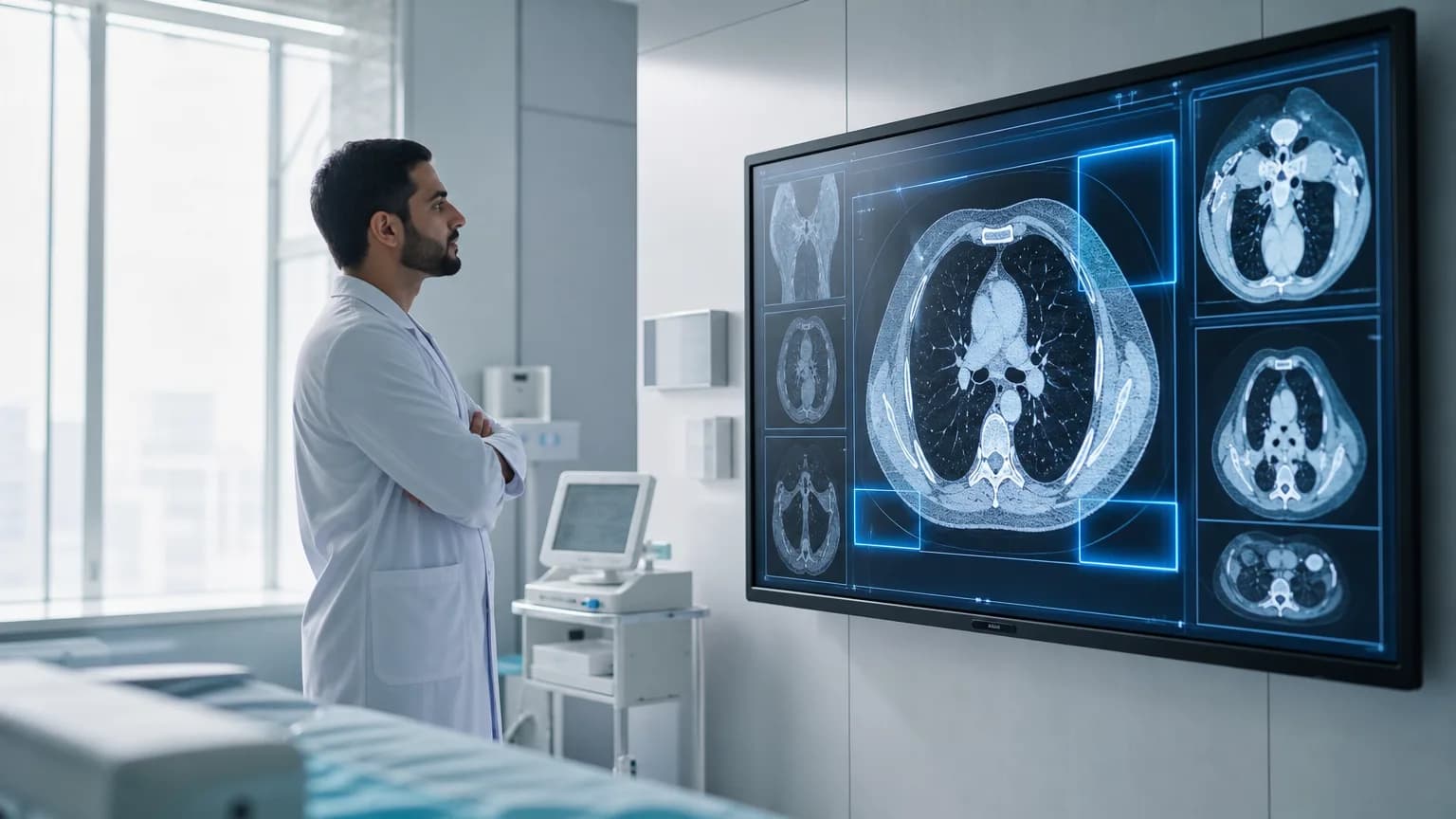
Months earlier, reports from December 2025 indicated that Saudi hospitals had integrated advanced AI algorithms into their radiology departments, cutting image-interpretation time by 40% and improving diagnostic accuracy in cancer and cardiovascular cases, according to sources covering the development.
These applications fall under what is known as "clinical decision support" tools, meaning they help doctors read images and prioritize cases, but do not replace them. Radiologists, based on the prevailing description of these systems, remain responsible for the final interpretation and clinical recommendation.
Early Detection: From the Retina to Alzheimer's
In the UAE, Dr. Aref Al-Nuryani, CEO of Al Qassimi Hospital under the Emirates Health Services Establishment, confirmed that new AI models will be launched during 2026 to diagnose diseases including Alzheimer's, Parkinson's, strokes, liver disease, high cholesterol, and thyroid disorders. He also noted that the hospital is preparing to launch an early-disease-detection device based on analyzing an "eye print," a system that captures a precise image of the retina in just two minutes and analyzes it instantly using AI.
This type of application, according to available sources, is still in the launch or development phase and is not yet widely deployed, unlike radiology tools that have already entered routine use in some hospitals.
What Do Published Studies Say About Accuracy?
A study from Harvard University found that AI produced accurate or near-accurate diagnoses in 67% of cases in an initial trial involving 76 patients, compared with an accuracy rate of 50% to 55% among the participating doctors. When both AI and doctors were given additional, more detailed information in a subsequent test, the system's accuracy rose to 82%, while the doctors' accuracy rose to between 70% and 79%. Researcher Arjun Manrai, who co-authored the study, cautioned that these results represent a promising signal rather than a final verdict, stressing the need to test these technologies through rigorous clinical trials before relying on them with confidence.
In more specialized fields, circulating data indicates that AI systems analyzing eye images can detect conditions such as diabetic retinopathy and macular degeneration with accuracy reaching 94%. More broadly, a review published in The Lancet Digital Health in 2020 found that AI algorithms achieved a median diagnostic accuracy of 87% (95% confidence interval of 84% to 90%) across a range of diseases including cancers, cardiovascular diseases, and respiratory infections.
By contrast, other studies have shown that general-purpose, consumer-facing AI models such as ChatGPT can significantly underestimate the severity of certain medical conditions when used by non-specialists, revealing a clear gap between specialized medical models trained on clinical data and general models available to the public.
Where Do Regulators Stand?
Available sources have not revealed any specific Arab regulatory approvals or published local clinical-certification standards in recent months. The most detailed regulatory framework available for comparison is the U.S. Food and Drug Administration's (FDA) list of AI-enabled approved medical devices, an American list that, so far, has no equally clear published Arab counterpart.
On the human-preparedness front, a survey conducted between March and April 2022, covering 4,492 medical students across nine Arab countries, found that 92.4% of them had not received any formal training in AI, pointing to a gap in institutional and educational readiness that parallels the gap in regulatory frameworks.
Conclusion and Limits of the Evidence
The current picture, based on available data, combines limited but real use in radiology and some early-screening tools with other projects still being launched, as is the case with Al Qassimi Hospital in the UAE. The accuracy recorded in published studies varies considerably, from 67% in general diagnostic contexts to 94% in retinal-image analysis, a range that reflects differences in diseases, data, and measurement methods rather than a fixed, generalizable figure.
There are, as of now, no clearly published, specific Arab regulatory approvals governing the clinical adoption of these tools, and the physician, based on the prevailing description of these technologies in available sources, remains ultimately responsible for the diagnostic decision. This report is for general information only and does not constitute medical advice.
WAKIB Editorial Team
This review was prepared and summarized by the WAKIB AI intelligence engine and vetted by our editorial board for accuracy and reliability.
Subscribe to Newsletter
Get a weekly summary of the most promising AI research and tools delivered to your inbox.
Telegram Channel
Join our active community on Telegram for real-time tracking of AI models and trends.