
A Unified Geometry for Batch Normalization: LieBN Extends Deep Learning to Nine Curved Data Spaces
The Core · TL;DR
- LieBN generalizes batch normalization to nine Lie group geometries, including SPD manifolds, rotation matrices, and full-rank correlation matrices.
- The framework uses left- and right-invariant metrics native to Lie groups to theoretically guarantee control over Riemannian mean and variance.
- A new right-invariant metric for SPD manifolds and matrix power deformation extend three prior Lie group structures.
- Posted to arXiv on June 13, 2026 (2607.08783) with released code, though an admin note flags text overlap with an earlier 2024 paper.
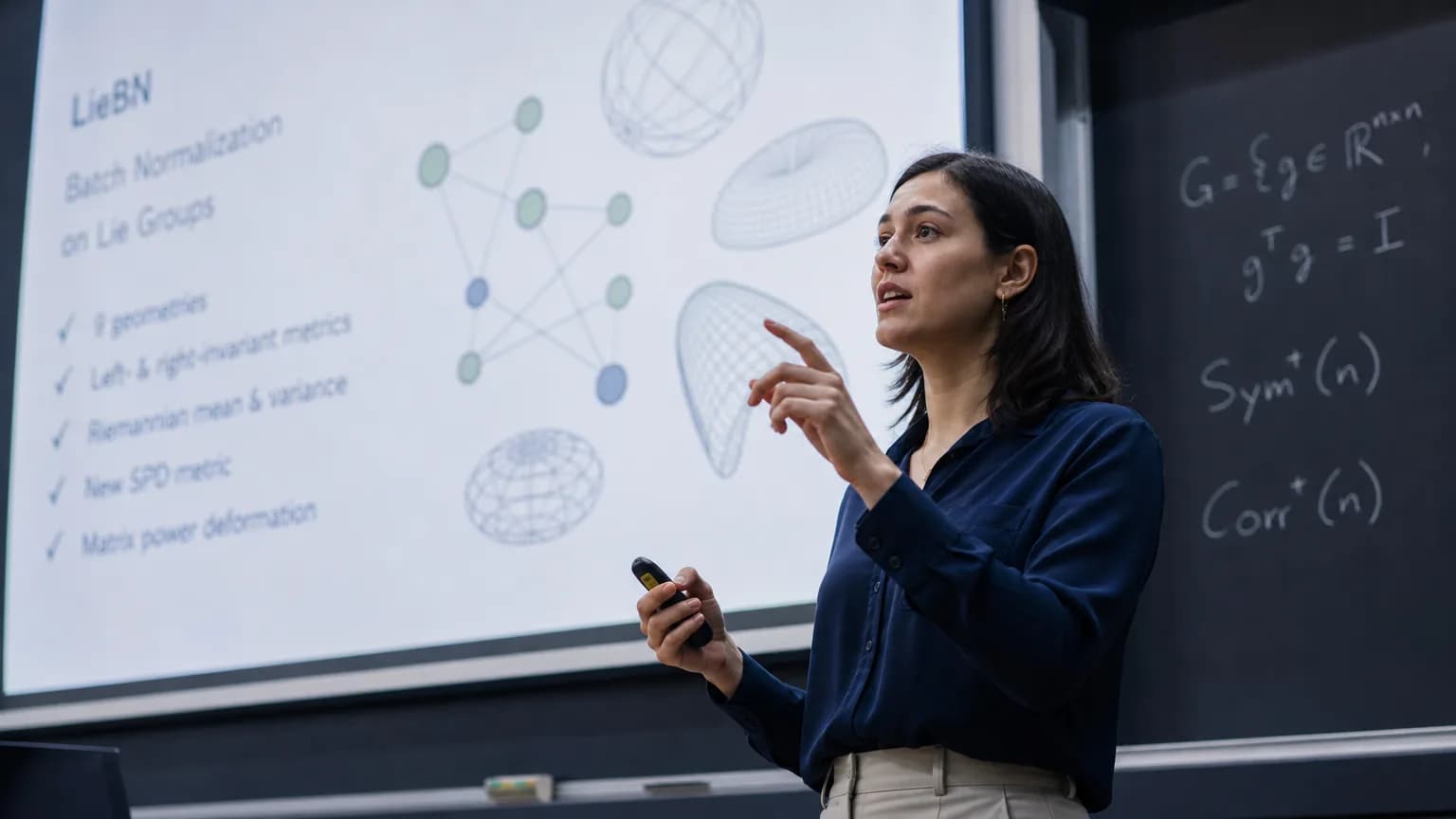
A new theoretical framework called LieBN generalizes one of deep learning's most basic operations, batch normalization, to work natively across nine different curved geometries. The paper, posted to arXiv on June 13, 2026 under identifier 2607.08783, tackles a problem that has quietly limited how well neural networks handle data that doesn't live on flat Euclidean space, such as rotation matrices, covariance structures, and correlation matrices.
Standard batch normalization assumes data points can be averaged and rescaled using ordinary arithmetic. That assumption breaks down for manifold-valued data, where distances and averages must be computed according to the curvature of the space itself. LieBN, short for Lie group Batch Normalization, addresses this by building a Riemannian Batch Normalization (RBN) framework directly on top of Lie groups, mathematical structures that combine smooth geometry with group operations.
How the framework works
The core insight rests on left- and right-invariant metrics, which exist naturally within every Lie group. By exploiting these metrics, the authors derive theoretical guarantees for controlling both the Riemannian mean and variance of a data distribution as it passes through a normalization layer. That control is what allows the technique to function as a genuine drop-in replacement for conventional batch normalization, rather than an approximation that only loosely respects the underlying geometry.
A specific technical contribution is a new right-invariant metric designed for Symmetric Positive Definite (SPD) manifolds, a geometry that shows up frequently in applications like covariance-based EEG classification and diffusion tensor imaging. The paper also extends three previously known Lie group structures using a technique called matrix power deformation, broadening the range of geometries the framework can support.
In total, the authors instantiate LieBN across nine distinct settings: four variants on the SPD manifold, one on the group of rotation matrices (relevant to tasks like pose estimation and robotics), and four on the manifold of full-rank correlation matrices. That breadth suggests the framework is intended less as a narrow fix for one data type and more as a general-purpose normalization layer for geometric deep learning.
Provenance and access
The submission carries an arXiv admin note flagging text overlap with an earlier paper, arXiv:2403.11261, indicating the current work builds directly on, or shares substantial material with, prior research from the same line of investigation rather than starting from a blank slate. The paper is listed under both the Machine Learning (cs.LG) and Artificial Intelligence (cs.AI) categories, and the authors have released accompanying code, giving other researchers a direct path to test the method on their own manifold-valued datasets.
For teams working on geometric deep learning, medical imaging pipelines, or robotics models that already rely on SPD or rotation-based representations, LieBN offers a mathematically grounded way to stabilize training without abandoning the geometric structure that makes those representations useful in the first place.
Original reporting and research used to synthesize this article.
WAKIB Editorial Team
This review was prepared and summarized by the WAKIB AI intelligence engine and vetted by our editorial board for accuracy and reliability.
Subscribe to Newsletter
Get a weekly summary of the most promising AI research and tools delivered to your inbox.
Telegram Channel
Join our active community on Telegram for real-time tracking of AI models and trends.