
A Trainable Connection Trick Shrinks Logic Gate Networks by 50x
The Core · TL;DR
- A new arXiv paper (2607.09399) introduces trainable connections for differentiable logic gate networks and lookup table networks, not just trainable gate types
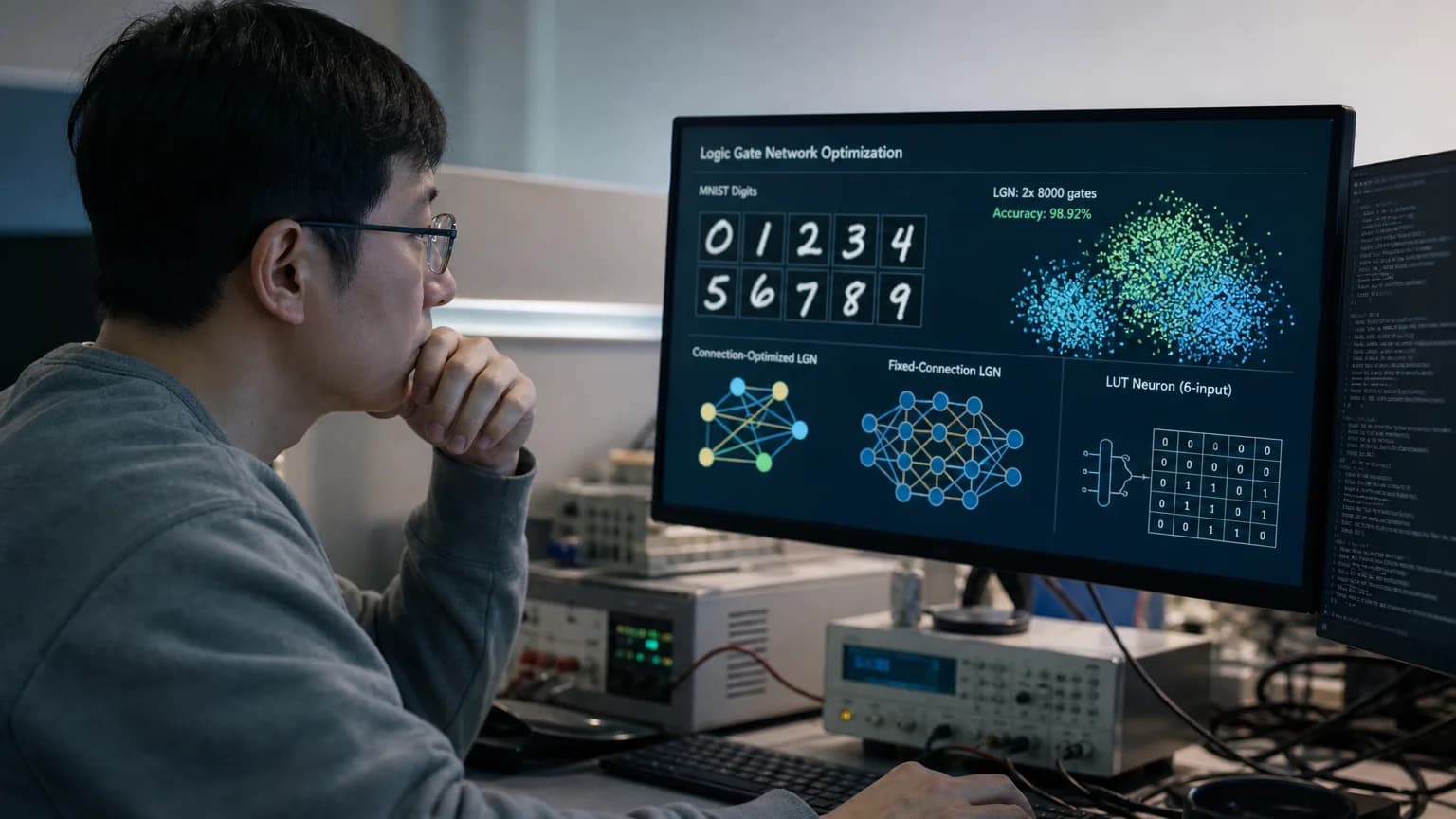
- Connection-optimized LGNs hit 98.92% MNIST accuracy with two 8000-gate layers, using about 50x fewer gates than fixed-connection LGNs
- A companion LUT neuron method achieved 98.88% accuracy with two layers of 2000 6-input LUTs while needing 4x fewer trainable parameters than fixed-connection LGN training
- Training was shown stable up to 10 layers for LGNs and 6 layers for LUTNs, validated on MNIST, Fashion-MNIST and Yin-Yang benchmarks
A research paper posted to arXiv on July 10 proposes a way to make differentiable logic gate networks (LGNs) drastically leaner without sacrificing accuracy, potentially reshaping how ultra-low-latency, hardware-friendly neural architectures get built.
Logic gate networks replace conventional neurons with literal Boolean gates (AND, OR, XOR and similar) arranged in layers, an approach prized for its efficiency once deployed on FPGAs or custom silicon. The catch has always been that most LGN training methods fix the wiring between gates ahead of time and only optimize which gate type sits at each node. That constraint forces networks to be far larger than necessary to compensate for suboptimal connectivity.
The new method, detailed at arxiv.org/abs/2607.09399, tackles that bottleneck directly by making the connections themselves trainable, both partially and fully, across deep LGNs and a related structure called lookup table networks (LUTNs). Using straight-through estimators alongside a technique for trimming away gates that produce constant, uninformative outputs, the authors report stable training at high learning rates in networks up to ten layers deep.
Big Efficiency Gains, Not Just Bigger Numbers
The headline result is efficiency rather than raw accuracy. On MNIST, a connection-optimized LGN using a single layer of 8,000 gates reached 98.45% accuracy, and stacking two such layers pushed that to 98.92%. Those numbers are competitive with, and in some configurations better than, fixed-connection LGN baselines, but they arrive with roughly 50 times fewer gates. That kind of reduction matters enormously for hardware implementations, where gate count translates almost directly into chip area, power draw and inference latency.
The paper also introduces a companion technique for LUT neurons, small lookup tables that map input combinations directly to outputs, showing they can be trained stably via backpropagation in networks as deep as six layers. A connection-training algorithm for LUTNs built from two layers of 2,000 six-input LUTs hit 98.88% accuracy on MNIST, and the broader LUT neuron formulation needed four times fewer trainable parameters than fixed-connection LGN training while still edging out its accuracy.
Where It Was Tested
Beyond MNIST, the researchers validated their approach on Fashion-MNIST and Yin-Yang, two standard benchmarks for probing how classification methods handle more complex or non-linearly separable data. Consistent performance across all three suggests the connection-optimization trick generalizes rather than being tuned narrowly to handwritten digits.
No contradictions or disputed figures surfaced in the reporting on this paper. The practical upshot for engineers working on edge inference and custom accelerators is a concrete path toward networks that need far less silicon to hit the same accuracy bar, a trade-off that has direct implications for anyone designing power-constrained or latency-sensitive AI hardware.
Original reporting and research used to synthesize this article.
WAKIB Editorial Team
This review was prepared and summarized by the WAKIB AI intelligence engine and vetted by our editorial board for accuracy and reliability.
Subscribe to Newsletter
Get a weekly summary of the most promising AI research and tools delivered to your inbox.
Telegram Channel
Join our active community on Telegram for real-time tracking of AI models and trends.