
A Three-Layer Network That Shows Its Work: Inside SAMPAT's Push for Interpretable AI
The Core · TL;DR
- SAMPAT is a new three-layer neural architecture detailed in a paper posted to arXiv on July 10, 2026, designed for interpretable machine learning.
- Its output can be expressed as a closed-form algebraic and analytic expression, giving full transparency into what the model computes rather than a black-box result.
- The architecture provably approximates any smooth, continuous, differentiable function and can represent polynomials, rational expressions, Gaussians and mixtures of Gaussians.
- Experiments on synthetic and benchmark datasets show SAMPAT matches the performance of more complex models while using simpler, more interpretable representations.
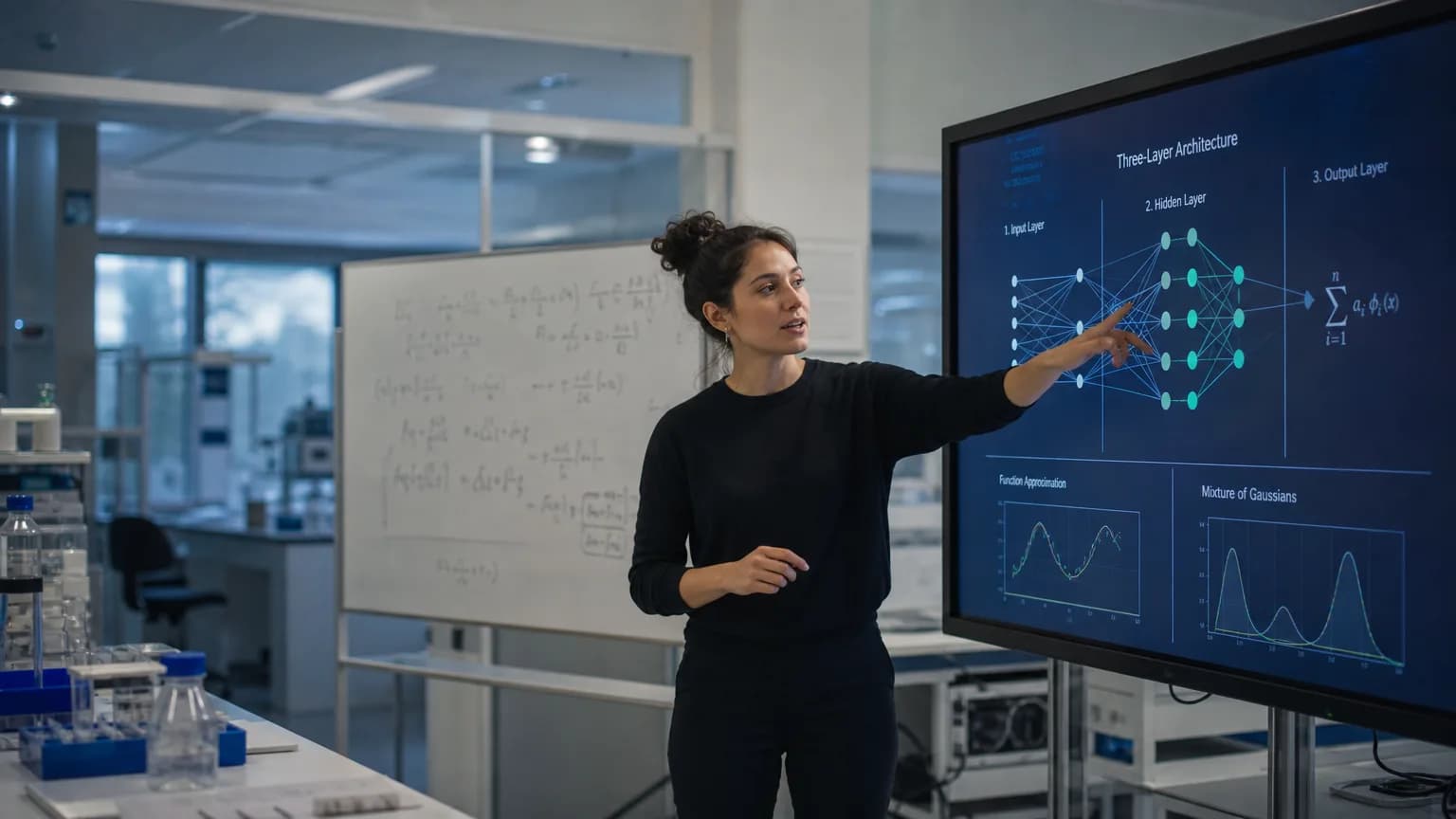
A neural network that can explain itself in closed-form algebra rather than a black box of weights is the premise behind SAMPAT, a new architecture detailed in a paper submitted to arXiv on July 10, 2026. The name stands for Smooth Approximation via Multivariate Polynomials and Analytic Transformations, and its authors argue it can match the performance of far more complex models while remaining fully transparent about what it computes.
The core structure is a three-layer network. According to the paper, just two layers are enough for many tasks, while adding skip connections and expanding to four or six layers lets SAMPAT represent a substantial range of methods already common across AI and machine learning. That flexibility is central to the pitch: rather than proposing one narrow model, the authors present a framework that can be tuned in depth and connectivity depending on the complexity of the problem at hand.
What makes it interpretable
Unlike conventional deep networks, whose internal representations are notoriously difficult to decode, SAMPAT's output can be written as a compact algebraic and analytic expression. That means the function a trained SAMPAT model learns isn't just approximated by the network, it can be read directly as a formula. The paper claims this gives the architecture complete interpretability, a property that has become increasingly valuable as regulators and enterprises push for AI systems whose decisions can be audited and explained rather than treated as opaque predictions.
Mathematically, the authors show SAMPAT can generate a wide variety of approximants, including standard and trigonometric polynomials, rational expressions, Gaussians, and mixtures of Gaussians. They also demonstrate a formal guarantee: SAMPAT can learn a continuous, everywhere differentiable function capable of approximating any smooth function to an arbitrary degree of closeness. That places the architecture in the same theoretical territory as universal approximation results long used to justify deep learning, but with an explicit, human-readable output rather than an implicit one.
Where it could be applied
Beyond its role as a general-purpose function approximator, the paper points to more specific uses, including polynomial factorization and modeling nonlinear dynamical systems. Both are domains where closed-form solutions carry real practical weight, whether for symbolic computation, control systems, or scientific modeling where understanding the underlying equation matters as much as the prediction itself.
The authors back their claims with experiments on synthetic and benchmark datasets, reporting that SAMPAT achieves competitive results using simpler representations than typical black-box alternatives. The work is cross-listed under machine learning, artificial intelligence, computer vision and pattern recognition, and functional analysis on arXiv, reflecting its dual identity as both an applied model and a mathematically grounded contribution. For a field increasingly scrutinized over the opacity of its most powerful systems, an architecture built from the ground up to be legible could carry weight well beyond its benchmark scores.
Original reporting and research used to synthesize this article.
WAKIB Editorial Team
This review was prepared and summarized by the WAKIB AI intelligence engine and vetted by our editorial board for accuracy and reliability.
Subscribe to Newsletter
Get a weekly summary of the most promising AI research and tools delivered to your inbox.
Telegram Channel
Join our active community on Telegram for real-time tracking of AI models and trends.