
New Benchmark Exposes a Blind Spot: LLMs Struggle to Tutor Like Teachers, Not Just Talk Like Them
The Core · TL;DR
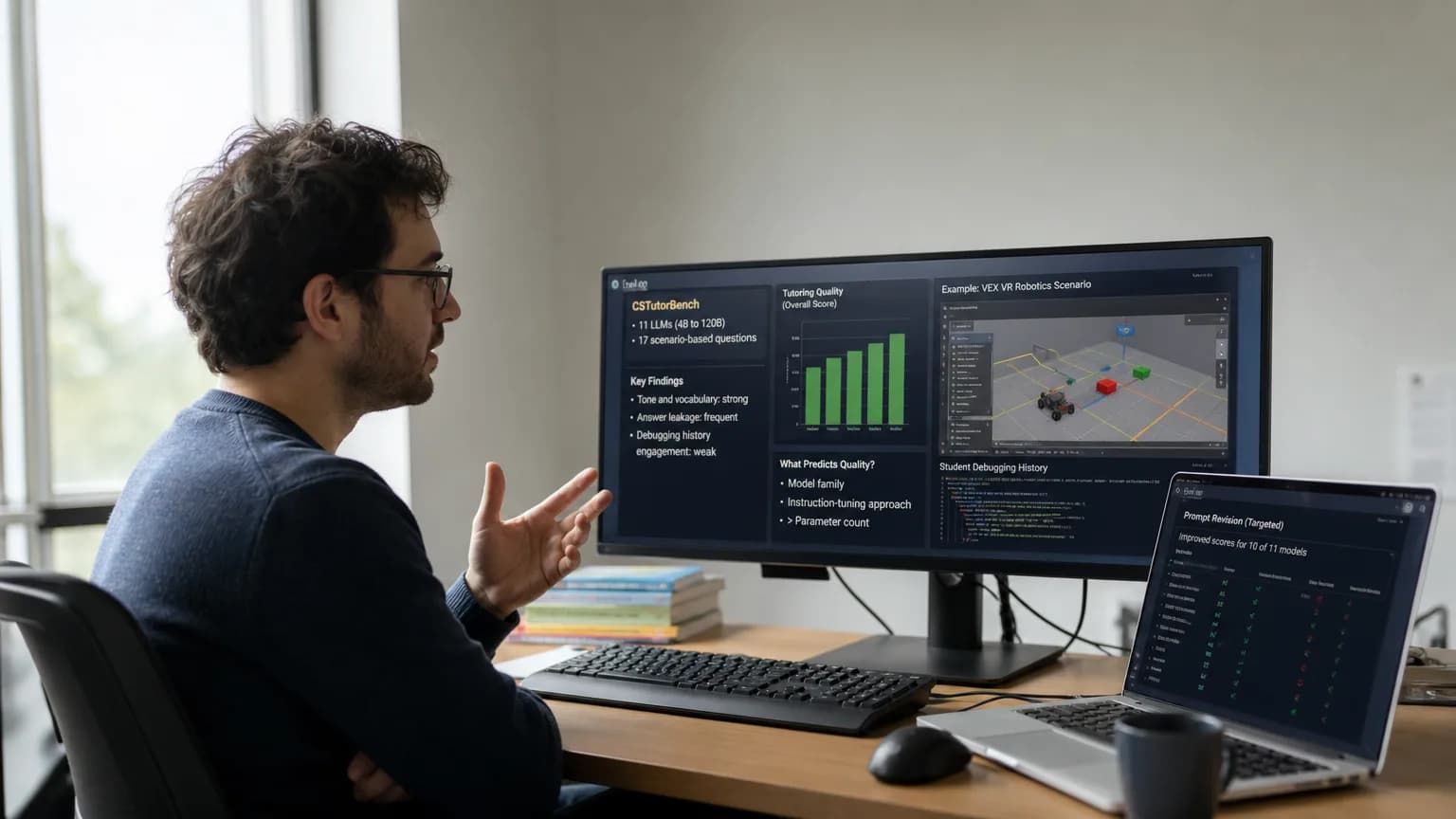
- CSTutorBench, a new benchmark from H. Chad Lane and Bryson Kageler, tests 11 LLMs (4B to 120B parameters) as CS tutors inside the VEX VR robotics environment using 17 scenario-based questions.
- Models scored well on tone and vocabulary but frequently leaked answers and failed to engage with students' debugging history, key pedagogical failures.
- Model family and instruction-tuning approach predicted tutoring quality better than parameter count, and a targeted prompt revision improved scores for 10 of 11 models.
- Related Seoul-presented research includes the GAIDE framework for teacher-built AI learning tools via 'vibe coding' and a pattern-based system for recommending programming learning content.
Eleven language models, ranging from lean 4-billion-parameter systems to 120-billion-parameter heavyweights, were put through a test that had nothing to do with coding ability and everything to do with teaching. The result: even the largest models frequently failed at the one thing a good computer science tutor is supposed to do, which is guide a student toward an answer without simply handing it over.
That finding comes from CSTutorBench, a new benchmark introduced by researchers H. Chad Lane and Bryson Kageler in a paper submitted to arXiv on July 6, 2026, and presented at SLM4ED'26, the first Workshop of Small Language Models for Education, held alongside AIED 2026 in Seoul. The benchmark grades models on 17 scenario-based questions set inside VEX VR, a block-based robotics environment used to teach introductory programming concepts. Each response is scored against a pedagogical rubric using a human-in-the-loop LLM-as-judge pipeline, a setup designed to catch not just whether an answer is correct, but whether it teaches.
Sounding Like a Tutor Isn't the Same as Being One
The models tested generally nailed the surface-level markers of good tutoring: appropriate vocabulary, warm tone, encouraging phrasing. Where they broke down was in the deeper mechanics of instruction. Many models leaked answers outright instead of steering students to discover solutions themselves, and most struggled to meaningfully engage with a student's actual debugging history, treating each question as if it arrived with no prior context.
Perhaps the more consequential finding for anyone selecting a model for educational deployment is that raw scale wasn't the deciding factor in tutoring quality. According to the study, which model family a system belonged to and how it had been instruction-tuned predicted performance better than parameter count did. A well-tuned smaller model could outperform a larger but less carefully aligned one, an outcome with direct implications for schools and edtech vendors weighing compute costs against learning outcomes.
There was a practical payoff, too. The researchers applied a targeted prompt revision informed by recent educational prompt-engineering research, and it lifted scores for 10 of the 11 models tested, suggesting that some of these pedagogical shortcomings are fixable through prompting rather than retraining.
Part of a Broader Push in AI-for-Education Research
CSTutorBench arrived alongside two related papers at the same cluster of Seoul workshops, both pointing toward the same underlying question: how AI systems should be shaped for classroom use rather than general-purpose assistance. One, led by Yukyeong Song of the University of Tennessee, Knoxville, introduces GAIDE, a framework built on Design Thinking and INTERACT methodologies that helps K-12 teachers build their own AI-powered learning tools through "vibe coding," the now-common practice of generating working code from natural-language prompts without traditional programming skills. An eight-week workshop involving three teachers and four faculty mentors, analyzed using CORDTRA interaction analysis, found that teachers' AI literacy improved after using the framework.
The other, accepted to the 10th Educational Data Mining in Computer Science Education Workshop and submitted to arXiv on June 9, 2026, proposes using pattern-based Knowledge Components to automatically match code-based learning resources that target similar programming concepts, tested against an expert-curated corpus of introductory Python materials.
Together, the papers suggest the field is moving past the question of whether LLMs can produce plausible-sounding educational content, toward the harder work of measuring and engineering whether they can actually teach.
Original reporting and research used to synthesize this article.
- 1Automated Recommendation of Programming Learning Content Using Pattern-based Knowledge Componentsarxiv.org
- 2CSTutorBench: Benchmarking Small Language Models as Tutors for Block-Based Programmingarxiv.org
- 3A Guiding Framework for K-12 Teachers in Creating AI-powered Learning Technologies through Vibe Codingarxiv.org
WAKIB Editorial Team
This review was prepared and summarized by the WAKIB AI intelligence engine and vetted by our editorial board for accuracy and reliability.
Subscribe to Newsletter
Get a weekly summary of the most promising AI research and tools delivered to your inbox.
Telegram Channel
Join our active community on Telegram for real-time tracking of AI models and trends.