
A Fixed Spectral Basis Challenges the Neural Operator Playbook for Solving PDEs
The Core · TL;DR
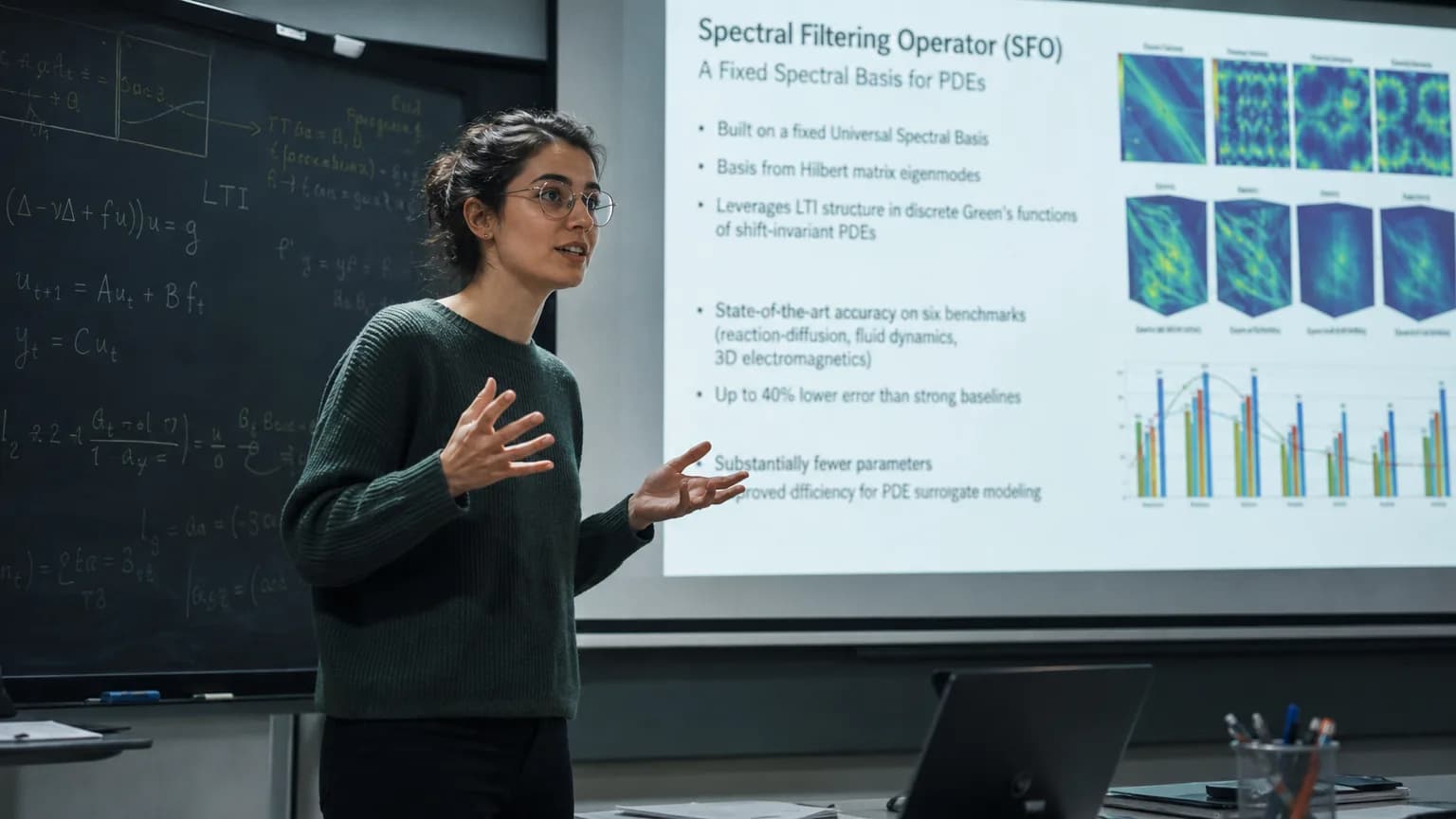
- A January 23, 2026 arXiv paper introduces the Spectral Filtering Operator (SFO), a neural operator built on a fixed 'Universal Spectral Basis' instead of a learned one.
- The basis is derived from Hilbert matrix eigenmodes and relies on a proven Linear Dynamical System structure in discrete Green's functions of shift-invariant PDEs.
- SFO reports state-of-the-art accuracy on six benchmarks (reaction-diffusion, fluid dynamics, 3D electromagnetics) with up to 40% lower error than strong baselines.
- The method achieves these results with substantially fewer parameters than competing approaches, hinting at efficiency gains for PDE surrogate modeling.
A paper submitted to arXiv on January 23, 2026 proposes a neural operator that discards one of the field's long-standing assumptions: that the mathematical basis used to represent a solution operator must be learned from data. The Spectral Filtering Operator (SFO), described in the submission, instead builds its integral kernels on top of a fixed, global structure called the Universal Spectral Basis (USB).
The USB is not tuned per task or dataset. It is derived analytically from the eigenmodes of the Hilbert matrix, a well-studied object in spectral filtering theory, and stays constant across every problem the operator is applied to. That is a departure from most modern neural operators, including Fourier Neural Operators and their many variants, which typically learn kernel parameters or basis functions directly from training data for each new setting.
The theoretical justification behind SFO rests on an observation about discrete Green's functions, the objects that describe how a partial differential equation propagates influence across space. For PDE discretizations that are shift-invariant, meaning their behavior doesn't change depending on where in the domain you look, the authors show these Green's functions carry a spatial Linear Dynamical System (LDS) structure. That structural regularity is what makes a single, fixed spectral basis expressive enough to represent solution operators across very different physical systems, rather than requiring a new learned basis each time.
Benchmark Results
The paper reports state-of-the-art accuracy on six benchmark problems spanning reaction-diffusion systems, fluid dynamics, and 3D electromagnetics, a spread that touches several distinct classes of PDEs commonly used to stress-test neural operators. Against strong existing baselines, SFO is said to cut prediction error by as much as 40 percent.
Perhaps more notable for practitioners is the parameter efficiency angle. The authors report that SFO reaches these results with substantially fewer parameters than the baseline models it outperforms. If that efficiency holds up under independent scrutiny, it would suggest that much of the parameter count in current neural operators is spent relearning structure that a fixed analytical basis can already capture, rather than encoding information that genuinely varies from problem to problem.
Why the Distinction Matters
Neural operators are increasingly used as fast surrogates for expensive numerical PDE solvers in engineering and scientific computing, from weather modeling to electromagnetic simulation. A method that needs less training data and fewer parameters to hit comparable or better accuracy has direct implications for deployment cost and training time, particularly in settings where generating high-fidelity simulation data for supervision is itself expensive.
The claims here come from a single preprint, and as with any newly submitted paper, independent replication and peer review will determine how well the reported gains generalize beyond the six tested benchmarks. No contradictions or inconsistencies were found across the available sourcing for this submission, but the broader research community has not yet had time to stress-test the Universal Spectral Basis approach on problems outside the paper's chosen domains.
Original reporting and research used to synthesize this article.
WAKIB Editorial Team
This review was prepared and summarized by the WAKIB AI intelligence engine and vetted by our editorial board for accuracy and reliability.
Subscribe to Newsletter
Get a weekly summary of the most promising AI research and tools delivered to your inbox.
Telegram Channel
Join our active community on Telegram for real-time tracking of AI models and trends.