
A 7B Chemistry Model Cuts Hallucinations by 79% Using a Multi-Agent Trick Borrowed From Game Theory
The Core · TL;DR
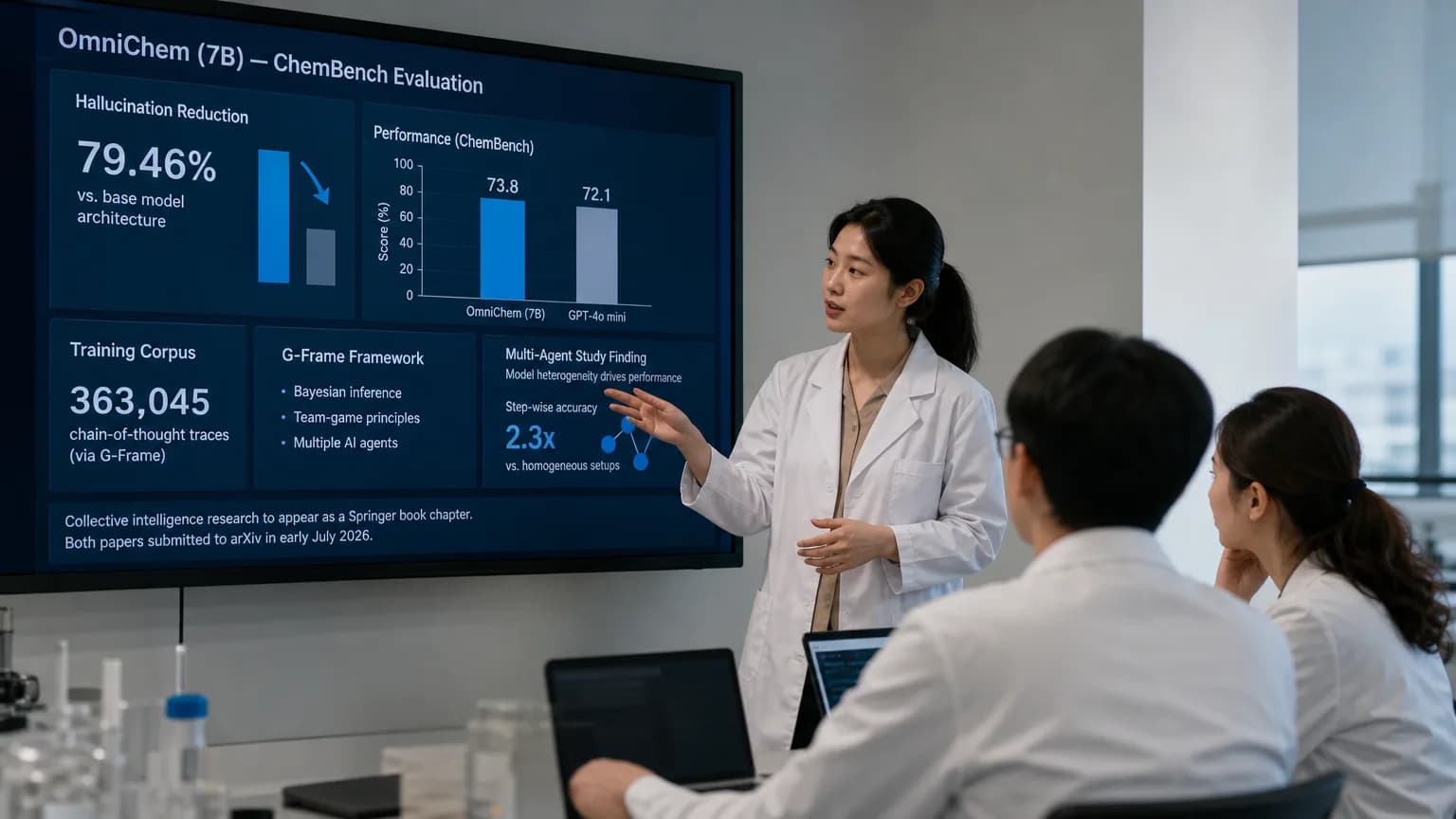
- OmniChem, a 7B parameter model, matches GPT-4o mini on ChemBench using a training corpus of 363,045 chain-of-thought traces generated via the new G-Frame framework.
- G-Frame combines Bayesian inference with team-game principles across multiple AI agents, cutting hallucinations by 79.46% versus the base model architecture.
- A related study finds model heterogeneity, not framework design or redundant sampling, drives multi-agent performance, boosting step-wise accuracy 2.3x over homogeneous setups.
- The collective intelligence research will appear as a Springer book chapter, while both papers were submitted to arXiv in early July 2026.
OmniChem, a compact 7-billion-parameter language model, is matching GPT-4o mini on ChemBench and a set of custom chemistry benchmarks, despite running on a fraction of the compute. The result comes from a new framework called G-Frame, detailed in a paper submitted to arXiv on July 9, 2026, and it points to a broader shift in how researchers are tackling hallucination in domain-specific AI: not by scaling up, but by scaling out.
G-Frame is described as an adaptive multi-agent system that blends Bayesian inference with team-game principles, essentially having multiple model instances check and challenge each other's reasoning before settling on an answer. Applied to OmniChem, this approach produced a 79.46% reduction in hallucinations compared to the same model's base architecture, a substantial gain for a field where a single fabricated reaction pathway or incorrect molecular property can derail downstream research.
Part of what makes OmniChem viable at 7B parameters is the training data behind it. The team built a specialized corpus of 363,045 chain-of-thought traces paired with 199,589 question-answer sets, generated through the G-Frame framework itself. That synthetic-but-structured dataset appears to be doing much of the heavy lifting, letting a relatively small model punch above its parameter count on chemistry-specific tasks.
Why Model Diversity Beats Bigger Frameworks
A companion paper, submitted a few days earlier on July 6, 2026, examines the mechanics of multi-agent coordination more broadly and offers a finding that cuts against some conventional assumptions in the field. The researchers report that heterogeneity among the models in a coordinated system, not the sophistication of the coordination framework itself, nor simply sampling the same model repeatedly, is the dominant driver of performance gains.
The numbers back this up: a heterogeneous multi-agent setup reached a step-wise accuracy of 0.64, versus 0.54 for individual models operating alone. That's roughly a 2.3x improvement over homogeneous configurations where identical models are simply run in parallel. In other words, mixing different model architectures together and letting them cross-check each other's reasoning steps outperforms throwing more compute at a single model, or even running several copies of the same one.
This second paper is framed around collective intelligence in foundation models and has been accepted as a book chapter in Advances in Global Applied Artificial Intelligence, with formal publication slated for Springer's Learning and Analytics in Intelligent Systems series. The authors position their multi-agent framework as a step toward AI systems that are inherently safer and more reliable, precisely because they don't rely on any single model's judgment being correct.
Taken together, the two papers suggest a practical playbook for teams trying to build reliable, specialized AI without frontier-scale budgets: pair a smaller model with a well-designed synthetic training corpus, then wrap it in a multi-agent verification layer built from diverse models rather than redundant copies. For chemistry, biology, and other high-stakes technical domains where hallucinations carry real costs, that combination may prove more valuable than simply waiting for the next generation of larger models.
Original reporting and research used to synthesize this article.
WAKIB Editorial Team
This review was prepared and summarized by the WAKIB AI intelligence engine and vetted by our editorial board for accuracy and reliability.
Subscribe to Newsletter
Get a weekly summary of the most promising AI research and tools delivered to your inbox.
Telegram Channel
Join our active community on Telegram for real-time tracking of AI models and trends.