
When Medical AI Can't See Who It's Failing, CAPRA Fills the Blind Spot
The Core · TL;DR
- CAPRA is a new calibrated proxy-axis framework for detecting hidden subgroup performance gaps in medical imaging AI when demographic metadata is missing.
- It infers semantic axes from images and calibrates them using a small labeled subset via patient-level cross-fitting, avoiding reliance on complete demographic labels.
- Tested across fundus, dermoscopy, and chest radiography imaging, CAPRA revealed disparities that metadata-only slicing methods missed.
- The framework remains informative even under dataset shift, a key requirement for real-world deployment across different hospitals and imaging equipment.
Most fairness audits of medical imaging AI rely on a simple assumption: that datasets come with reliable demographic labels like age, sex, or race attached to every scan. In practice, that metadata is frequently missing, incomplete, or unreliable, leaving hospitals and researchers unable to check whether a diagnostic model quietly underperforms on certain patient groups. A new framework called CAPRA, detailed in a paper submitted to arXiv on July 10, 2026, tackles this gap directly.
CAPRA stands for a calibrated proxy-axis approach to subgroup analysis, built specifically for situations where the metadata needed to slice a dataset by demographic group simply isn't there. Rather than depending on labels that may not exist, the framework infers semantic axes directly from the images themselves. It then calibrates the posterior probabilities of those inferred axes using a small subset of the data that does have metadata labels, applying patient-level cross-fitting to keep the calibration statistically sound and avoid leakage between training and evaluation splits.
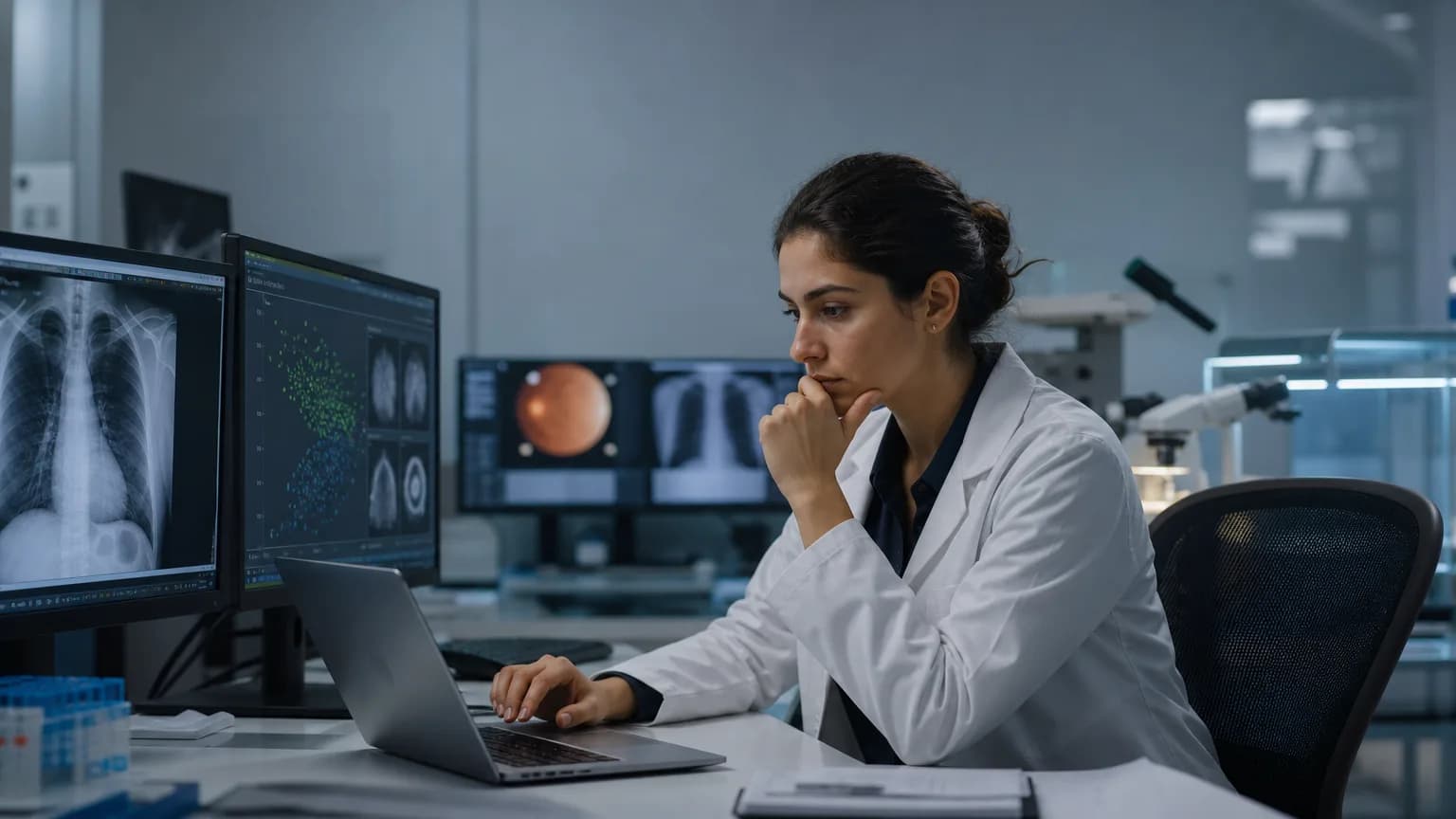
The research team, which includes submitting author Guanhua Ye, tested CAPRA across three distinct imaging modalities: fundus photography (used for retinal disease screening), dermoscopy (skin lesion imaging), and chest radiography. That spread matters because fairness tools that only work on one type of scan have limited practical value in a hospital setting where multiple imaging pipelines run simultaneously.
Catching What Metadata-Only Audits Miss
The paper's central claim is that CAPRA surfaces disparity patterns that conventional metadata-only slicing methods overlook entirely. In other words, even when demographic labels are available for part of a dataset, standard auditing techniques can still miss performance gaps that only become visible when the analysis incorporates image-derived signals alongside whatever sparse metadata exists. The authors also report that CAPRA stays informative even when the underlying data distribution shifts, a property that matters for real-world deployment where imaging equipment, patient populations, and clinical protocols change over time and location.
This kind of dataset shift is a persistent headache for deployed medical AI: a model validated on one hospital's imaging equipment can behave unpredictably when moved to another site with different scanners or patient demographics. A subgroup analysis tool that degrades under that shift is of limited use once a model leaves the lab.
The paper has been categorized under image and video processing, artificial intelligence, computer vision and pattern recognition, and multimedia on arXiv, reflecting its position at the intersection of clinical AI safety and core machine learning methodology. For teams building or auditing diagnostic imaging systems, CAPRA offers a concrete answer to a question that's increasingly hard to ignore: how do you check for bias when the very data needed to check for it isn't recorded in the first place?
Original reporting and research used to synthesize this article.
WAKIB Editorial Team
This review was prepared and summarized by the WAKIB AI intelligence engine and vetted by our editorial board for accuracy and reliability.
Subscribe to Newsletter
Get a weekly summary of the most promising AI research and tools delivered to your inbox.
Telegram Channel
Join our active community on Telegram for real-time tracking of AI models and trends.