
Two New arXiv Papers Tackle Robot Safety Logic and Off-Road Speed with Minimal Data
The Core · TL;DR
- A new arXiv paper (2508.19186) uses depth-first search over negated LTL path properties to formally verify multi-step robot navigation plans, unifying reactive obstacle avoidance with longer-horizon planning.
- A second paper (2607.13319) introduces OptCar, which adapts generalist vehicle models to off-road terrain using just 5 minutes of real data per surface, matching specialists trained on 30 minutes of road data.
- OptCar cuts trajectory tracking error by 55% at 6 m/s on vegetation and dirt terrain versus a fine-tuned AnyCar baseline.
- The two papers are unrelated but both reflect a push toward safer, more data-efficient autonomous vehicle and robot navigation systems.
Two separate research papers landing on arXiv this cycle push autonomous vehicle and robotics research in very different but complementary directions: one formalizes how robots reason about obstacle avoidance using logic-based planning, the other shows how a generalist driving model can be adapted to aggressive off-road terrain with just five minutes of real-world data.
Formal Verification Meets Reactive Planning
The first paper (arXiv:2508.19186) targets a persistent gap in autonomous robotics: the disconnect between reactive obstacle avoidance and longer-horizon multi-step planning. Rather than treating these as separate control layers bolted together, the authors apply model checking techniques, specifically depth-first search combined with negated Linear Temporal Logic (LTL) path properties, to verify and generate safe trajectories in a single framework.
LTL is a formalism traditionally used in software and hardware verification to express properties over time, such as "the robot must never enter zone X" or "the robot must eventually reach goal Y." By negating these path properties and searching for violations via depth-first traversal, the system can catch unsafe multi-step plans before they're executed, rather than relying purely on reactive, moment-to-moment obstacle detection. For robotics teams building navigation stacks for warehouses, drones, or field robots, this kind of formal guarantee matters more than incremental gains in raw obstacle-detection accuracy: it offers a mathematically grounded way to certify that a planned path won't lead into a dead end or unsafe region several steps down the line.
OptCar: Off-Road Speed Without the Data Bill
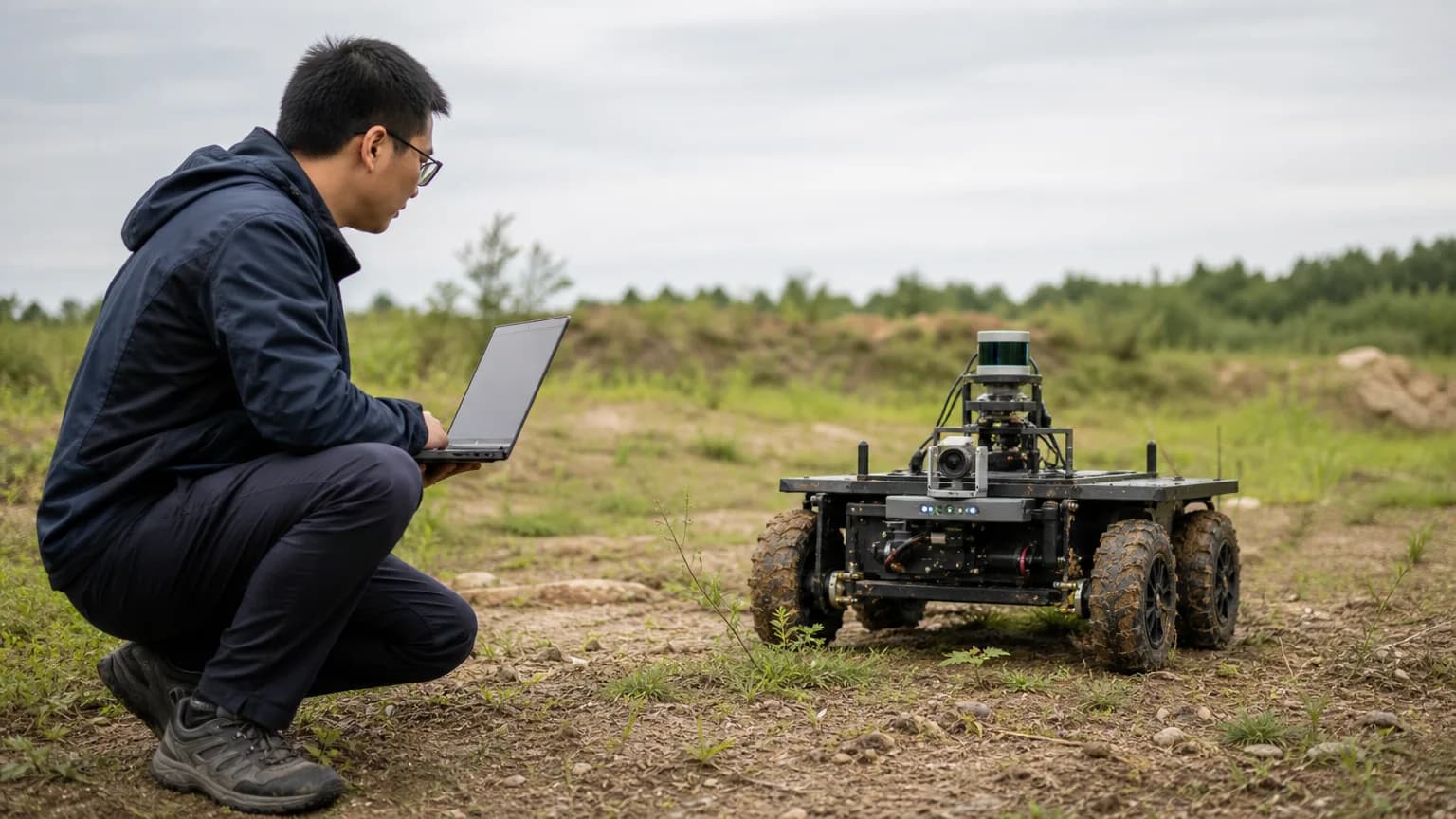
The second paper (arXiv:2607.13319) introduces OptCar, a method for adapting generalist vehicle dynamics models to high-speed off-road driving. The core claim is efficiency: OptCar needs only five minutes of real-world data per terrain type to reach performance competitive with specialist models trained on 30 minutes of road data each.
That's a six-fold reduction in per-terrain data collection, which is significant for any team trying to scale autonomous ground vehicles across varied environments like construction sites, agricultural land, or disaster zones, where collecting hours of labeled driving data for every surface type is impractical. The paper reports a 55% reduction in trajectory tracking error at 6 meters per second on vegetation and dirt terrain, benchmarked against a fine-tuned AnyCar baseline, a recognized reference model for generalist car dynamics.
Why It Matters Together
Neither paper references the other, and they solve different problems: one is about verifying safety in navigation logic, the other about sample-efficient adaptation of physical dynamics models. But both point toward the same broader trend in autonomous systems research: squeezing more reliability and adaptability out of less data and fewer assumptions. Formal methods like LTL model checking reduce the reliance on exhaustive real-world testing to catch planning failures, while approaches like OptCar reduce the data burden for deploying vehicles across unpredictable terrain.
For engineering teams building or evaluating autonomy stacks, the combination suggests a maturing toolkit: verified planning logic on one side, rapid terrain adaptation on the other, both aimed at cutting the cost and risk of real-world deployment.
Original reporting and research used to synthesize this article.
WAKIB Editorial Team
This review was prepared and summarized by the WAKIB AI intelligence engine and vetted by our editorial board for accuracy and reliability.
Subscribe to Newsletter
Get a weekly summary of the most promising AI research and tools delivered to your inbox.
Telegram Channel
Join our active community on Telegram for real-time tracking of AI models and trends.