
StanceMoE Hits 94.26% Accuracy Detecting Who Stands Where on the Nakba Narrative
The Core · TL;DR
- StanceMoE, a Mixture-of-Experts model built on a fine-tuned BERT encoder, scored a 94.26% macro-F1 on the StanceNakba 2026 Subtask A benchmark of 1,401 English texts.
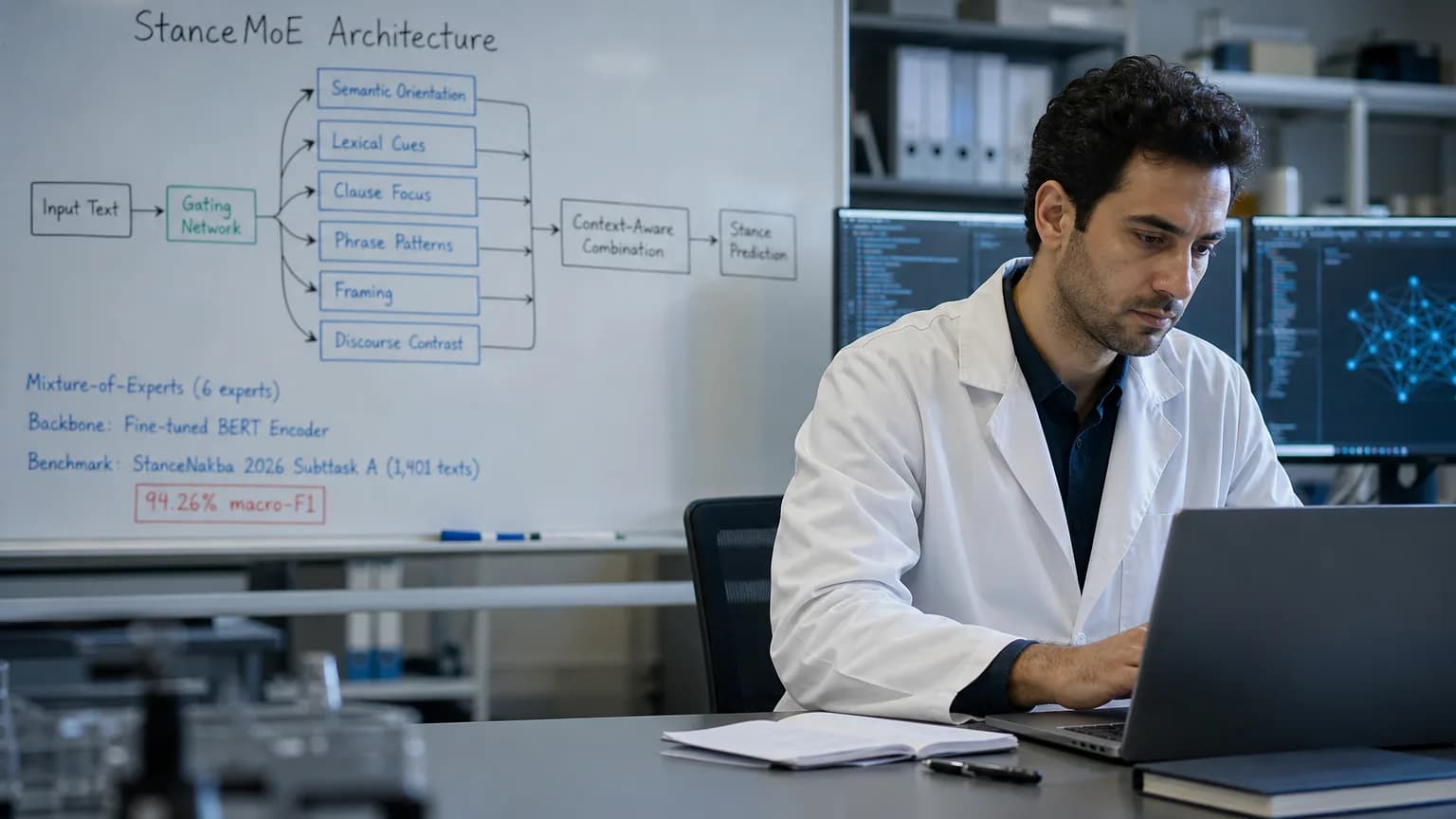
- The architecture routes inputs through six specialized expert modules covering semantic orientation, lexical cues, clause focus, phrase patterns, framing, and discourse contrast, combined via a context-aware gating mechanism.
- It outperformed traditional baselines and other BERT-based variants that lack the mixture-of-experts routing design.
- The research was accepted at the workshop proceedings of LREC 2026, targeting actor-level stance detection in politically sensitive text.
A six-headed Mixture-of-Experts model called StanceMoE has posted a 94.26% macro-F1 score on one of the toughest tests in computational stance detection: figuring out not just what a text says about a contested historical event, but who is saying it and from what position.
The benchmark is StanceNakba 2026 Subtask A, a dataset of 1,401 annotated English-language texts built specifically to probe actor-level stance detection around the Nakba, the displacement of Palestinians in 1948. Unlike simpler sentiment or topic classification tasks, actor-level stance detection requires a model to attribute a position to a specific speaker or source rather than just tag a document as positive, negative, or neutral. That distinction matters for anyone building tools to track how different actors, from media outlets to political figures, frame contested historical and geopolitical events.
StanceMoE's architecture is what sets it apart from prior approaches. Built on top of a fine-tuned BERT encoder, the model routes each input through six specialized expert modules rather than relying on a single monolithic classifier. Each expert is tuned to a distinct linguistic signal: global semantic orientation, salient lexical cues, clause-level focus, phrase-level patterns, framing indicators, and contrast-driven discourse shifts (the kind of "but," "however," or "despite" constructions that often signal a rhetorical pivot). A context-aware gating mechanism then decides, on a per-input basis, how much weight each expert's output should receive, effectively letting the model adapt its reasoning strategy to the specific characteristics of the text it's parsing.
That adaptive routing appears to be the key differentiator against the alternatives it was benchmarked against. According to the paper's authors, StanceMoE outperformed both traditional baseline classifiers and other BERT-based variants that lack the mixture-of-experts routing layer. The implication is that stance detection, especially at the granularity of "who believes what," benefits more from combining specialized narrow experts than from scaling up a single general-purpose encoder.
Why the Framing Matters
Detecting linguistic framing around events like the Nakba is a notoriously difficult NLP problem because the same factual claim can carry very different connotations depending on lexical choice, clause structure, and discourse markers. A model that can isolate these signals separately, rather than blending them into one undifferentiated representation, is better positioned to explain its own reasoning too, since each expert's activation pattern offers a partial account of why a given stance was assigned.
The work was accepted into the workshop proceedings of the 15th International Conference on Language Resources and Evaluation (LREC 2026), placing it within the broader academic push to build more rigorous, actor-aware benchmarks for stance and framing analysis. Given the sensitivity of the subject matter, the practical value of StanceMoE will likely be judged not just on its F1 score, but on how well its expert-based architecture generalizes to other polarized topics beyond the Nakba dataset it was trained and tested on.
Original reporting and research used to synthesize this article.
WAKIB Editorial Team
This review was prepared and summarized by the WAKIB AI intelligence engine and vetted by our editorial board for accuracy and reliability.
Subscribe to Newsletter
Get a weekly summary of the most promising AI research and tools delivered to your inbox.
Telegram Channel
Join our active community on Telegram for real-time tracking of AI models and trends.