
Researchers Detail Unified Guidance System for Fixed-Wing UAVs to Track and Engage Targets Autonomously
The Core · TL;DR
- A new arXiv paper (2607.12801), submitted July 14, 2026, presents a unified control framework for fixed-wing UAVs handling detection, tracking, and terminal engagement in one system.
- Target tracking combines YOLO-based visual detection with inertial data through an Unscented Kalman Filter, while Control Barrier Functions embedded in an NMPC controller prevent the UAV from losing sight of the target.
- A quaternion-based Biased Proportional Navigation Guidance law takes over for the terminal phase, enabling strikes with constrained impact angles.
- The framework is structured in three phases: vision-based acquisition, NMPC-based tracking, and terminal guidance, addressing a gap left by prior systems that treat these stages separately.
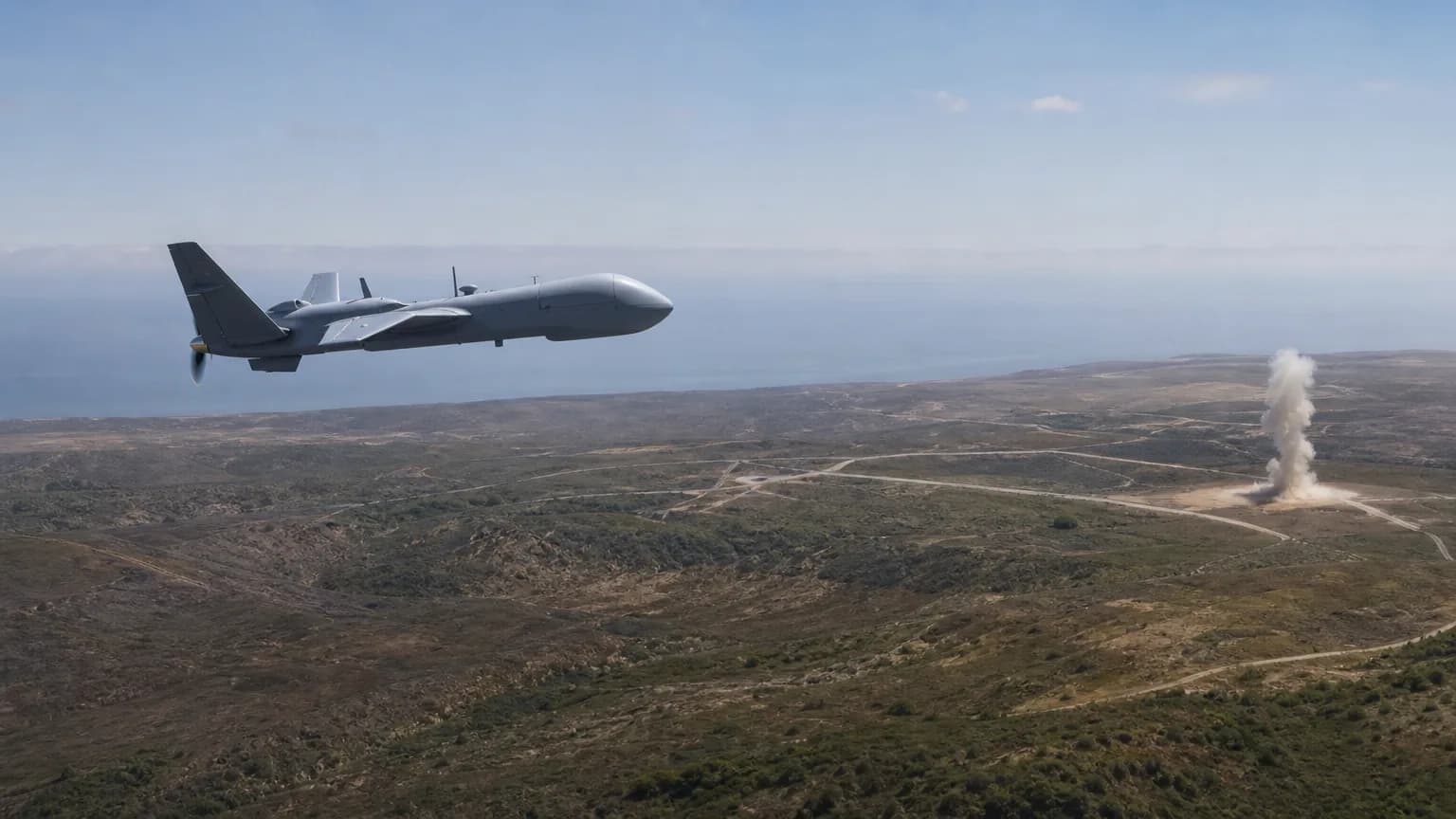
A fixed-wing drone equipped with a pan-tilt camera, capable of spotting a target, tracking it while avoiding blind spots, and then executing a precision terminal strike, all without switching between separate control stacks. That is the core contribution of a new arXiv paper (2607.12801) submitted on July 14, 2026, which proposes a single unified control framework spanning the entire mission lifecycle rather than stitching together disconnected subsystems for detection, tracking, and guidance.
The paper, filed under Robotics, Artificial Intelligence, and Systems and Control categories, breaks the mission into three sequential phases. The first is vision-based target acquisition, where the aircraft uses onboard cameras to locate a target of interest. The second is tracking, handled by a constraint-aware Nonlinear Model Predictive Control (NMPC) strategy. The third is terminal guidance, activated only once specific engagement conditions are met.
Fusing Vision and Inertial Data
Target state estimation relies on an Unscented Kalman Filter (UKF) that fuses YOLO-based visual detections with inertial measurements. This combination is designed to smooth out the noise and dropouts that plague pure vision-based tracking, particularly when a target maneuvers unpredictably or partially leaves the camera's field of view. By blending inertial cues with detection outputs, the estimator aims to maintain a stable lock on target position and velocity even under degraded visual conditions.
Keeping the Camera on Target
One of the more technically distinctive elements of the framework is its use of Control Barrier Functions (CBFs) inside the NMPC tracking loop. These act as safety constraints that keep the UAV's flight path from causing the target to slip out of the camera's field of view, a failure mode the researchers describe as self-occlusion. Rather than treating tracking and obstacle-style avoidance as separate problems, the CBFs are baked directly into the optimization that governs the aircraft's trajectory, so the drone continuously adjusts its position to preserve a clean line of sight while still closing in on the target.
Handing Off to Terminal Guidance
Once the tracking phase satisfies predefined terminal engagement conditions, control authority shifts to a quaternion-based Biased Proportional Navigation Guidance (BPNG) law. This final-phase controller is built to hit the target while respecting a specified impact angle, a requirement common in scenarios where the approach vector matters as much as the point of contact. Using quaternions for this stage suggests an emphasis on avoiding the singularities that can arise with more conventional Euler-angle representations during aggressive terminal maneuvers.
Why the Integration Matters
Most prior work in this space treats detection, tracking, and terminal guidance as isolated engineering problems, each with its own controller and handoff logic that can introduce latency or instability at the seams. By formalizing all three phases inside one framework, with CBFs explicitly protecting against occlusion during the tracking phase, the authors are targeting a practical gap: keeping a moving, uncooperative target continuously visible while a fixed-wing platform, which cannot hover or reverse like a multirotor, maneuvers toward it. The paper does not report contradicting details on methodology or timeline, and no independent flight-test validation figures are cited in the available disclosure.
Original reporting and research used to synthesize this article.
WAKIB Editorial Team
This review was prepared and summarized by the WAKIB AI intelligence engine and vetted by our editorial board for accuracy and reliability.
Subscribe to Newsletter
Get a weekly summary of the most promising AI research and tools delivered to your inbox.
Telegram Channel
Join our active community on Telegram for real-time tracking of AI models and trends.