
Physics-Informed Neural Networks Learn to Predict Shockwaves Without Rerunning Simulations
The Core · TL;DR
- A physics-informed neural network (PINN) now models how shockwaves propagate through steel-aluminum bimaterial systems, built around the governing equations of linear elasticity rather than raw data patterns alone.
- The framework was validated against ANSYS Workbench Explicit Dynamics finite-element simulations of a Split Hopkinson Pressure Bar setup, matching wave transmission, reflection, and displacement histories at the material interface.
- Once trained, the network predicts wave behavior for new time points and altered material properties without needing additional finite-element simulations, a potential speed advantage for high-strain-rate material testing.
- The study was submitted to arXiv on July 7, 2026, with no contradictions flagged in the reported findings.
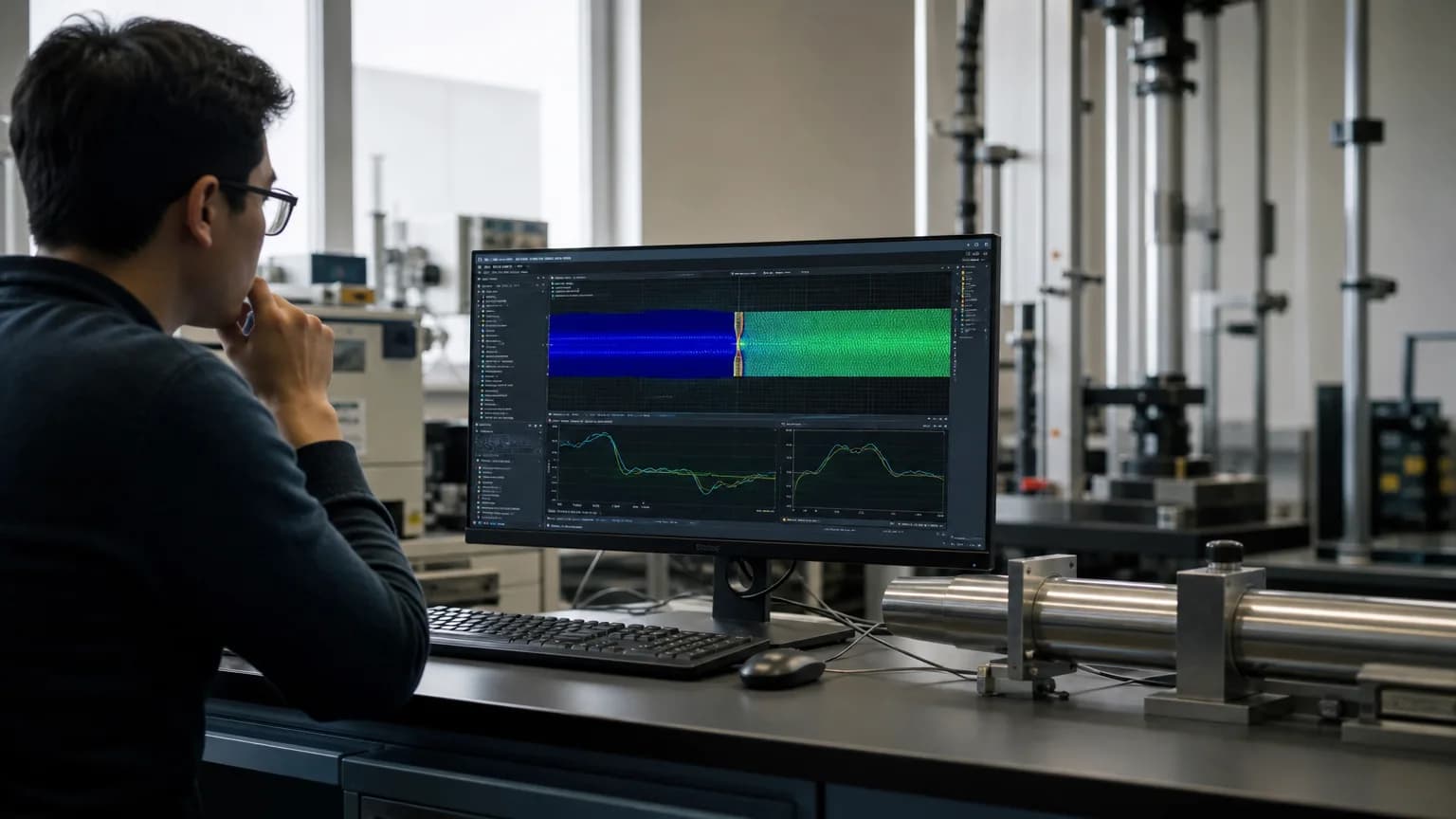
A steel-aluminum rod, the kind used in a Split Hopkinson Pressure Bar test, sits at the center of a new machine learning framework designed to predict how shockwaves travel through layered materials, without needing a fresh finite-element simulation every time conditions change.
Researchers behind a paper submitted to arXiv on July 7, 2026 built a physics-informed neural network (PINN) that models transient elastodynamic wave propagation in bimaterial systems. Rather than treating wave behavior as a black-box pattern to memorize, the network is trained directly against the axisymmetric equations of linear elasticity that govern how stress waves move through solid materials. That constraint is what separates a PINN from a conventional data-driven model: the physics itself acts as a built-in check on the network's predictions.
Validating Against Real Simulation Data
To test the approach, the team used a steel-aluminum specimen configured to mirror a Split Hopkinson Pressure Bar setup, a standard experimental method for studying how materials respond to high-strain-rate impacts. High-fidelity finite-element simulations run in ANSYS Workbench Explicit Dynamics provided both the validation benchmark and supplementary training data, giving the network a rigorous standard to be measured against.
The results show the trained network correctly captures how waves transmit through and reflect off the interface between the two materials, a notoriously difficult phenomenon to model because of the abrupt change in material stiffness and density at the boundary. It also reproduces the axial and radial displacement histories recorded across the specimen, meaning the network isn't just approximating a single output value but tracking how the material moves and deforms over time and space.
Predicting Beyond the Training Data
The more consequential finding is what the network can do once training ends. The framework generalizes to time instants it never saw during training and to materials with altered properties, all without triggering another round of finite-element analysis. For engineers, that capability matters because explicit dynamics simulations of wave propagation are computationally expensive, often requiring fine time steps and dense meshes to capture fast-moving stress fronts accurately.
If a trained PINN can interpolate and extrapolate reliable wave predictions across new material combinations, it could shift part of the workload in impact testing and material characterization away from repeated simulation runs and toward a model that, once trained, produces near-instant estimates. That has practical implications for fields that rely heavily on Split Hopkinson Pressure Bar testing and similar high-strain-rate experiments, including ballistics research, aerospace structural design, and impact-resistant material development, where iterating quickly across material combinations is often the bottleneck.
The paper does not claim the network replaces experimental validation entirely, but it does demonstrate that embedding governing physical equations directly into the training process can produce a model that respects material boundaries and wave mechanics without being explicitly told the answer for every new scenario.
Original reporting and research used to synthesize this article.
WAKIB Editorial Team
This review was prepared and summarized by the WAKIB AI intelligence engine and vetted by our editorial board for accuracy and reliability.
Subscribe to Newsletter
Get a weekly summary of the most promising AI research and tools delivered to your inbox.
Telegram Channel
Join our active community on Telegram for real-time tracking of AI models and trends.