
One Camera, One Light, Two Reflections: A Software Trick for Cheaper Eye Tracking
The Core · TL;DR
- Researcher Tongbing Huang and co-authors propose a gaze-estimation method that needs only one camera and one light source, using a mathematically simulated 'virtual light source' to replace a second physical LED.
- The technique combines polynomial regression with a newly introduced normalization factor built specifically for single-glint eye-tracking systems, which traditionally struggle with accuracy compared to multi-glint setups.
- The work was originally presented at VSIP 2019 in Wuhan, China, and published in the ACM conference proceedings in 2020, though its arXiv preprint carries a July 2026 submission date.
- Reducing hardware to a single light source could lower cost and complexity for eye tracking in VR headsets, laptops, and accessibility devices.
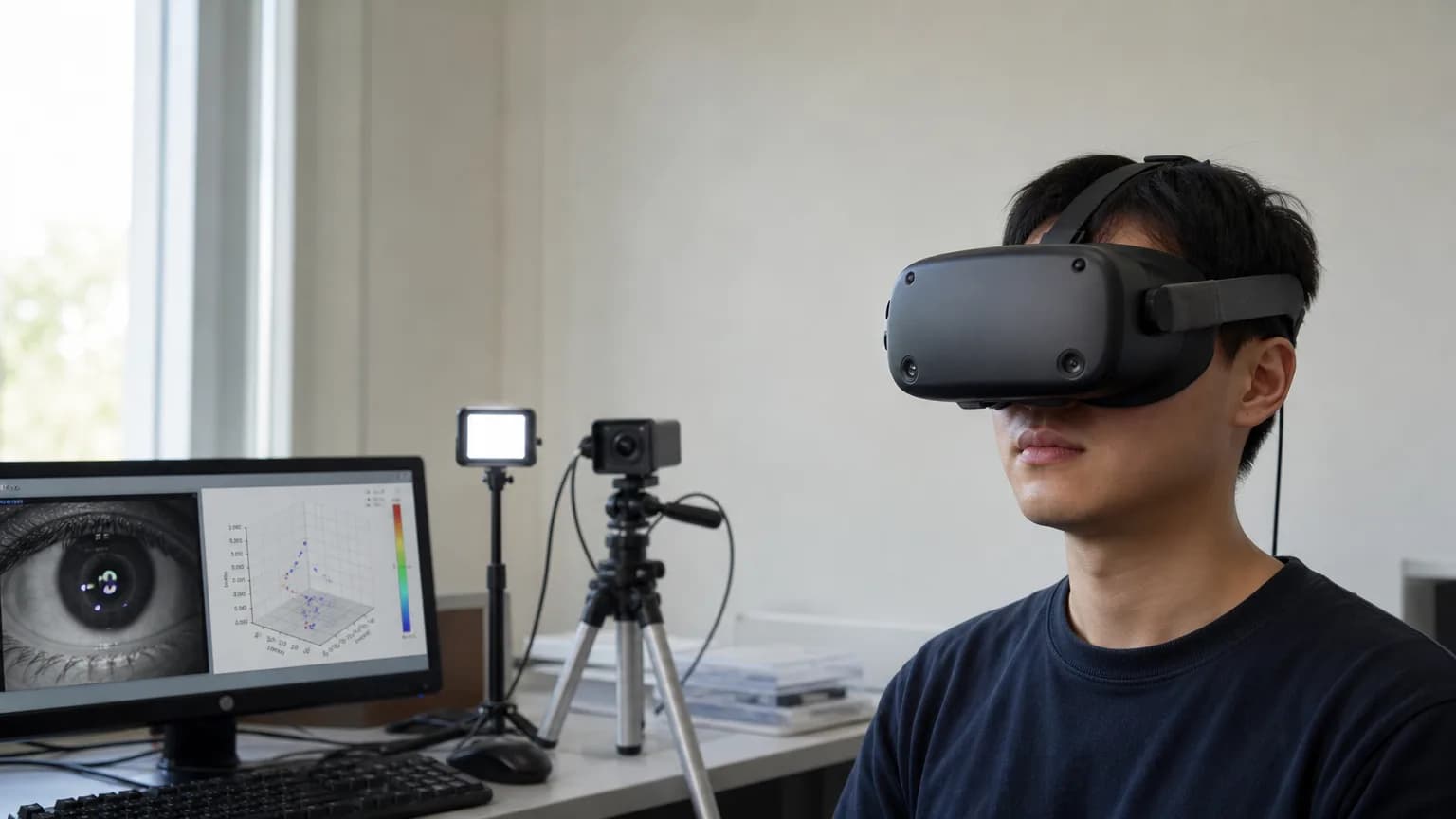
Eye trackers have long relied on multiple infrared light sources to pinpoint exactly where a person is looking, but a paper led by researcher Tongbing Huang proposes doing the job with just one camera and a single light source, no extra hardware required.
The core idea is a "virtual light source": a mathematical stand-in that mimics a second illuminator by placing it, on paper, in a position mirroring the real light source relative to the camera. Instead of physically adding a second LED to the rig, the method calculates where its reflection (or "glint") would theoretically fall on the eye, then uses that synthetic data point alongside the real one to estimate gaze direction.
To make the geometry work mathematically, the researchers pair the virtual-source concept with polynomial regression and introduce a new normalization factor tailored specifically for single-glint systems, the class of eye trackers that only have one real corneal reflection to work with. Most existing regression-based calibration techniques were built assuming at least two glints were available, so adapting them to a one-light setup required this additional correction step to keep accuracy from degrading.
Why the Hardware Reduction Matters
Commercial and research-grade gaze trackers typically use two or more near-infrared emitters precisely because multiple glints make it easier to triangulate the eye's position and correct for head movement. Stripping that down to a single light source cuts component cost and simplifies the physical design, which could matter for embedding eye tracking into lower-cost devices such as budget VR headsets, laptops, or accessibility tools where every additional sensor adds expense and power draw. The tradeoff is that single-glint systems traditionally sacrifice some robustness, which is precisely the gap this virtual-source approach and its accompanying normalization method are designed to close.
Publication Trail
The work was first presented at the 2019 International Conference on Video, Signal and Image Processing (VSIP 2019), held in Wuhan, China, from October 29 to 31 that year. It was subsequently published in the official proceedings, "VSIP '19: Proceedings of the 2019 International Conference on Video, Signal and Image Processing" (pages 10 to 14, ACM, 2020). The paper's arXiv listing shows a submission date of July 6, 2026, indicating the preprint was posted well after the original conference appearance and formal publication, a common pattern for older conference papers that get archived on arXiv later for broader visibility.
For teams building consumer eye-tracking features, whether for wearables, driver-monitoring systems, or assistive technology, the appeal of this research is straightforward: it targets the same calibration accuracy expected from dual-glint hardware while asking manufacturers to ship one less light source per unit.
Original reporting and research used to synthesize this article.
WAKIB Editorial Team
This review was prepared and summarized by the WAKIB AI intelligence engine and vetted by our editorial board for accuracy and reliability.
Subscribe to Newsletter
Get a weekly summary of the most promising AI research and tools delivered to your inbox.
Telegram Channel
Join our active community on Telegram for real-time tracking of AI models and trends.