
New XAI Framework Brings Auditor-Friendly Explanations to Banking Anomaly Detection
The Core · TL;DR
- New arXiv paper (2607.13469) presents an explainable AI framework for banking transaction anomaly detection combining Isolation Forest with feature-level explanations
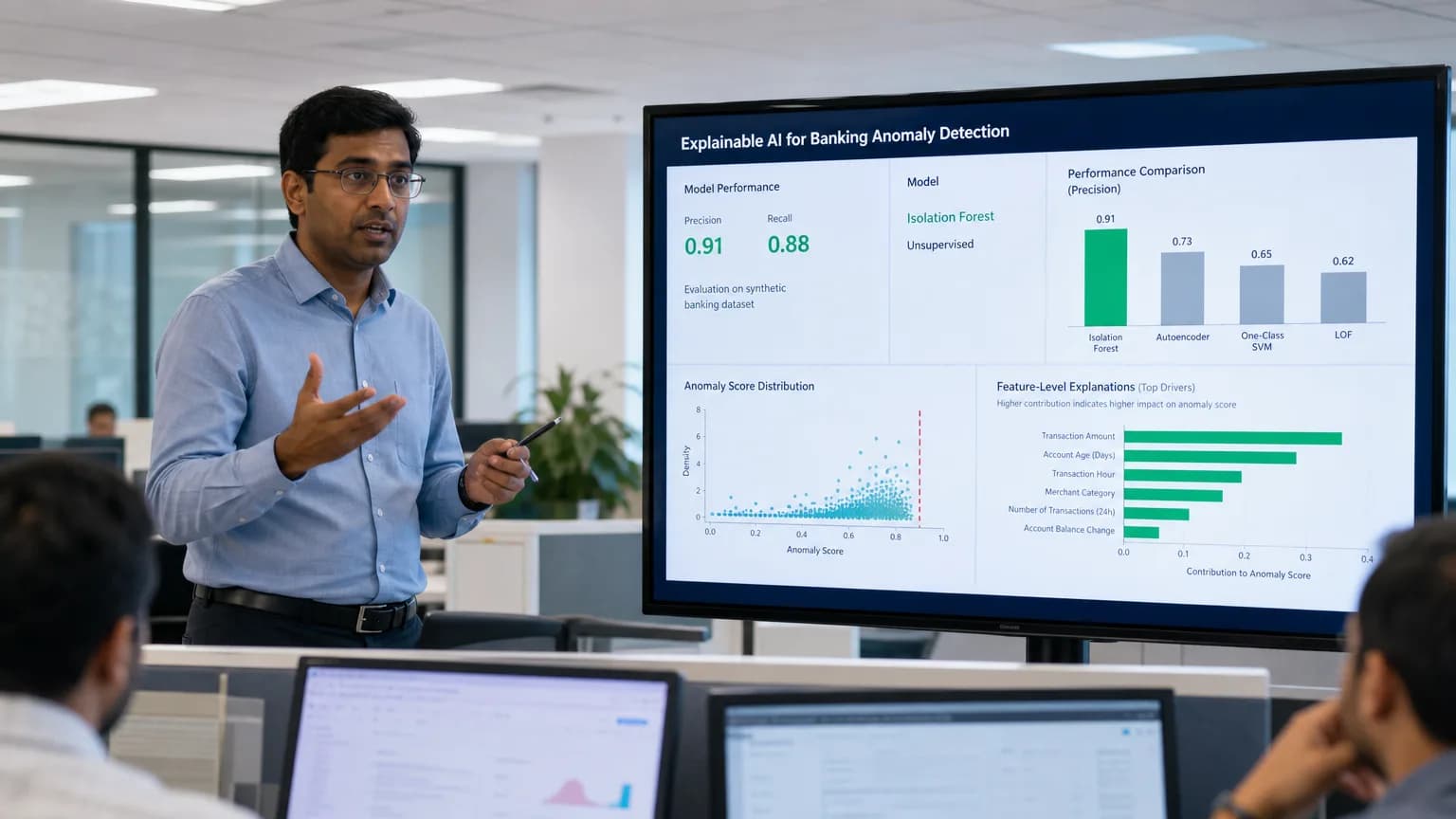
- The framework hit 0.91 precision and 0.88 recall on a synthetic banking dataset, beating three unsupervised baseline models
- A Streamlit dashboard translates model outputs into visual, feature-level explanations usable by auditors without ML expertise
- Expert reviewers reported higher decision confidence and quality when given feature-level explanations alongside anomaly scores
A research team has published a new explainable AI (XAI) framework designed to help bank auditors understand why a transaction gets flagged as suspicious, rather than simply trusting a black-box score. Detailed in a paper posted to arXiv (2607.13469), the system pairs an Isolation Forest (iForest) model for unsupervised anomaly scoring with an explanation layer that translates the model's output into feature-level reasoning a compliance officer can actually act on.
The core problem the paper tackles is familiar to anyone who has worked in financial crime monitoring: anomaly detection models are good at spotting outliers, but poor at explaining themselves. iForest, a widely used unsupervised technique, isolates unusual data points by measuring how quickly they can be separated from the rest of the dataset through random partitioning. It's efficient and doesn't require labeled fraud examples, which makes it attractive for banks where confirmed fraud cases are rare and hard to come by. The tradeoff has always been interpretability: analysts get a risk score, not a reason.
To close that gap, the framework layers explainability techniques on top of the iForest scores, breaking down which specific transaction features (amount, frequency, location, timing, and similar variables) contributed most to a flagged result. On a synthetic banking dataset built to simulate real-world transaction patterns, the system reported 0.91 precision and 0.88 recall, outperforming three unsupervised baseline models tested in the same study. Those numbers suggest the added explanation layer didn't come at the cost of detection accuracy, a common concern when interpretability features are bolted onto existing pipelines.
Built for the Audit Desk, Not the Data Science Team
Perhaps the more practically significant contribution is the delivery mechanism. The researchers built a Streamlit dashboard that presents the model's findings visually, aimed squarely at audit professionals who don't have a machine learning background. Rather than requiring auditors to interpret raw anomaly scores or SHAP-style plots unassisted, the interface surfaces the specific factors driving each alert in a format meant to fit into existing audit workflows.
The paper backs this design choice with expert feedback: auditors who reviewed the feature-level explanations reported measurably higher confidence in their decisions and, according to the researchers, made better-quality calls as a result. That kind of validation matters in a domain where false positives waste investigator time and false negatives carry regulatory and financial risk.
For banks under growing pressure from regulators to justify automated decision-making, tools like this address a real gap between detection performance and accountability. Unsupervised models have long been favored for fraud and anomaly work because labeled data is scarce, but regulators increasingly expect institutions to explain, not just detect, suspicious activity. This framework is a research-stage attempt to satisfy both requirements at once, though its performance so far has been demonstrated only on synthetic data rather than live production transactions.
Original reporting and research used to synthesize this article.
WAKIB Editorial Team
This review was prepared and summarized by the WAKIB AI intelligence engine and vetted by our editorial board for accuracy and reliability.
Subscribe to Newsletter
Get a weekly summary of the most promising AI research and tools delivered to your inbox.
Telegram Channel
Join our active community on Telegram for real-time tracking of AI models and trends.