
New Paper Extends Kolmogorov Complexity Theory to Symmetry Groups with a "Geometric Coding Theorem"
The Core · TL;DR
- A new arXiv paper, 'CAS I: A Geometric Coding Theorem,' launches a series on Computational Algorithmic Statistics, extending algorithmic information theory to symmetry groups.
- The authors introduce a 'symmetry prior,' proven to be a universal lower semi-computable semi-measure for fix-retractable symmetry groups.
- The paper's core result reproduces the classical Coding Theorem, which links algorithmic probability and complexity, inside a geometric, group-theoretic setting.
- Classified under Information Theory, AI, Category Theory, and Group Theory, the work sets a mathematical foundation for future papers applying symmetry-aware complexity measures.
A paper posted to arXiv under the title "CAS I: A Geometric Coding Theorem" opens what its authors describe as a new series on Computational Algorithmic Statistics, or CAS. Submitted on July 15, 2026 and catalogued as arXiv:2607.13796, the work tackles a narrow but foundational question in algorithmic information theory: how does complexity behave when the objects being measured carry symmetry?
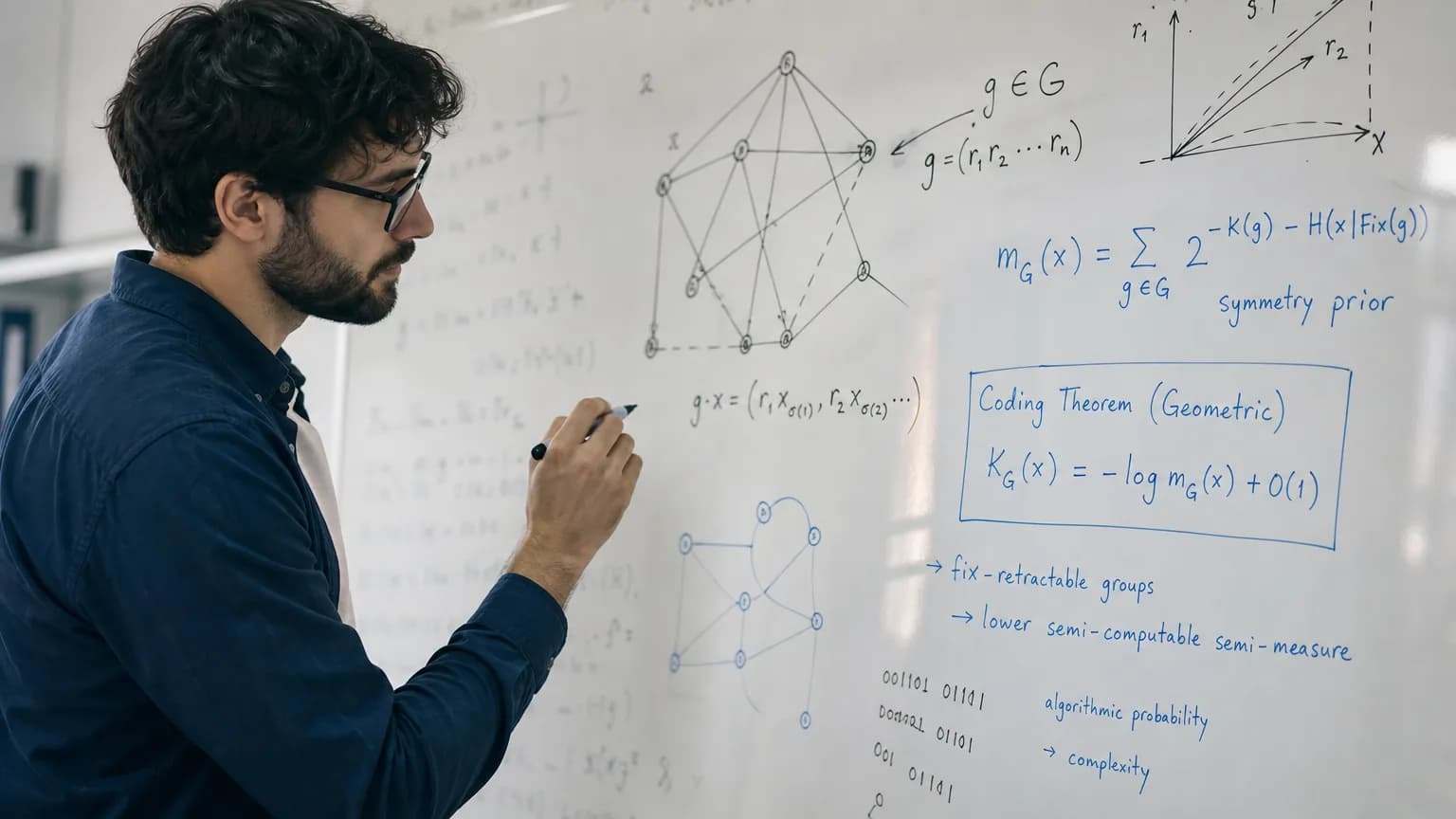
The paper's central contribution is the construction of a symmetry prior, which the authors prove is a universal lower semi-computable semi-measure for what they call fix-retractable symmetry groups. In plain terms, this is a mathematical device that assigns probabilities to structured objects based on how compressible they are, adapted specifically to account for symmetry rather than treating every object as an unstructured string. This matters because classical algorithmic information theory, built on Kolmogorov complexity and Solomonoff's universal prior, was never designed with symmetry groups in mind. Real-world data, from molecular structures to visual patterns to physical systems, is often riddled with symmetry that generic compression-based measures either ignore or handle clumsily.
Reviving the Coding Theorem in a Geometric Setting
The paper's namesake result, the Geometric Coding Theorem, is a direct analogue of the classical Coding Theorem from algorithmic information theory. The original theorem, a cornerstone result linking a string's algorithmic probability to its Kolmogorov complexity, established that objects easier to describe algorithmically are also more probable under a universal distribution. By reconstructing this relationship inside the algebraic framework of symmetry groups, the authors extend a decades-old pillar of the field into territory where group-theoretic and category-theoretic structure, not just raw description length, governs complexity.
The interdisciplinary reach of the paper is reflected in its arXiv classification, spanning Information Theory, Artificial Intelligence, Category Theory, and Group Theory. That spread signals an ambition beyond pure mathematics: the authors are positioning symmetry-aware complexity measures as tools with potential relevance to AI systems that need to reason about structured, symmetric data rather than arbitrary bitstrings.
Why This Could Matter Beyond Theory
Framing this as "CAS I" suggests the authors are laying a foundation rather than delivering a self-contained result. Algorithmic statistics, the discipline concerned with using compressibility to explain and predict data, has historically struggled to formalize how symmetry interacts with complexity in a principled way. If the CAS framework holds up under scrutiny and gets built out in subsequent papers, it could give researchers a rigorous vocabulary for describing why symmetric structures, from crystal lattices to neural network weight-sharing schemes, tend to be simpler and more probable than their asymmetric counterparts.
No contradictions or disputed claims have surfaced around this submission so far. Given the paper's early-stage, foundational nature, its real test will come as later entries in the CAS series attempt to apply the symmetry prior to concrete computational or statistical problems.
Original reporting and research used to synthesize this article.
WAKIB Editorial Team
This review was prepared and summarized by the WAKIB AI intelligence engine and vetted by our editorial board for accuracy and reliability.
Subscribe to Newsletter
Get a weekly summary of the most promising AI research and tools delivered to your inbox.
Telegram Channel
Join our active community on Telegram for real-time tracking of AI models and trends.