
New Benchmark Exposes a Blind Spot in AI Agents: Remembering to Do Things Later
The Core · TL;DR
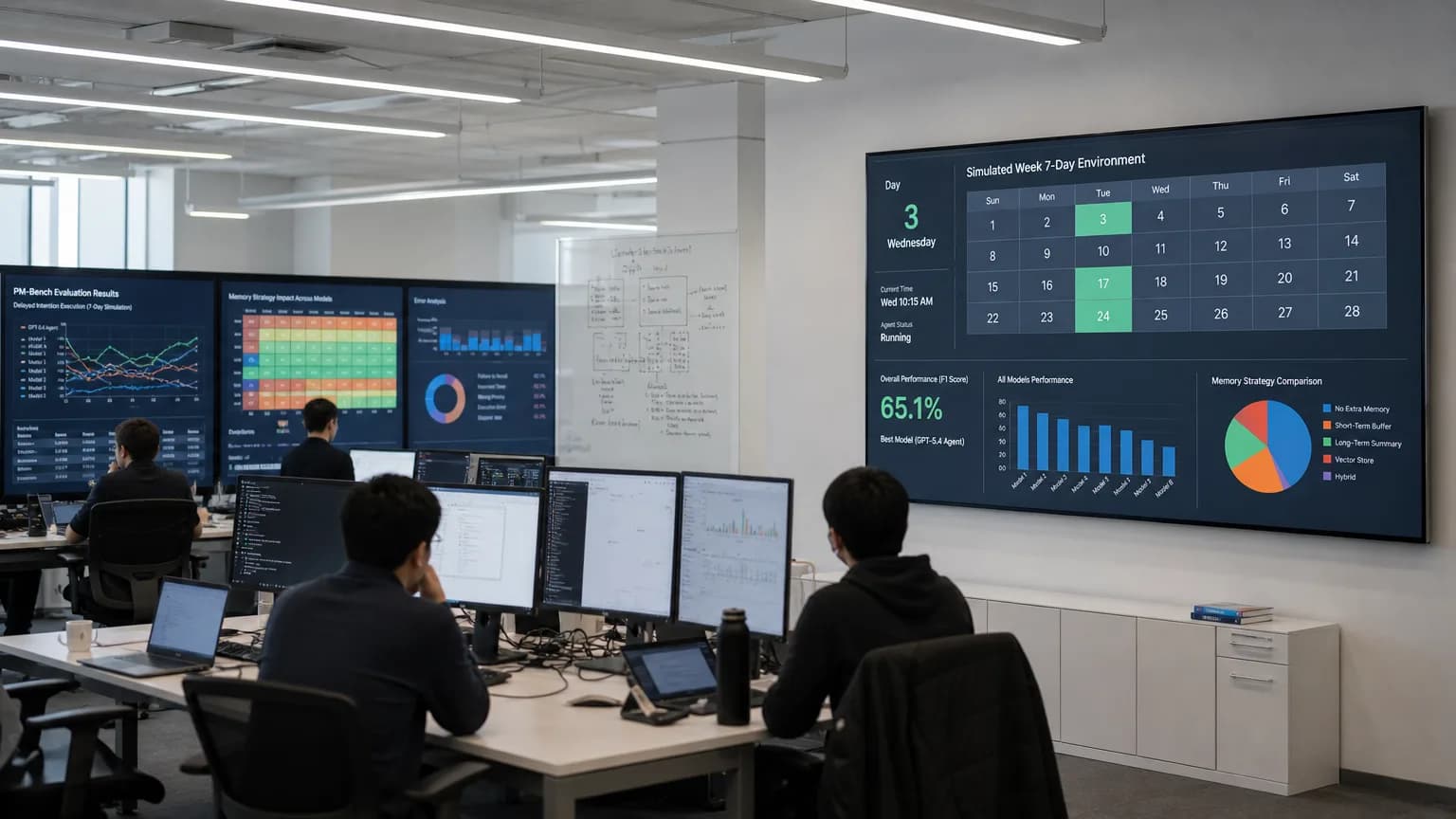
- PM-Bench, a new text-based benchmark inspired by cognitive science's Virtual Week paradigm, tests whether LLM agents can remember and execute delayed intentions over a simulated seven-day period.
- The best-performing system, a GPT-5.4 agent, achieved just 65.1% F1 score, highlighting a substantial gap in AI reliability for time-delayed tasks.
- Eight leading LLMs were tested across eight different agent configurations, and no single memory-boosting strategy worked consistently across all models.
- The paper was submitted to arXiv on July 14, 2026 and accepted at COLM 2026, adding a new evaluation dimension beyond standard fact-retrieval memory tests.
A GPT-5.4 powered agent, the strongest performer among eight state-of-the-art models tested, managed only a 65.1% F1 score on a new evaluation designed to measure whether AI systems can remember to act on plans they made earlier. The benchmark, called PM-Bench, targets a capability largely absent from existing LLM evaluations: prospective memory, or the ability to hold onto an intention and carry it out at the right future moment without being explicitly reminded.
The paper introducing PM-Bench was submitted to arXiv on July 14, 2026, and accepted as a conference paper at COLM 2026. Its design borrows from the "Virtual Week" paradigm, a well-established tool in cognitive science used to study how humans track delayed intentions over simulated stretches of time. PM-Bench adapts that structure into a text-based environment where an agent operates across a simulated seven-day week, tasked with keeping user goals active, executing time- or event-triggered actions when their conditions arise, and noticing when the environment shifts in ways that affect earlier commitments.
Why Memory Over Time Is Different From Memory of Facts
Most memory benchmarks for language models test retrieval: can the system recall a fact it was told, or find a needle buried in a long context window. PM-Bench probes something closer to executive function. An agent might be told to send a message once a certain event occurs, or to check back on a task after a delay, and then has to keep that commitment alive through several intervening turns filled with unrelated activity. Success requires not just remembering that something needs to happen, but recognizing when the trigger condition has actually been met, and adjusting if the environment has quietly changed in the meantime.
The researchers ran eight leading LLMs through eight distinct agent configurations, testing various strategies meant to boost this kind of memory, from explicit reminder scaffolding to structured note-taking approaches. None of them produced a consistent winner. The paper's authors report that no single method dominates across all the models tested, meaning gains from one technique on one model do not reliably transfer to another. That inconsistency suggests prospective memory failures are not caused by one fixable bottleneck but arise from a mix of factors specific to each model's architecture and training.
A Ceiling Well Below Human-Level Reliability
A 65.1% F1 score from the best-performing configuration, built on GPT-5.4, leaves a wide gap before agents could be trusted with unsupervised, multi-day responsibilities. For comparison, human performance on Virtual Week-style tasks tends to be considerably higher, even accounting for lapses. The result lands at a moment when AI labs are pushing agents toward longer-horizon, more autonomous roles, from scheduling assistants to multi-step task execution in enterprise software. PM-Bench's findings imply that the harder challenge isn't giving agents more context or bigger memory windows, but teaching them to act on the right thing at the right time without a human nudge.
The benchmark itself, now public alongside the COLM 2026 paper, gives the research community a concrete yardstick for this gap, and a likely target for the next wave of agent architecture experiments.
Original reporting and research used to synthesize this article.
WAKIB Editorial Team
This review was prepared and summarized by the WAKIB AI intelligence engine and vetted by our editorial board for accuracy and reliability.
Subscribe to Newsletter
Get a weekly summary of the most promising AI research and tools delivered to your inbox.
Telegram Channel
Join our active community on Telegram for real-time tracking of AI models and trends.