
MIT Taps AI-Physics Pioneer Jesse Thaler to Lead Its Nuclear Science Laboratory
The Core · TL;DR
- Jesse Thaler becomes director of MIT's Laboratory for Nuclear Science on August 1, 2026, succeeding Bolek Wyslouch after his decade-long tenure.
- Thaler is a theoretical particle physicist and the inaugural director of IAIFI, an NSF AI institute focused on artificial intelligence and fundamental interactions, since 2020.
- Mike Williams will succeed Thaler as IAIFI director, while IAIFI itself was just renewed for another five years of NSF funding.
- The move reflects LNS's evolution since 1946 from a nuclear and particle physics lab into a hub covering cosmology, gravity, field theory, and quantum information science.
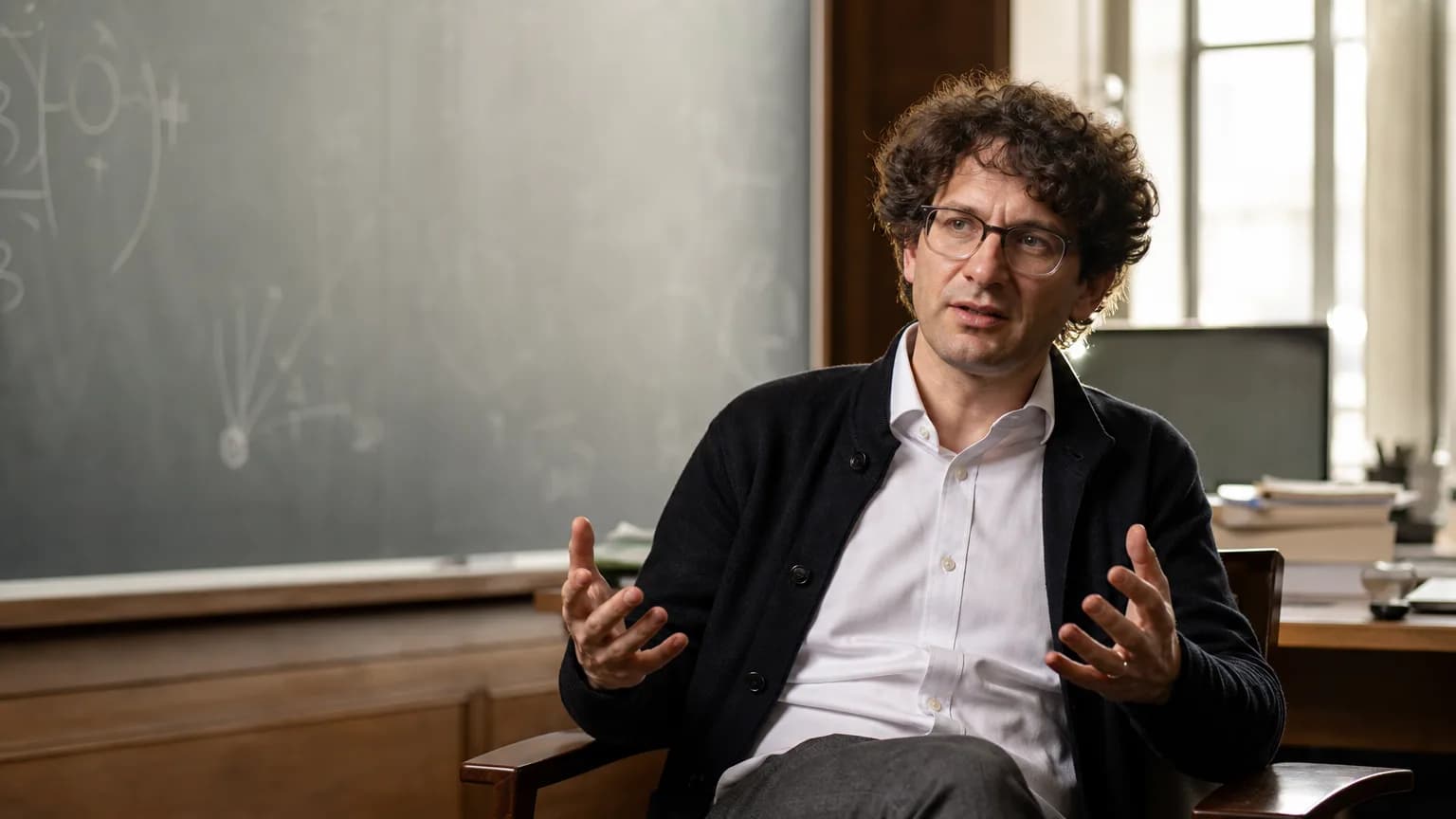
Jesse Thaler will take over as director of MIT's Laboratory for Nuclear Science on August 1, 2026, stepping into a role that has been held by Professor Bolek Wyslouch for the past decade. The appointment places a physicist known for blending quantum field theory with machine learning at the head of one of MIT's oldest and broadest research institutions.
Thaler currently holds the title of William and Emma Rogers Professor of Physics within the MIT Center for Theoretical Physics, itself a Leinweber Institute (CTP-LI) following what the Science Philanthropy Alliance has called the largest philanthropic gift ever made to theoretical physics. That donation from the Leinweber Foundation funded a broader network of theoretical physics institutes, of which MIT's center is now a part.
His background sits at the intersection of two disciplines that have increasingly converged over the past decade. As a theoretical particle physicist, Thaler has spent his career applying machine learning methods to problems in fundamental physics, an approach that has gained traction as particle detectors and cosmological surveys generate datasets too large and complex for traditional analysis alone. That dual expertise appears central to why MIT chose him for this post: LNS, founded in 1946 to advance nuclear and particle physics, has since expanded into cosmology, gravity, quantum field theory, and quantum information science, fields where computational and AI-driven techniques now play an outsized role.
Thaler's credentials in that space are well established. Since 2020, he has served as the inaugural director of the NSF AI Institute for Artificial Intelligence and Fundamental Interactions (IAIFI), a center that recently secured another five years of funding. Under his leadership, IAIFI launched a doctoral program spanning physics, statistics, and data science, run jointly with the MIT Institute for Data, Systems, and Society. That program reflects a broader push within physics departments to train researchers who can move fluidly between theoretical rigor and modern data science tooling.
As Thaler transitions to LNS, physics professor Mike Williams will take the reins at IAIFI, ensuring continuity for the institute's research agenda and its funding relationship with the National Science Foundation.
Thaler's own academic path traces a conventional but strong pedigree: a BS in math and physics from Brown University in 2002, followed by a PhD in physics from Harvard in 2006. His rise to director of LNS marks a notable moment for a field watching AI reshape how fundamental science gets done, placing someone fluent in both languages, physics and machine learning, at the helm of an institution whose scope now extends well beyond its original nuclear physics mandate.
The leadership change also underscores how thoroughly AI methods have permeated even the most traditional corners of experimental and theoretical science. LNS's expansion into quantum information and cosmology over the decades already signaled a widening remit; Thaler's appointment suggests that trajectory will continue, with computational and AI-native approaches likely to shape the lab's research priorities going forward.
Original reporting and research used to synthesize this article.
WAKIB Editorial Team
This review was prepared and summarized by the WAKIB AI intelligence engine and vetted by our editorial board for accuracy and reliability.
Subscribe to Newsletter
Get a weekly summary of the most promising AI research and tools delivered to your inbox.
Telegram Channel
Join our active community on Telegram for real-time tracking of AI models and trends.