
Inside Amazon's Warehouses, a Journalist Finds the Human Cost of "Efficient" AI
The Core · TL;DR
- FT journalist Sarah O'Connor's new book 'We Are Not Machines' investigates the human labor hidden behind AI and warehouse automation.
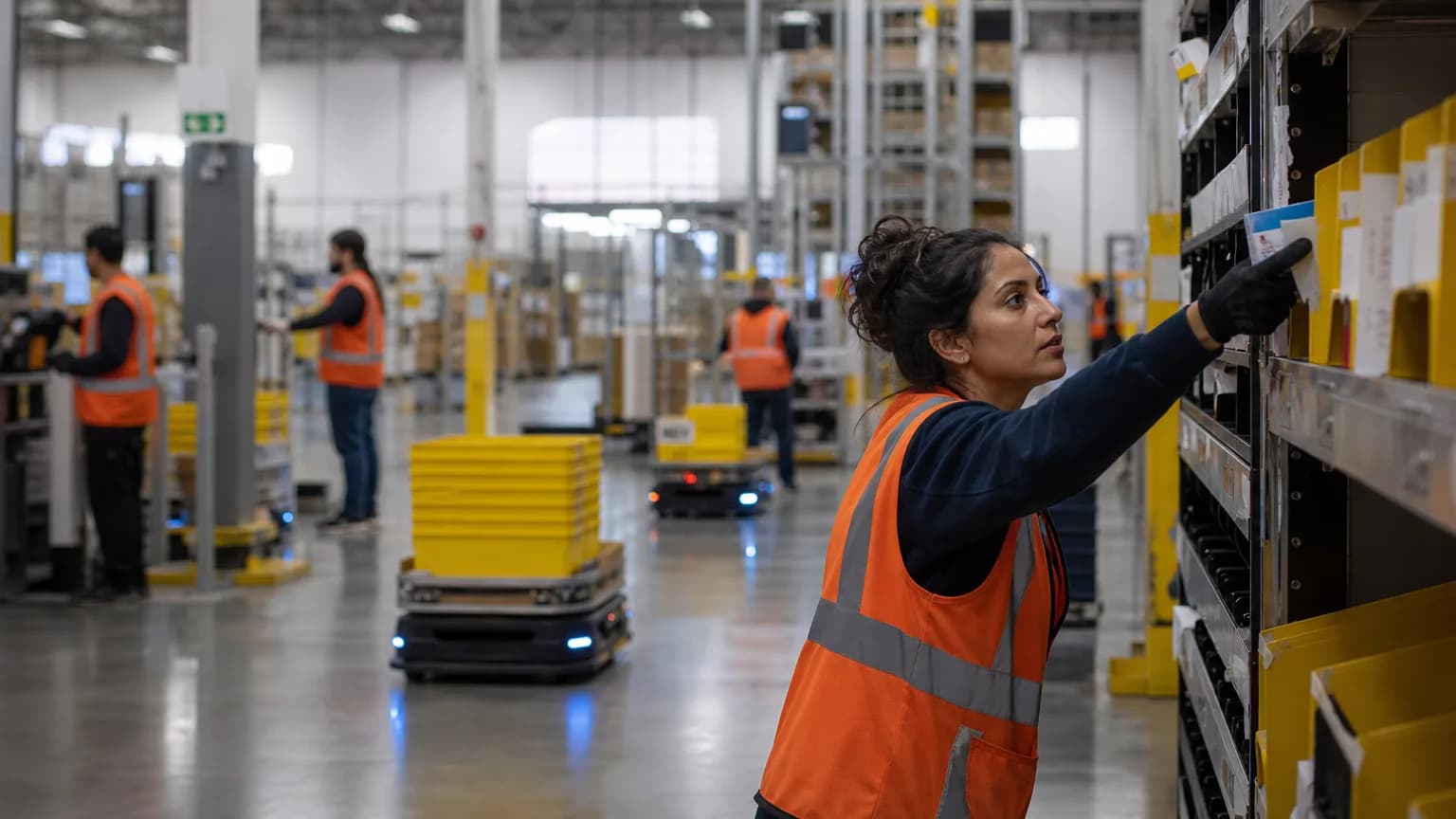
- At Amazon's EMA4 warehouse in Sutton Coldfield, robots and humans work together, but AI camera systems still require human verification.
- Remote workers in Costa Rica and India review up to 8,000 videos per nine-hour shift to audit the accuracy of Amazon's AI shelf-monitoring systems.
- The book's title echoes a 1969 Swedish miners' protest against workplace monitoring, drawing a parallel to today's AI-driven labor tracking.
Nine-hour shifts. Up to 8,000 video clips reviewed per week. Workers in Costa Rica and India staring at footage of Amazon shelves, checking whether the company's AI camera systems correctly logged what robots and humans put on them. That is one of the starkest images in "We Are Not Machines," a new book by Financial Times journalist Sarah O'Connor that examines what automation is actually doing to the people working alongside it.
O'Connor, a reporter at the FT for close to twenty years, builds her book around a simple but pointed title. It borrows from a 1969 protest by Swedish miners, who carried signs reading "Vi är ej maskiner" ("We are not machines") after their employer introduced new monitoring methods to track their output underground. More than half a century later, O'Connor argues, the underlying tension has not disappeared. It has just moved into warehouses, call centers, and the invisible backend labor that keeps AI systems accurate.
Watching the Robots, Watching the Watchers
Much of the book's reporting comes from O'Connor's visit to Amazon's EMA4 fulfillment center in Sutton Coldfield, England, where robots and human workers share the floor for picking and stowing inventory. The site is often held up as an example of efficient human-machine collaboration. But O'Connor's account complicates that framing by tracing what happens after the robots do their part: the AI vision systems monitoring shelves are not fully self-correcting, and their outputs still need human verification.
That verification work has been offshored to remote employees in Costa Rica and India, who spend their shifts reviewing thousands of video segments to catch errors the algorithms miss. It is a detail that reframes the popular narrative around warehouse automation. The robots may reduce certain physical tasks, but they also generate new, less visible forms of labor: repetitive, screen-based, and largely disconnected from the workers whose jobs the technology is meant to support.
A Labor Market Already Feeling the Strain
O'Connor's reporting lands against a backdrop of a cooling UK labor market. Job vacancies fell to a five-year low in June, a data point she uses to argue that the conversation about AI and automation can no longer be treated as speculative. Whether or not that vacancy dip is directly attributable to AI adoption, O'Connor treats it as evidence that the labor market is already adjusting to a world where software and robotics are absorbing more of the work traditionally done by people.
The book does not read as a rejection of automation itself. Instead, it presses on the question of dignity: who bears the cost of making these systems appear seamless, and how visible that cost remains to consumers and executives. The comparison to the 1969 miners' protest is deliberate. Monitoring technology, O'Connor suggests, has always provoked resistance not because workers oppose efficiency, but because they resent being reduced to inputs the machine watches rather than partners it serves.
For an industry preoccupied with model benchmarks and deployment speed, O'Connor's reporting is a reminder that AI systems still lean heavily on human labor to function reliably, and that labor is often the least discussed part of the pipeline.
Original reporting and research used to synthesize this article.
WAKIB Editorial Team
This review was prepared and summarized by the WAKIB AI intelligence engine and vetted by our editorial board for accuracy and reliability.
Subscribe to Newsletter
Get a weekly summary of the most promising AI research and tools delivered to your inbox.
Telegram Channel
Join our active community on Telegram for real-time tracking of AI models and trends.