
Graph Neural Network Hits 99% Accuracy Decoding Muscle Signals for Prosthetics in Real Time
The Core · TL;DR
- A graph neural network for real-time sEMG-based gesture recognition achieved 99% average classification accuracy in a new study.
- The full graph construction and prediction pipeline ran in just 48ms on an Apple M1 Pro CPU, suggesting feasibility for real-time, on-device use.
- Data was collected from 8 healthy subjects using a Myoband with 8 forearm electrodes, a relatively small test group.
- The system targets applications in advanced hand prosthetics and augmented reality gesture control.
Eight electrodes wrapped around a forearm, one lightweight graph neural network, and a 48-millisecond response time: that's the combination behind a new gesture recognition system aimed at hand prosthetics and augmented reality controls, detailed in a paper submitted on July 8, 2026.
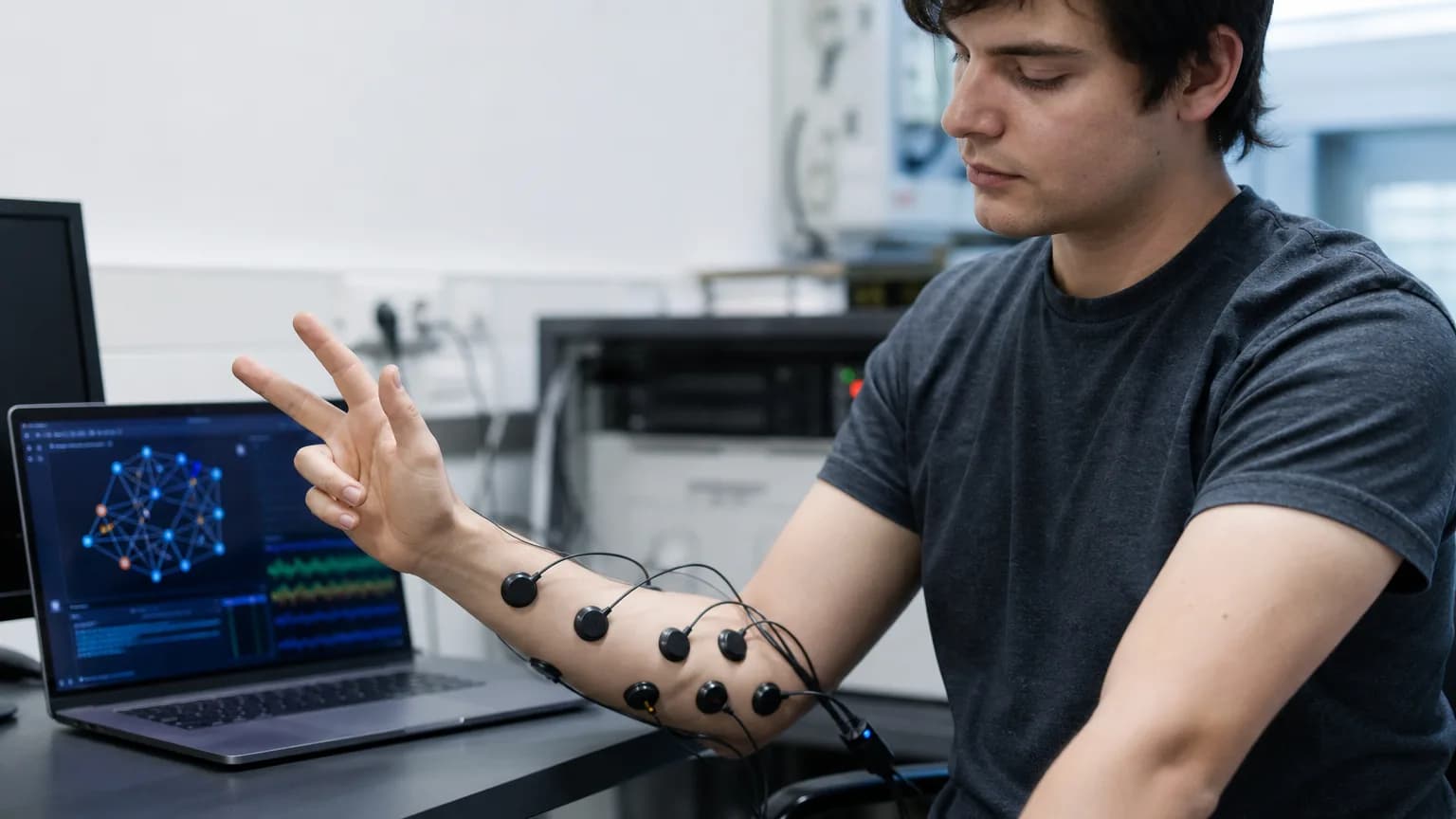
The research tackles a longstanding bottleneck in myoelectric control: turning raw surface electromyography (sEMG) signals into gesture predictions fast enough and accurately enough for someone to trust a prosthetic hand with everyday tasks. The team built their system around a Myoband sensor array with eight electrodes positioned around the forearm, collecting muscle activity data from eight healthy test subjects. Rather than feeding raw signal data into a conventional classifier, the researchers modeled the relationships between electrode channels as a graph, letting a graph neural network learn spatial dependencies between muscle groups as gestures are performed.
Why the Numbers Matter
The headline result is a 99% average classification accuracy across the tested gestures, a figure that puts the approach in competitive territory with some of the more computationally expensive deep learning pipelines used in prior sEMG research. What distinguishes this work is the speed at which that accuracy is achieved: both constructing the graph representation from incoming signal data and running the prediction took an average of just 48 milliseconds on an Apple M1 Pro CPU.
That number matters because it was measured on consumer-grade hardware rather than a specialized GPU cluster. For gesture recognition to be usable in a prosthetic hand or an AR headset, the entire pipeline needs to run locally, in real time, without draining a battery or requiring a tethered workstation. A 48ms latency figure suggests the model could plausibly run on embedded processors found in wearable devices, though the paper's benchmark was specifically tied to the M1 Pro rather than a lower-power microcontroller.
Beyond the Lab
The stated target applications extend past prosthetics into augmented reality, where gesture-based input is increasingly used for hands-free interaction with headsets and smart glasses. A system that can distinguish between hand gestures from muscle activity alone, without relying on cameras or handheld controllers, could offer a more discreet and physically unobtrusive input method for both fields.
The study's scope is still modest: eight subjects and a single sensor configuration is a small sample relative to the diversity of muscle anatomy, skin conditions, and electrode placement variability that real-world deployment would need to account for. Classification accuracy figures from controlled lab settings with healthy subjects also tend to be optimistic compared to performance in amputees, whose residual limb muscle activity can differ substantially from that of able-bodied users, an important caveat for a technology explicitly framed around prosthetic control.
Graph-based architectures have gained traction in recent sEMG research precisely because they can encode the physical layout of electrodes as structural information rather than treating each channel as an independent, unordered input. This paper's contribution sits within that broader trend, offering a data point on how far that architectural choice can push both accuracy and inference speed simultaneously.
Original reporting and research used to synthesize this article.
WAKIB Editorial Team
This review was prepared and summarized by the WAKIB AI intelligence engine and vetted by our editorial board for accuracy and reliability.
Subscribe to Newsletter
Get a weekly summary of the most promising AI research and tools delivered to your inbox.
Telegram Channel
Join our active community on Telegram for real-time tracking of AI models and trends.