
Google Vids Adds Personal AI Avatars, Turning Google Workspace Into a Video Studio
The Core · TL;DR
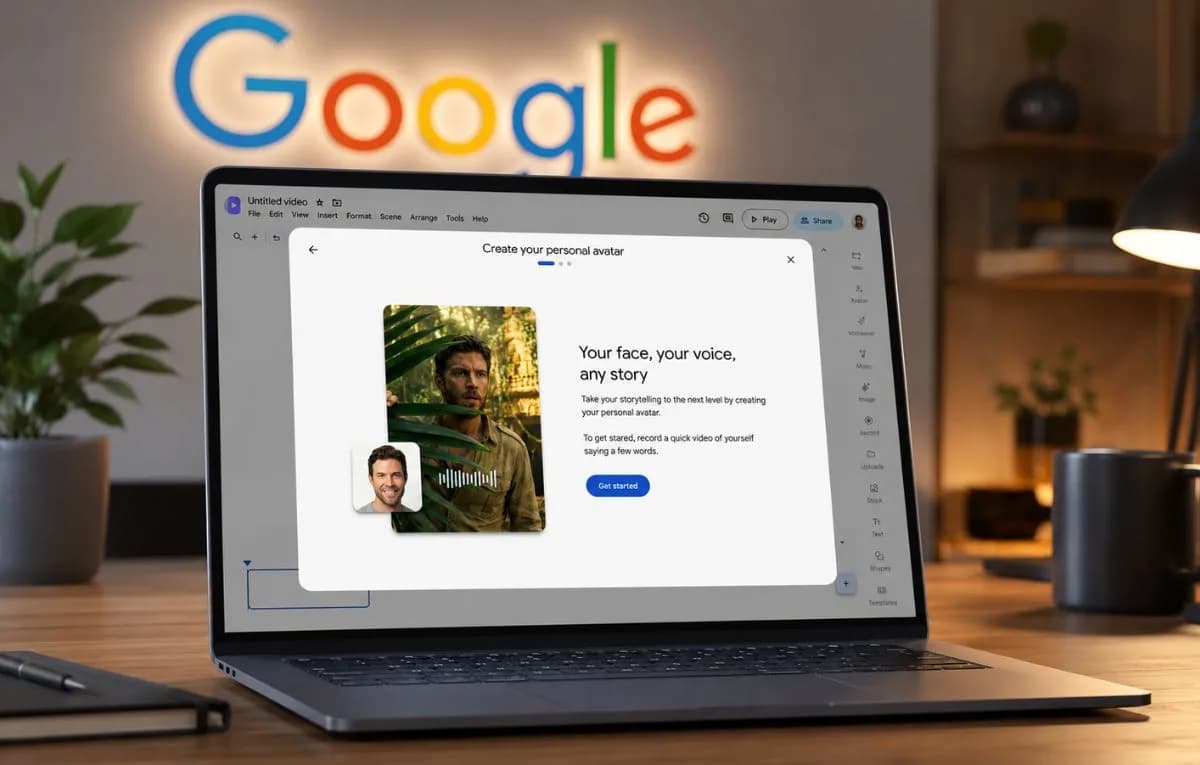
- Google Vids now lets users create a personal AI avatar cloning their face and voice from a selfie and voice sample, built on the Gemini Omni multimodal model.
- Avatars are locked to the account holder's own Google Account, age-restricted to 18+, and every generated or edited clip carries an invisible SynthID watermark.
- New editing tools include step-by-step video revisions without full regeneration, background swaps, smartphone lighting fixes, and visual effects.
- The update is aimed at Google Workspace enterprise customers for training and internal comms, putting Vids in direct competition with HeyGen, Synthesia, Captions, and D-ID.
Google is letting Workspace users clone themselves on camera. The company's latest update to Google Vids introduces personal digital avatars that replicate a user's face and voice from nothing more than a selfie and a short voice recording, folding a capability once reserved for specialized AI video startups directly into everyday office software.
The feature is powered by Gemini Omni, Google's multimodal model, which now sits at the core of Vids' video generation pipeline. Users can produce clips from text prompts or reference images, and rather than regenerating an entire video every time a change is needed, Gemini Omni supports sequential, step-by-step edits. That workflow shift matters for anyone producing longer-form content: swapping a scene, adjusting a line of dialogue, or tweaking a visual effect no longer means starting from scratch.
Beyond avatars, the update brings a set of production tools that would typically require dedicated editing software: background replacement, lighting correction for footage shot on smartphones, and applied visual effects. Combined with avatar generation, these additions push Vids well past its original scope as a lightweight, Slides-adjacent video tool.
Guardrails Built Around Identity
Google has attached clear restrictions to the avatar feature, evidently anticipating misuse concerns that have dogged AI likeness tools industry-wide. Avatars are tied to the user's own Google Account and can only replicate that account holder's appearance and voice, not anyone else's. Access is also age-gated, limited to users 18 and older in the regions where the feature is rolling out.
Every clip produced or modified through Vids carries an invisible SynthID watermark, Google's provenance system for flagging AI-generated media. That watermarking applies broadly, not just to avatar-based content, giving enterprises and platforms a built-in mechanism to trace synthetic footage back to its AI origin.
Aimed Squarely at the Enterprise
Google is positioning this rollout as a Workspace feature first, not a consumer novelty. The company frames the primary use cases around corporate communications: internal updates, employee training modules, and other recurring content that companies currently outsource to production teams or specialized platforms. A personal avatar that can deliver a scripted training video or company announcement, generated and revised without a camera crew, is a direct pitch to IT and HR departments already paying for Workspace seats.
That positioning also draws a competitive line. By baking avatar generation, voice cloning, and AI editing into a tool already bundled with Gmail, Docs, and Slides, Google is now competing head-on with HeyGen, Synthesia, Captions, and D-ID, companies that built their entire business around AI presenter videos. Those platforms will need to differentiate on production quality or specialized features, because Google's version comes at no additional cost to the millions of organizations already inside its Workspace ecosystem.
Original reporting and research used to synthesize this article.
WAKIB Editorial Team
This review was prepared and summarized by the WAKIB AI intelligence engine and vetted by our editorial board for accuracy and reliability.
Subscribe to Newsletter
Get a weekly summary of the most promising AI research and tools delivered to your inbox.
Telegram Channel
Join our active community on Telegram for real-time tracking of AI models and trends.