
FaceMesh2HPO Turns 2D Photos Into 3D Clinical Clues for Rare Genetic Disorders
The Core · TL;DR
- FaceMesh2HPO converts standard 2D facial photos into 3D meshes with 478 landmarks to detect phenotypic traits tied to genetic disorders.
- The framework was trained using annotations from 124 clinicians covering 10 disorders and 107 Human Phenotype Ontology (HPO) terms.
- A hierarchical PointNet-based classifier achieved AUROC scores between 0.55 and 0.89, performing better at broad parent categories than specific leaf terms.
- External validation revealed inconsistent generalizability across different disorders, highlighting the need for further refinement before clinical use.
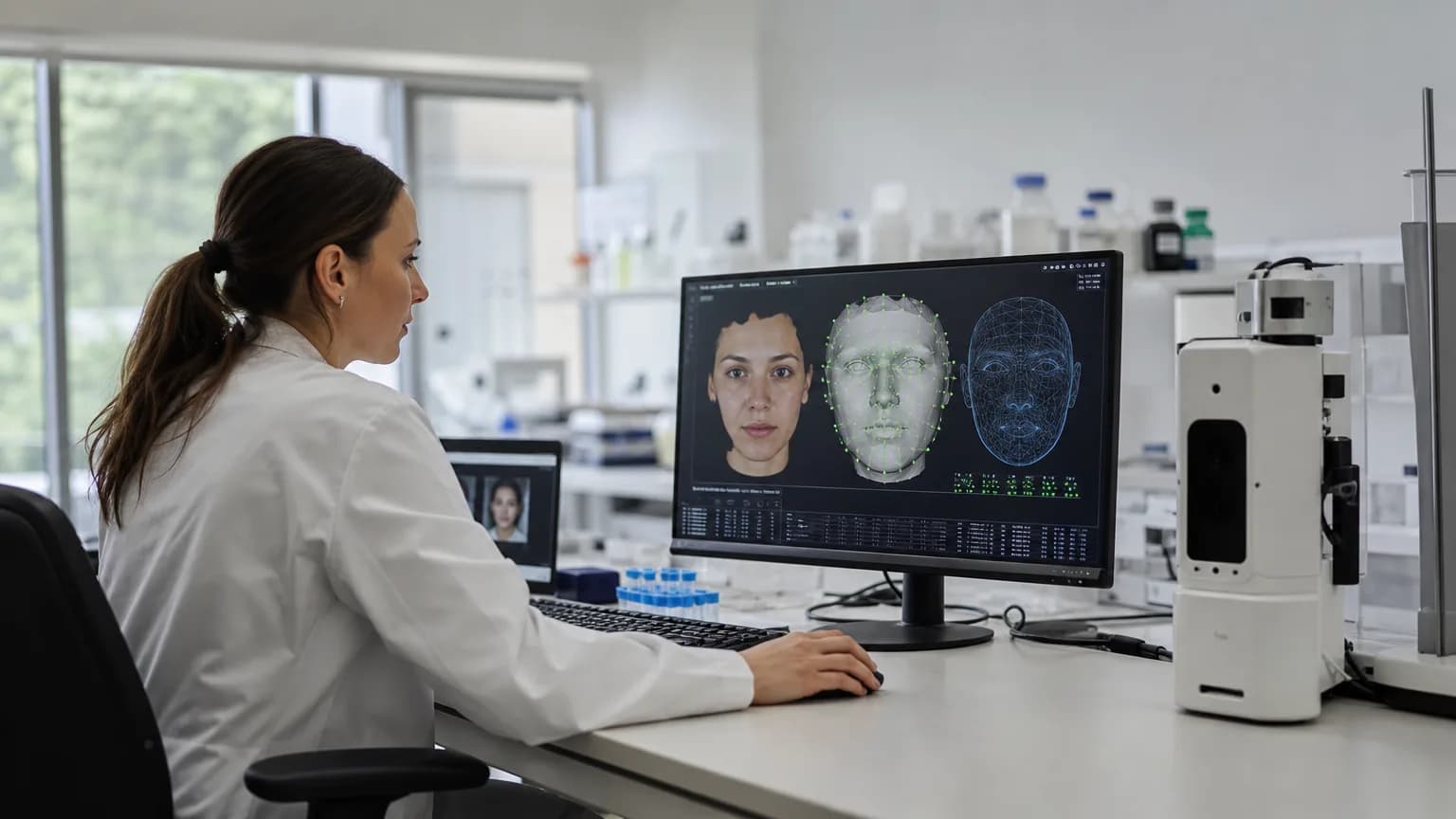
Researchers behind FaceMesh2HPO have built a machine learning pipeline that converts an ordinary 2D facial photograph into a 3D mesh capable of flagging phenotypic traits linked to genetic disorders, mapped directly onto the Human Phenotype Ontology (HPO) that clinicians already use for diagnosis.
The system reconstructs 478 facial landmarks per image, producing a dense 3D representation of a patient's face from a single photo. That mesh then feeds into a hierarchical PointNet-based classifier, which cascades through disorder categories while progressively eliminating irrelevant features before narrowing in on specific HPO terms. The goal is to give clinicians a decision-support tool that can point toward subtle craniofacial markers, the kind of signals experienced geneticists learn to recognize but that are easy to miss without specialized training.
Training and validating a model like this requires clinical-grade ground truth, not crowdsourced guesses. The team assembled annotations from 124 clinicians spanning 10 distinct disorders and 107 individual HPO terms, a scale of expert labeling that is unusual for facial phenotyping research and lends the dataset real diagnostic weight.
Mixed but Meaningful Results
The best-performing models reached AUROC scores ranging from roughly 0.55 to 0.89 depending on the specific term being predicted. That spread is telling: classification accuracy was consistently stronger at parent nodes in the HPO hierarchy (broader categories like "abnormal facial shape") than at the more granular leaf terms further down the tree. This pattern suggests the model is better at recognizing that something is phenotypically unusual than at pinpointing exactly which fine-grained trait is responsible, a limitation that mirrors challenges seen elsewhere in hierarchical medical classification.
External validation added another layer of nuance. When tested on data outside the original training distribution, generalizability varied significantly across the 10 disorders studied, with some conditions transferring well to new patient populations and others showing a notable drop-off. That inconsistency underscores a recurring issue in clinical AI: performance on a curated cohort doesn't always predict how a tool behaves on the broader, messier population it would eventually serve.
Why It Matters
Facial phenotyping has long been used informally in genetics clinics, where practitioners visually assess craniofacial features to narrow down suspected syndromes. FaceMesh2HPO's contribution is to formalize that process computationally, tying it to the HPO standard that already underpins much of clinical genomics informatics. If refined further, tools built on this approach could help flag candidates for genetic testing earlier, particularly in settings where specialist geneticists are scarce.
The paper, submitted to arXiv on July 6, 2026, positions this as an early-stage but structurally sound proof of concept rather than a deployment-ready diagnostic. The gap between parent-node and leaf-term accuracy, along with the uneven external validation results, signals where future work needs to focus: expanding disorder coverage, improving fine-grained term resolution, and stress-testing the model against more diverse populations before it could support real clinical decisions.
Original reporting and research used to synthesize this article.
WAKIB Editorial Team
This review was prepared and summarized by the WAKIB AI intelligence engine and vetted by our editorial board for accuracy and reliability.
Subscribe to Newsletter
Get a weekly summary of the most promising AI research and tools delivered to your inbox.
Telegram Channel
Join our active community on Telegram for real-time tracking of AI models and trends.