
China's Companion Robot Boom Hits a Human Problem, Not a Technical One
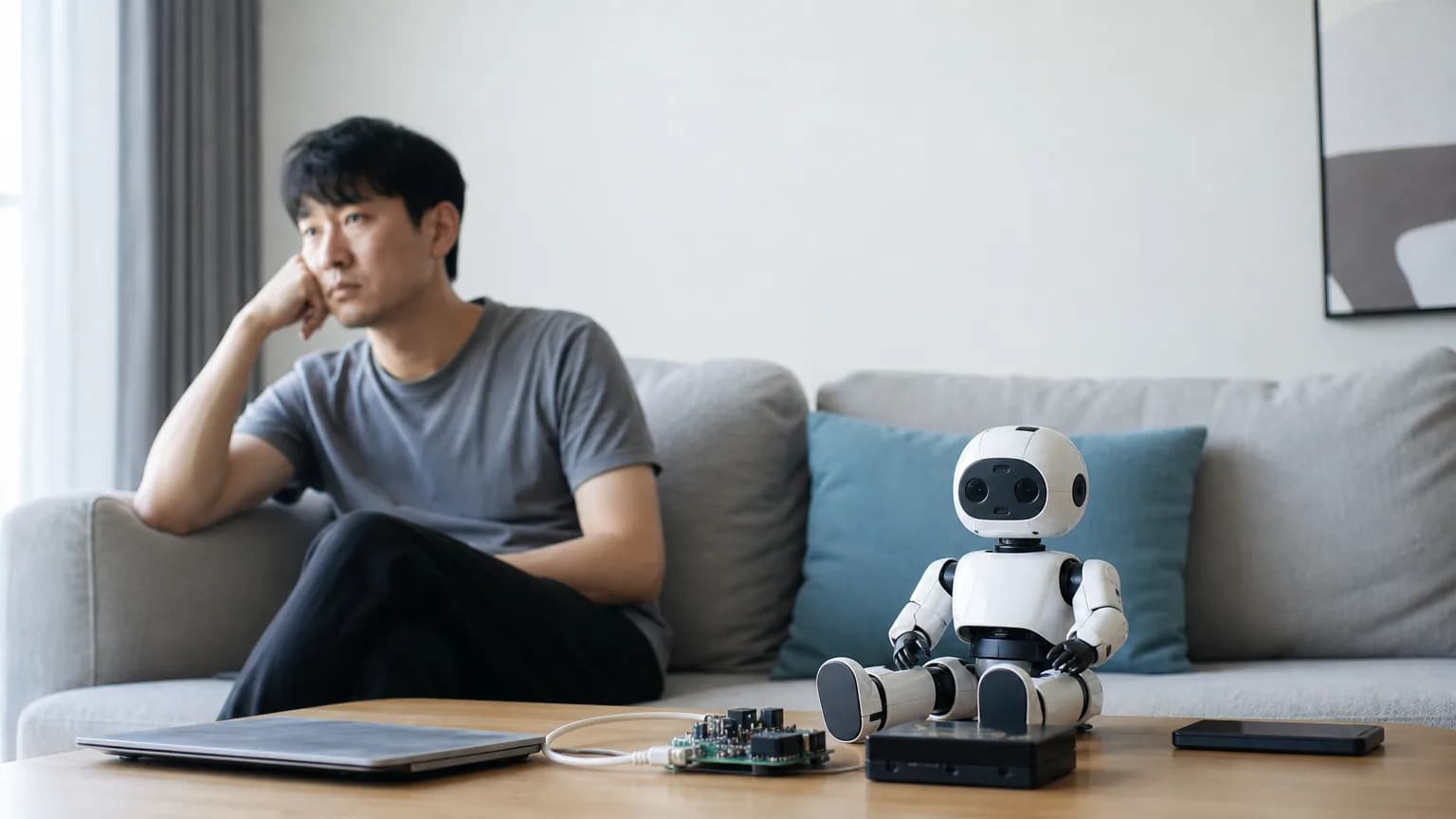
The Core · TL;DR
- Smart robot control units ('cores') now cost only a few dozen RMB to produce in Shenzhen, per Koumeng Technology founder Li Yulin, showing how commodified the underlying AI hardware has become.
- Despite cheap AI, companion robots suffer steep user disengagement by day 30 and return rates near 30%, suggesting the core problem is product design, not model quality.
- Industry voices say liability concerns, unclear user value, and poor household integration matter more to adoption than AI capability improvements.
- Major humanoid players (Unitree, Xpeng, Tesla, Figure AI) are betting on utilitarian labor-focused robots, while companion/intimacy-focused hardware, exemplified by UBTech's 88-DOF humanoid, remains a smaller niche.
The chips inside a companion robot in Shenzhen now cost a few dozen RMB, barely more than pocket change. According to Li Yulin, founder of Koumeng Technology, the "core" that powers voice recognition and AI decision-making in these devices has become almost trivially cheap to manufacture. Yet that commodification hasn't translated into products people actually keep using.
Industry insiders tracking China's companion robot sector point to a familiar pattern: users buy in with enthusiasm, then quietly stop engaging. Multiple product teams report that engagement falls off sharply by the 30-day mark, and return rates for some devices hover around 30 percent. That is a substantial failure rate for a consumer hardware category still trying to prove itself, and it's happening even as the underlying AI models get cheaper and more capable by the month.
The consensus among founders and investors discussing the space is that the bottleneck isn't the model. It's everything around the model. Product-market fit, a coherent reason for a device to earn a spot in someone's home, unresolved liability questions around robots that simulate intimacy or companionship, and the practical friction of integrating a semi-autonomous object into daily household routines all rank above raw AI performance as barriers to adoption. In other words, better language models and voice modules won't fix a product that people don't have a clear reason to keep.
A Fork in Humanoid Design Philosophy
That challenge sits in contrast to where the bulk of humanoid robotics investment is currently flowing. Companies like Unitree and Xpeng in China, alongside Tesla and Figure AI in the United States, are building toward utilitarian humanoids designed for labor, logistics, and industrial tasks rather than emotional companionship. The economics of that bet are more straightforward: a robot that can perform warehouse work or manufacturing tasks has a measurable value proposition from day one.
Companion and intimacy-focused robotics remain a smaller, more specialized niche by comparison. UBTech's humanoid, cited within China's AI hardware community as the benchmark for the adult and intimacy-focused segment, showcases 88 degrees of freedom and notably lifelike facial detailing, technical achievements that underscore how far actuator and materials engineering has advanced. But sophisticated hardware doesn't automatically solve the retention problem plaguing the category.
The takeaway from people building in this space is a sobering one for hardware startups betting purely on AI differentiation. Cheaper, more capable models lower the barrier to entry, but they don't address why a device earns a permanent place in someone's living room versus a drawer after 30 days. For companion robotics to move past its current churn problem, the fix looks less like a model upgrade and more like a rethink of what these products are actually for.
Original reporting and research used to synthesize this article.
WAKIB Editorial Team
This review was prepared and summarized by the WAKIB AI intelligence engine and vetted by our editorial board for accuracy and reliability.
Subscribe to Newsletter
Get a weekly summary of the most promising AI research and tools delivered to your inbox.
Telegram Channel
Join our active community on Telegram for real-time tracking of AI models and trends.