
How AI Agents Learned to Reason, Act and Observe
The Core · TL;DR
- ReAct, introduced in October 2022, defined the reason-act-observe agent loop that underlies most modern AI agents
- ChatGPT in November 2022 relied purely on next-token prediction and RLHF, with no built-in mechanism for taking actions mid-task
- Meta's Toolformer (Feb. 2023) showed tool use could be trained into model weights rather than only prompted
- Transformer co-inventor Lukasz Kaiser linked a late-2025 jump in agent effectiveness back to this ReAct-based loop
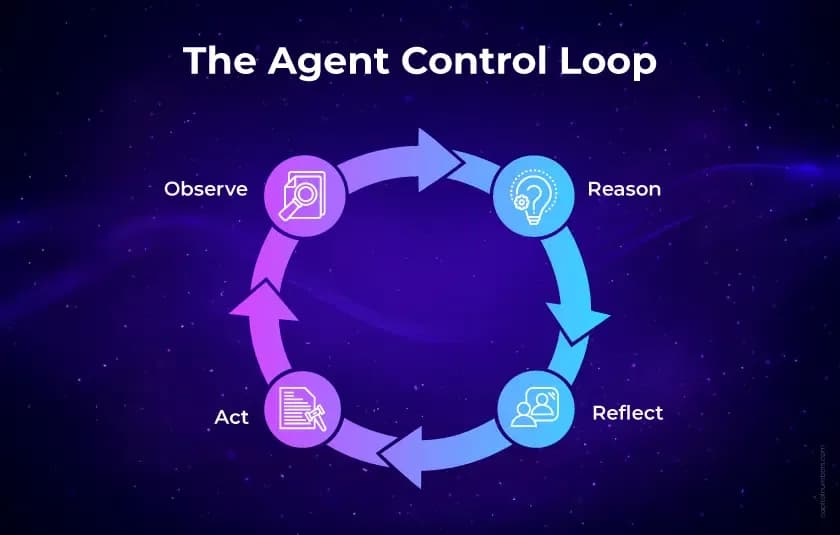
Ask an AI engineer what changed between the ChatGPT of late 2022 and the agents running today, and the answer usually comes down to a loop: reason, act, observe, repeat. That loop has a name, ReAct, and understanding it explains why today's AI agents behave so differently from the chatbots that came before them.
Where it started
In November 2022, the most advanced conversational AI available was ChatGPT, a system built on next-token prediction and refined through reinforcement learning from human feedback (RLHF). It could hold a conversation and follow instructions, but it had no built-in way to check a fact, run a calculation, or interact with the outside world mid-task. Everything it produced came from what it had already learned during training.
That same fall, researchers introduced ReAct, a prompting technique that gave models a structured way to interleave thinking with doing. Instead of generating a single answer in one pass, a ReAct-style agent reasons about what it needs, takes an action such as a search or a tool call, observes the result, and folds that observation back into its next reasoning step. The cycle repeats until the task is done.
From prompting trick to trained capability
ReAct started as a clever prompting pattern, something a developer could implement through careful instructions rather than a change to the underlying model. Meta's Toolformer, released in February 2023, pointed toward the next step: instead of only prompting a model to use tools, it showed that tool use could be trained directly into a model's weights.
That distinction matters for anyone building agents today. A prompted capability depends on the developer getting the instructions right every time and is only as reliable as the scaffolding around it. A trained capability becomes part of how the model behaves by default, which tends to produce steadier performance across a wider range of tasks without bespoke prompt engineering.
Why the loop still matters
Practitioners have pointed to late 2025 as a moment when agents built around this reasoning-acting-observing structure noticeably improved in effectiveness. Lukasz Kaiser, one of the researchers behind the original Transformer architecture, discussed this shift on the "Unsupervised Learning" podcast, tracing it back to the groundwork laid by ReAct and the tool-use training explored in work like Toolformer.
The agent loop of reason, act, observe, repeat is the structural idea that turned language models from answer generators into systems capable of completing multi-step tasks.
For engineers designing agentic systems, the practical takeaway is straightforward. The gap between a model that talks about a task and one that completes it is often not raw scale, but whether the architecture and training give it a real loop for gathering information, acting on it, and correcting course.
Original reporting and research used to synthesize this article.
WAKIB Editorial Team
This review was prepared and summarized by the WAKIB AI intelligence engine and vetted by our editorial board for accuracy and reliability.
Subscribe to Newsletter
Get a weekly summary of the most promising AI research and tools delivered to your inbox.
Telegram Channel
Join our active community on Telegram for real-time tracking of AI models and trends.