
Grok 4.5's Real Edge Isn't the Benchmark Score, It's the Bill
The Core · TL;DR
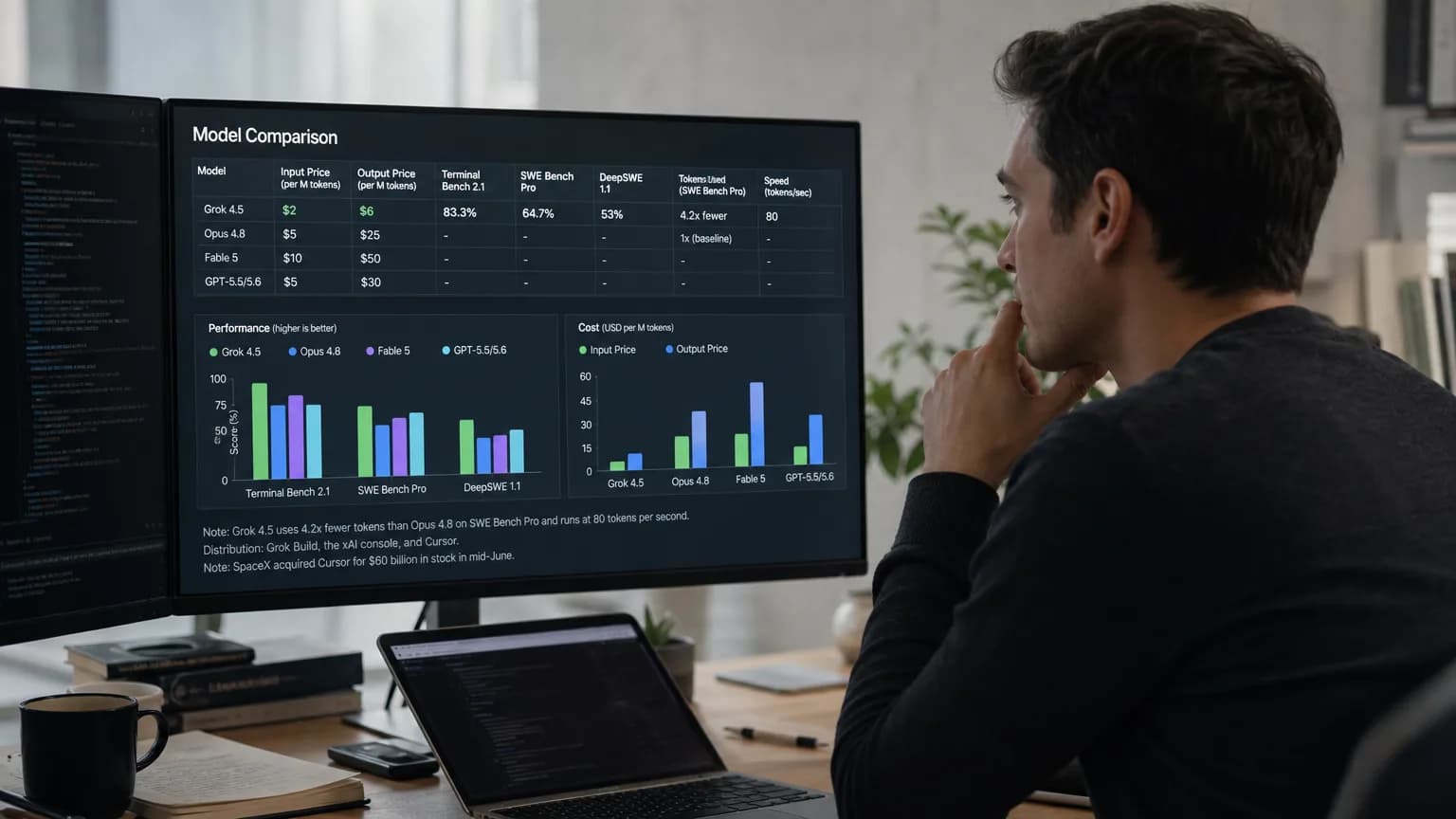
- Grok 4.5 prices in at $2/$6 per million input/output tokens, far undercutting Opus 4.8 ($5/$25), Fable 5 ($10/$50), and GPT-5.5/5.6 ($5/$30)
- The model scores 83.3% on Terminal Bench 2.1, 64.7% on SWE Bench Pro, and 53% on DeepSWE 1.1, competitive but not category-leading
- Grok 4.5 uses 4.2x fewer tokens than Opus 4.8 on SWE Bench Pro while running at 80 tokens per second
- Distribution runs through Grok Build, the xAI console, and Cursor, notable since SpaceX acquired Cursor for $60 billion in stock in mid-June
xAI's Grok 4.5 doesn't top every leaderboard it appears on, but it may be the cheapest way to get near the top. Trained on tens of thousands of Nvidia GB300 GPUs, the model lands at 83.3% on Terminal Bench 2.1, 64.7% on SWE Bench Pro, and 53% on DeepSWE 1.1, a spread that puts it in the same tier as rivals from Anthropic and OpenAI without leading any single category outright.
What sets Grok 4.5 apart shows up on the invoice. xAI prices the model at $2 per million input tokens and $6 per million output tokens. Anthropic's Opus 4.8 charges $5 and $25 for the same split. Fable 5 asks for $10 input and $50 output. OpenAI's GPT-5.5 and GPT-5.6 sit at $5 input and $30 output. On paper, Grok 4.5 costs a fraction of what its closest competitors charge for comparable agentic and coding work.
That gap widens once token efficiency enters the picture. On SWE Bench Pro tasks, Grok 4.5 consumes 4.2 times fewer tokens than Opus 4.8 to reach its results, while generating output at 80 tokens per second. Combine lower per-token pricing with fewer tokens needed per task, and the effective cost difference between Grok 4.5 and its priciest rivals stretches well beyond the headline rate card. For teams running high-volume agentic workloads, that compounding effect can matter more than a few points of accuracy on any single benchmark.
xAI is positioning the model squarely at coding, agentic pipelines, and knowledge-work automation, and it's shipping through Grok Build, the xAI console, and Cursor. The Cursor distribution channel is notable given the broader context: SpaceX acquired Cursor's parent company in mid-June for $60 billion in stock, tying xAI's flagship model to one of the most widely used AI coding environments through a corporate link rather than a simple API partnership.
Why Benchmark Gaps May Not Decide the Winner
The pattern emerging across Grok 4.5, Opus 4.8, Fable 5, and GPT-5.5/5.6 suggests the frontier model race is shifting away from pure capability contests. When scores cluster within single-digit percentage points of each other, cost per solved task and tokens burned per session become the more decisive metrics for engineering teams choosing a default model for production agents.
That's especially relevant for SWE Bench Pro and DeepSWE-style workloads, where agents make many sequential tool calls and revisions before closing an issue. A model that needs a quarter as many tokens to reach a comparable outcome changes the economics of running agents at scale, even if its raw accuracy trails by a few points on any given benchmark. xAI's bet with Grok 4.5 appears to be that throughput and price, not leaderboard supremacy, will determine which model developers actually build on.
Original reporting and research used to synthesize this article.
- 1Grok 4.5 is so cheap compared to Fable 5 and GPT 5.5 that benchmark gaps may not matter muchthe-decoder.com
- 2Task Decomposition-Guided Reranking for Adaptive Agent Skill Retrievalarxiv.org
- 3PluraMath: Extending Mathematical Reasoning Evaluation Beyond High-Resource Languagesarxiv.org
- 4Memory in the Loop: In-Process Retrieval as ExtendedWorking Memory for Language Agentsarxiv.org
- 5Decision Protocols in Multi-Agent Large Language Model Conversationsarxiv.org
- 6When Should LLMs Search? Counterfactual Supervision for Search Routingarxiv.org
- 7DT-Guard: Intent-Driven Reasoning-Active Training for Reasoning-Free LLM Safety Guardrailarxiv.org
- 8TurnOPD: Making On-Policy Distillation Turn-Aware for Efficient Long-Horizon Agent Trainingarxiv.org
- 9Beyond Static Evaluation: Building Simulation Environments for Scalable Agentic Reinforcement Learningarxiv.org
- 10Anthropic extends free Fable 5 access for subscribers as OpenAI's GPT-5.6 Sol heats up the pricing warthe-decoder.com
- 11PORTS: Preference-Optimized Retrievers for Tool Selection with Large Language Modelsarxiv.org
- 12Learning to Control LLM Agent Harnesses with Offline Reinforcement Learningarxiv.org
- 13Most LLM Conformity Needs No Speaker: Measuring the Speaker-Free Floor in Peer-Pressure Benchmarksarxiv.org
- 14Doomed from the Start: Early Abort of LLM Agent Episodes via a Recall-Controlled Probe Cascadearxiv.org
- 15AI-Model Network: Concept, Current State and Futurearxiv.org
- 16Benchmarking KV-Cache Optimizations across Task Quality and System Performance for Long-Context Servingarxiv.org
- 17PolyWorkBench: Benchmarking Multilingual Long-Horizon LLM Agentsarxiv.org
- 18Controlling Tool Use with Heading-Specific Activation Steeringarxiv.org
- 19From Passive Retrieval to Active Memory Navigation: Learning to Use Memory as a Structured Action Spacearxiv.org
- 20Onnes: A Physics-Grounded Multi-Agent LLM Simulator for Cryogenic Fault Diagnosis in Quantum Computing Infrastructurearxiv.org
- 21Self-Review Reinforcement Learning (SRRL) with Cross-Episode Memory and Policy Distillationarxiv.org
- 22Lean-Quantum: Toward AI-Assisted Formalization of Quantum Informationarxiv.org
- 23Prompt Robustness Is Task-Dependent: Comparing Objective and Belief-Style Questions in LLM Evaluationarxiv.org
- 24Copilot goes cheap as Microsoft phases out OpenAI and Anthropic models to cut coststhe-decoder.com
- 25Beyond the Leaderboard: A Synthesis of Tool-Use, Planning, and Reasoning Failures in Large Language Model Agentsarxiv.org
- 26Akashic: A Low-Overhead LLM Inference Service with MemAttentionarxiv.org
- 27Danus: Orchestrating Mathematical Reasoning Agents with Fact-Graph Memoryarxiv.org
- 28Information Gain-based Rollout Policy Optimization: An Adaptive Tree-Structured Rollout Approach for Multi-Turn LLM Agentsarxiv.org
- 29ChatGPT can now listen and talk at the same time, making AI conversations seem more humanthe-decoder.com
WAKIB Editorial Team
This review was prepared and summarized by the WAKIB AI intelligence engine and vetted by our editorial board for accuracy and reliability.
Subscribe to Newsletter
Get a weekly summary of the most promising AI research and tools delivered to your inbox.
Telegram Channel
Join our active community on Telegram for real-time tracking of AI models and trends.