
Arabic Dialects Challenge AI: Why Voice Assistants Struggle to Understand Gulf, Egyptian and Levantine Speech Like They Do English
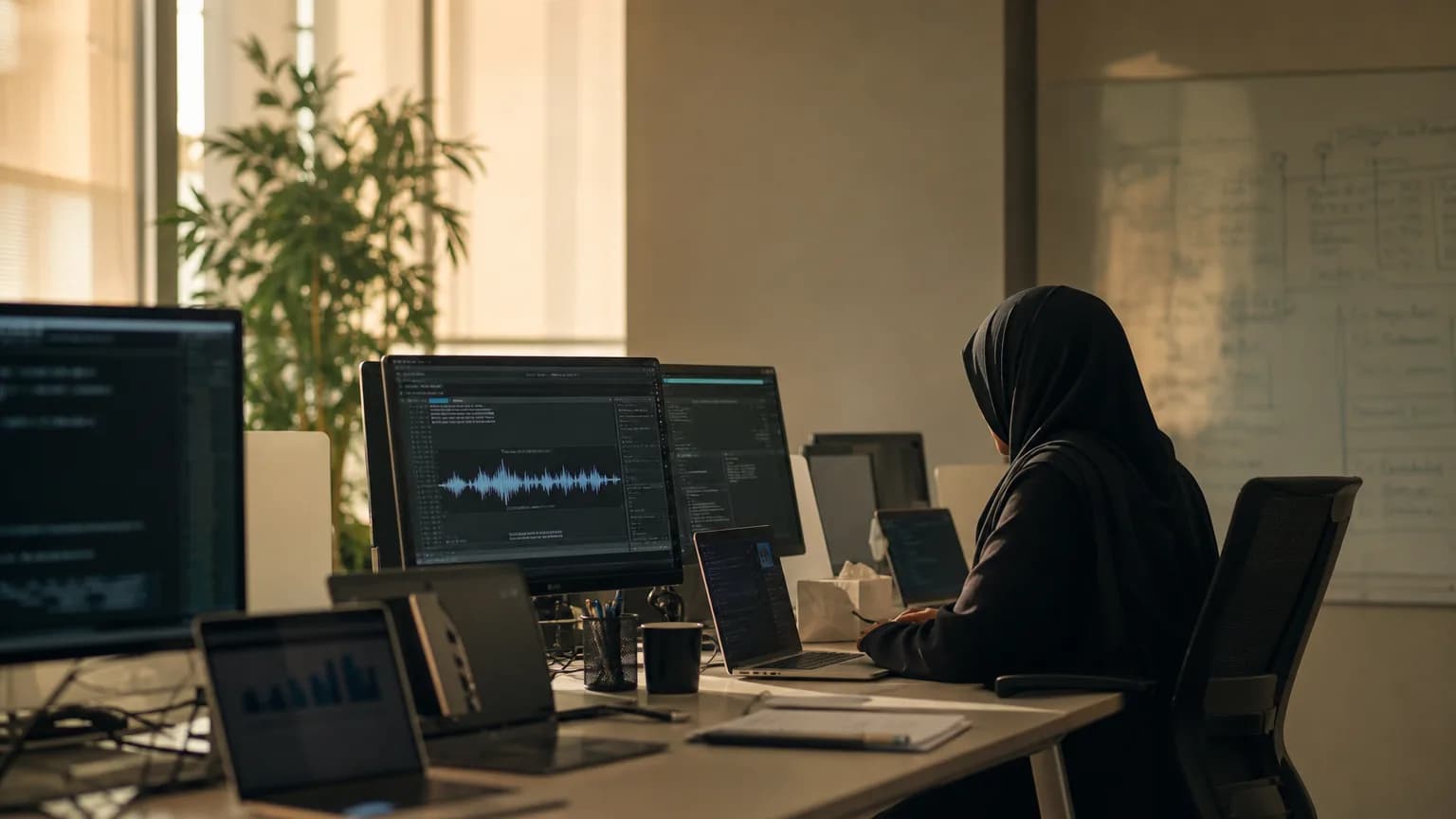
The Core · TL;DR
- Arabic speech recognition systems are trained primarily on Standard Arabic, making Gulf, Egyptian and Levantine dialects far more prone to errors despite being the language of actual daily communication.
- Current performance benchmarks often measure word error rates on scripted speech rather than spontaneous real-world conversation, potentially masking the true scale of the gap in everyday use.
- Companies such as Cohere, Speechmatics and Munassit, along with datasets like Casablanca, are making tangible progress in narrowing the gap through models and datasets tailored to Arabic dialects.
AI-generated voice
When an Arabic speaker talks to a smart voice assistant in their everyday dialect, whether Gulf, Egyptian or Levantine, the odds that the system will misunderstand them are far higher than for an English speaker. This is not just a fleeting impression but a documented phenomenon in Automatic Speech Recognition (ASR) research, rooted both in the nature of the Arabic language itself and in the data used to train these systems.
The Root of the Problem: Standard Arabic Versus Spoken Reality
Research shows that Modern Standard Arabic (MSA), the formal written form used in news broadcasts, dominates most of the training data available for AI systems. But this is not the form people actually speak in their daily lives. Models trained primarily on broadcast MSA run into real difficulties as soon as a natural conversation begins in a colloquial dialect.
Studies show that speech recognition clearly exposes the limits of current models, requiring further fine-tuning and adaptation to handle the diversity of spoken Arabic. This makes the gap between Arabic and English language processing more visible in this field than in almost any other.
Gulf, Egyptian, Levantine and Maghrebi dialects each carry vocabulary, sounds and pronunciation rhythms that differ significantly from one another and from Standard Arabic. Most commercial speech recognition systems are built primarily to support Standard Arabic, and they struggle to handle this rich dialectal diversity used in everyday life.
This gap has tangible market consequences. In a 2025 survey of organizations across the Gulf Cooperation Council countries, AI adoption rates rose from 62 to 84 percent, yet only 31 percent of these organizations said they had reached the stage of widespread deployment of such systems. In a separate survey conducted in the UAE, 92 percent of respondents said they preferred a smart assistant designed specifically for the Middle East over generic solutions.
What Do Performance Benchmarks Actually Measure?
Research evaluating Arabic speech recognition systems relies on a metric called Word Error Rate (WER), which simply measures the percentage of spoken words the system fails to recognize correctly. Published benchmarks consistently show that error rates for Arabic dialects are higher than for Standard Arabic, even when testing the same model on both.
However, researchers point to an important gap in the evaluation methods themselves. Benchmarks often test a model's ability to generalize across multiple dialects without being specifically trained on them beforehand, known as zero-shot generalization. But they tend to focus on scripted, structured speech rather than spontaneous, real-world conversation, meaning actual performance in daily use could be worse than laboratory figures suggest.
Among the most prominent evaluation tools is a general benchmark that tests models' generalization ability across six test sets covering Standard Arabic along with Egyptian, Gulf, Levantine and Maghrebi dialects simultaneously.
Who Is Trying to Close the Gap?
A number of companies and research labs have begun investing specifically in improving recognition of Arabic dialects. In July 2026, Cohere announced that its "Cohere Transcribe Arabic" model achieved the lowest average word error rate among open-source models on the Hugging Face leaderboard for Arabic speech recognition, scoring 25.87, an improvement of 2.45 points over the previous leading model. Human reviewers also preferred this model over the well-known Whisper model in 96 percent of tests.
In March 2026, Speechmatics launched a bilingual Arabic-English medical model that achieved a word error rate of 6.3 percent in mixed-speech tests, a 35 percent improvement over its closest competitor in recent benchmarks.
Infobip's recent experiments indicate that Arabic chatbots and voice assistants often need greater human supervision in their early stages compared to English-language systems, but their accuracy and user satisfaction rise sharply after retraining on proprietary regional conversational data, including Gulf dialects. Along similar lines, the company Munassit is engineering dialect-specific models built on training that prioritizes Gulf speech first, then expands to cover multiple Arabic dialects, rather than relying on a single Arabic model assumed to suit everyone.
Some of the most concrete progress has come from the region itself. Munsit, built by the UAE-based CNTXT AI, is an Arabic-first speech recognition model trained on roughly 30,000 hours of Arabic audio: pretrained on 15,000 hours of weakly labelled speech spanning Modern Standard Arabic and its dialects, then refined through continual supervised fine-tuning on a smaller, hand-checked set. In work published as part of the NADI 2025 shared task, it reported a word error rate of 26.68 percent across six Arabic benchmarks (SADA, Common Voice 18.0, MASC in both clean and noisy conditions, MGB-2 and Casablanca), ahead of the general-purpose systems most products still default to, including OpenAI’s Whisper and Meta’s SeamlessM4T. The platform states support for more than 25 dialects, among them Khaleeji, Emirati, Najdi and Hijazi, and pairs the recognition model with an Arabic text-to-speech system, Faseeh.
On the data front, the "Casablanca" initiative stands out, a dataset comprising roughly 48 hours of audio recordings covering eight Arabic dialects from the Levant, the Gulf, Yemen and North Africa, in an effort to provide training material that better represents the actual linguistic diversity of Arabic.
Despite these accelerating efforts, disparities in dialect recognition quality persist. Research indicates that fully closing this gap will still require more diverse training data and evaluation standards that more closely reflect the real, everyday use of the Arabic language.
WAKIB Editorial Team
This review was prepared and summarized by the WAKIB AI intelligence engine and vetted by our editorial board for accuracy and reliability.
Subscribe to Newsletter
Get a weekly summary of the most promising AI research and tools delivered to your inbox.
Telegram Channel
Join our active community on Telegram for real-time tracking of AI models and trends.