
Anthropic Launches 'Reflect', a Usage Dashboard That Turns Claude Habits Into Data
The Core · TL;DR
- Anthropic launched 'Reflect' in beta on July 9, 2026, a dashboard that visualizes how users interact with Claude over 1, 3, 6, or 12-month periods.
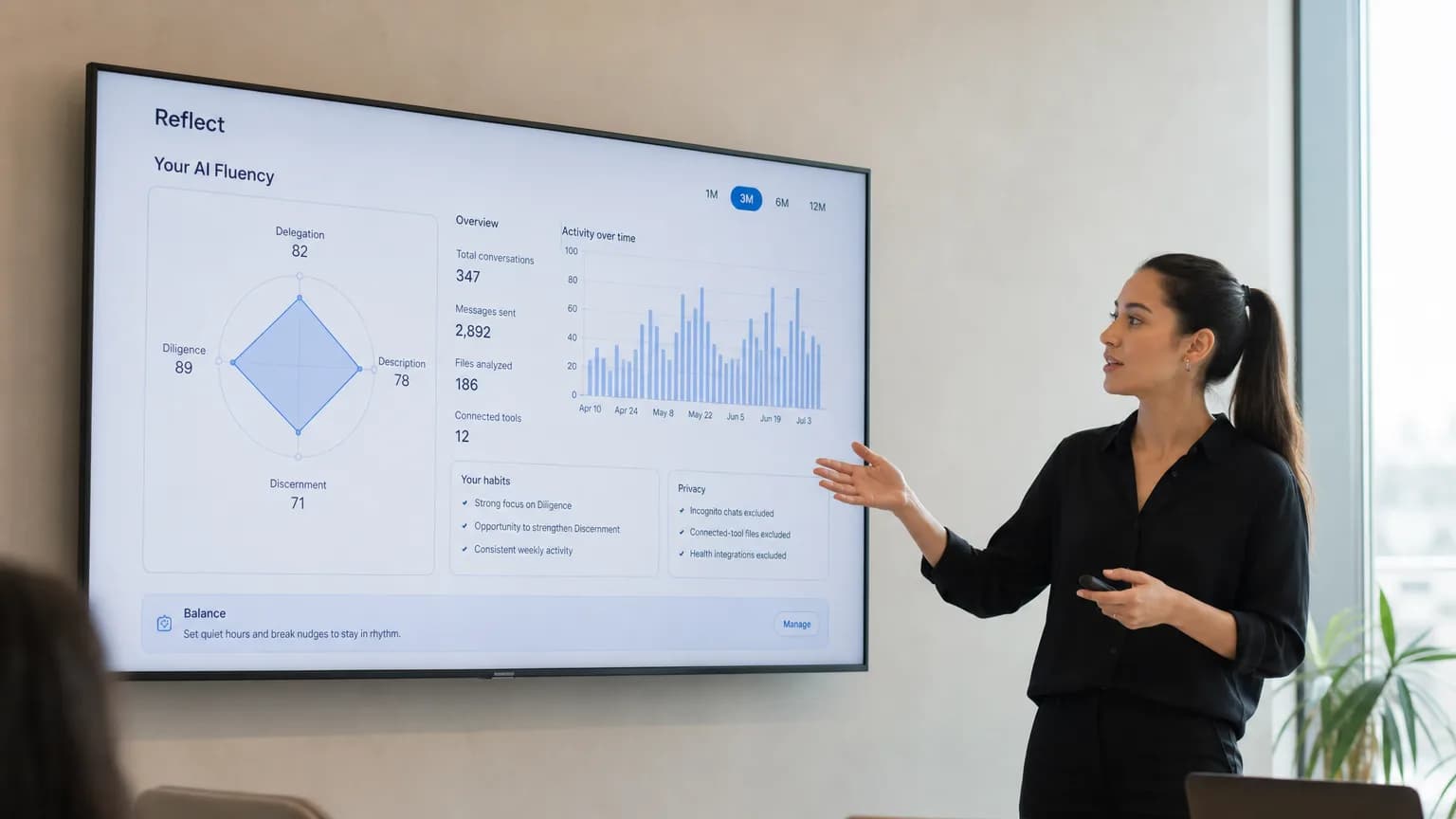
- The feature introduces a '4D AI Fluency Framework' (Delegation, Description, Discernment, Diligence) to assess prompting quality, not just usage volume.
- Reflect excludes incognito chats, connected-tool files, and health-integration conversations from its analytics for privacy.
- Users can also set quiet hours and break nudges, and MacRumors compared the feature to Spotify Wrapped.
Anthropic wants users to see themselves the way Claude sees them. On July 9, 2026, the company rolled out a beta feature called Reflect, a personal analytics dashboard that shows people exactly how they've been using the chatbot over time.
Reflect lives inside Settings on Claude's web and desktop apps, and it works something like a productivity mirror. Users can pull up activity summaries covering the last 1, 3, 6, or 12 months, revealing patterns such as peak usage hours and the kinds of tasks they've been offloading to the model. It's the sort of retrospective slice-and-dice that MacRumors likened directly to Spotify Wrapped, except instead of your most-played songs, you get a breakdown of your relationship with an AI assistant.
The centerpiece of Reflect is what Anthropic calls the 4D AI Fluency Framework, a rubric built around four categories: Delegation, Description, Discernment, and Diligence. Rather than just counting messages sent, the framework appears designed to help users evaluate the quality of their prompting and judgment, essentially grading how effectively someone collaborates with Claude rather than just how often they open the app.
Guardrails Baked Into the Design
Anthropic has clearly anticipated the privacy concerns that come with any tool that logs and visualizes personal AI usage. Incognito chats are excluded entirely from Reflect's insights, as are any underlying files pulled in through connected third-party tools. Conversations tied to health-related integrations are walled off as well, keeping sensitive medical context out of the dashboard's analytics.
The feature also leans into wellness territory. Users can configure quiet hours or set up nudges that prompt a break after a certain stretch of continuous use, features that echo screen-time tools already common on phones and social platforms. That framing suggests Anthropic is positioning Reflect not just as a novelty metrics screen, but as a lightweight self-regulation tool for people who might be leaning on Claude more than they realize.
Why It Matters
The launch lands at a moment when AI companies are increasingly scrutinized over how their products affect user behavior and attention. By building usage transparency and break reminders directly into Claude, Anthropic is making a visible bet that engagement metrics and user wellbeing don't have to be at odds, at least publicly. Whether Reflect meaningfully changes how people interact with the assistant, or simply becomes a curiosity people check once and forget, will depend on how deeply Anthropic integrates it into the core product experience beyond this initial beta.
For now, Reflect gives Claude users something most chatbot interfaces have lacked: a structured, retrospective view of their own AI habits, wrapped in a framework that tries to measure skill rather than just screen time.
Original reporting and research used to synthesize this article.
WAKIB Editorial Team
This review was prepared and summarized by the WAKIB AI intelligence engine and vetted by our editorial board for accuracy and reliability.
Subscribe to Newsletter
Get a weekly summary of the most promising AI research and tools delivered to your inbox.
Telegram Channel
Join our active community on Telegram for real-time tracking of AI models and trends.