
A Water-Filling Rule for Multi-Agent AI: New Paper Tightens the Math Behind Learned Communication Graphs
The Core · TL;DR
- HIBCG (Heterogeneous Information-Bottleneck Coordination Graphs) is a new method for learning sparse communication graphs in cooperative multi-agent reinforcement learning, posted to arXiv on May 17, 2026 and revised July 10, 2026.
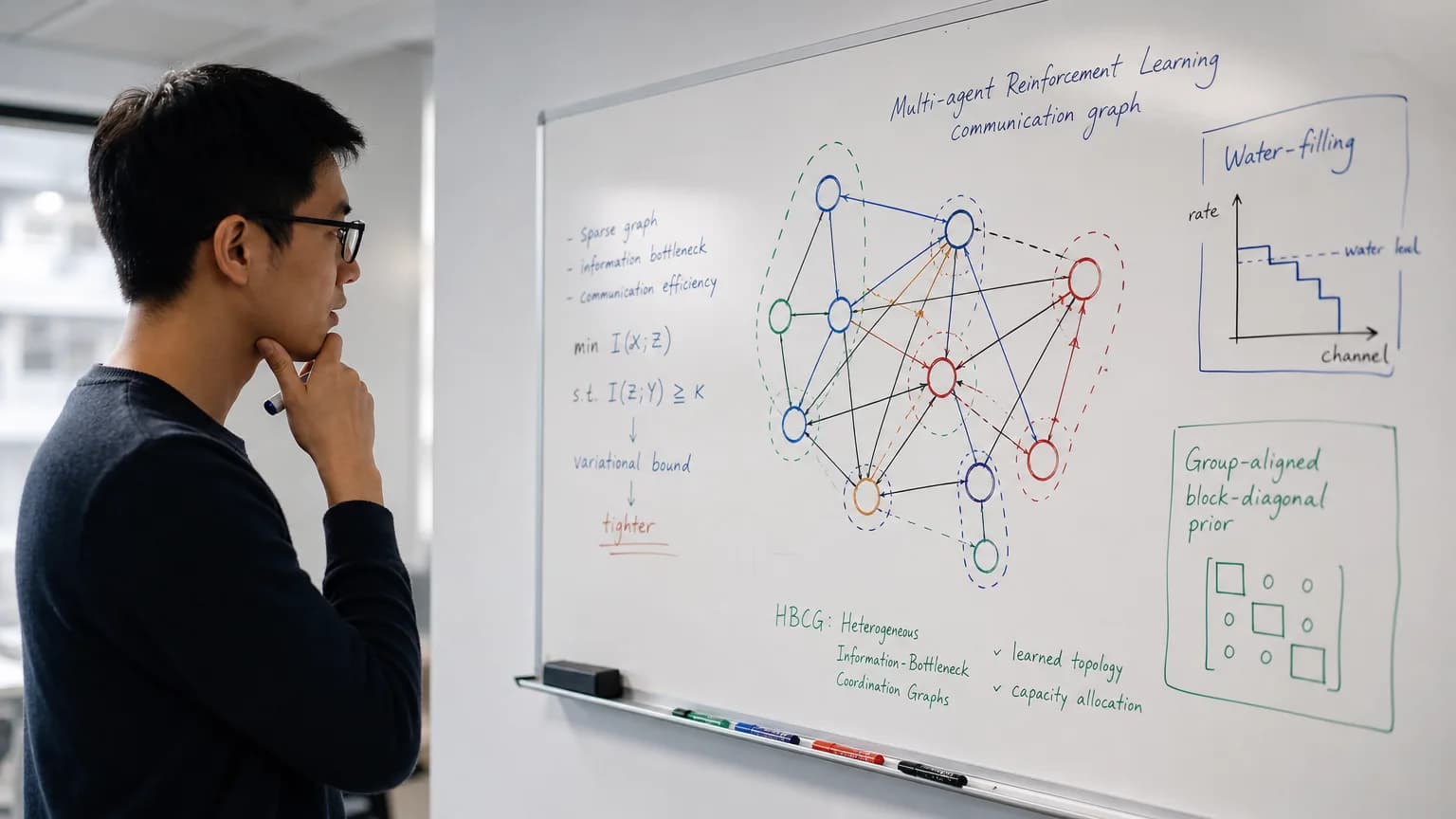
- The paper proves that its group-aligned block-diagonal prior strictly tightens the variational bound on topology learning, giving theoretical justification for which agent-to-agent edges to keep.
- It also shows that message capacity allocation across the learned graph follows a water-filling principle, borrowed from classical information theory.
- Author Wei Duan classifies the work under AI, Machine Learning, and Multiagent Systems on arXiv; no contradictions were found in the reporting.
Wei Duan's latest paper doesn't propose a flashier multi-agent architecture. Instead, it does something rarer in the crowded field of cooperative reinforcement learning: it proves why a particular design choice works, rather than just showing that it does.
The paper, titled "HIBCG" for Heterogeneous Information-Bottleneck Coordination Graphs, was first posted to arXiv on May 17, 2026, and revised on July 10, 2026. It tackles a problem that sits at the core of every multi-agent system where robots, drones, or software agents need to decide who talks to whom. Full connectivity between agents is expensive and often unnecessary; sparse, learned communication graphs are more efficient, but most existing methods pick their edges heuristically, with little theoretical grounding for why a given sparsification pattern should be optimal.
Tightening the Bound
HIBCG builds on graph information bottleneck (GIB) theory, a framework that trades off how much information a representation compresses against how much task-relevant signal it retains. The paper's key contribution is a "group-aligned block-diagonal prior" that governs which edges in the coordination graph get kept and which get dropped. Duan shows mathematically that this prior strictly tightens the variational bound on topology learning compared to less structured priors, meaning the model has a provably better guarantee on how well its learned graph structure captures the information agents actually need to share.
The second theoretical result concerns bandwidth, not just topology. Once edges are chosen, agents still need to decide how much "capacity," effectively how much information, to push across each connection. HIBCG shows this allocation follows a water-filling principle, the same concept used in classical information theory and communications engineering to optimally distribute power or bandwidth across parallel channels. Applied here, it gives agents a principled rule for prioritizing message capacity toward the links that matter most, rather than spreading it evenly or relying on learned heuristics with no closed-form justification.
Why the Theory Matters
Cooperative multi-agent reinforcement learning underpins applications from warehouse robot fleets to distributed sensor networks and multi-drone coordination, domains where communication bandwidth and latency are real constraints, not abstractions. A method that can guarantee tighter bounds on both graph sparsity and capacity allocation offers engineers something heuristic approaches can't: confidence that the learned communication pattern isn't just empirically decent but theoretically close to optimal under the information bottleneck objective.
Duan's paper is filed under arXiv's Artificial Intelligence, Machine Learning, and Multiagent Systems categories, reflecting its dual identity as both a theoretical contribution and a practical architecture proposal. No contradictions or disputed claims surfaced in the available reporting on the paper's methodology or timeline, and the two-month gap between initial submission and the July revision suggests standard peer feedback refinement rather than any substantive retraction or correction.
Original reporting and research used to synthesize this article.
WAKIB Editorial Team
This review was prepared and summarized by the WAKIB AI intelligence engine and vetted by our editorial board for accuracy and reliability.
Subscribe to Newsletter
Get a weekly summary of the most promising AI research and tools delivered to your inbox.
Telegram Channel
Join our active community on Telegram for real-time tracking of AI models and trends.