
A Single Decoder for All Your Quantum Error Codes? New Research Puts Meta-Learning to the Test
The Core · TL;DR
- New meta-decoding framework learns a single syndrome-to-recovery mapping shared across FiveQubit, Steane, Planar3x3, and Planar5x5 stabilizer codes.
- Meta-MLP and hardware-aware VQC decoders were tested across five regimes, from simple interpolation to few-shot adaptation to unseen codes and code sizes.
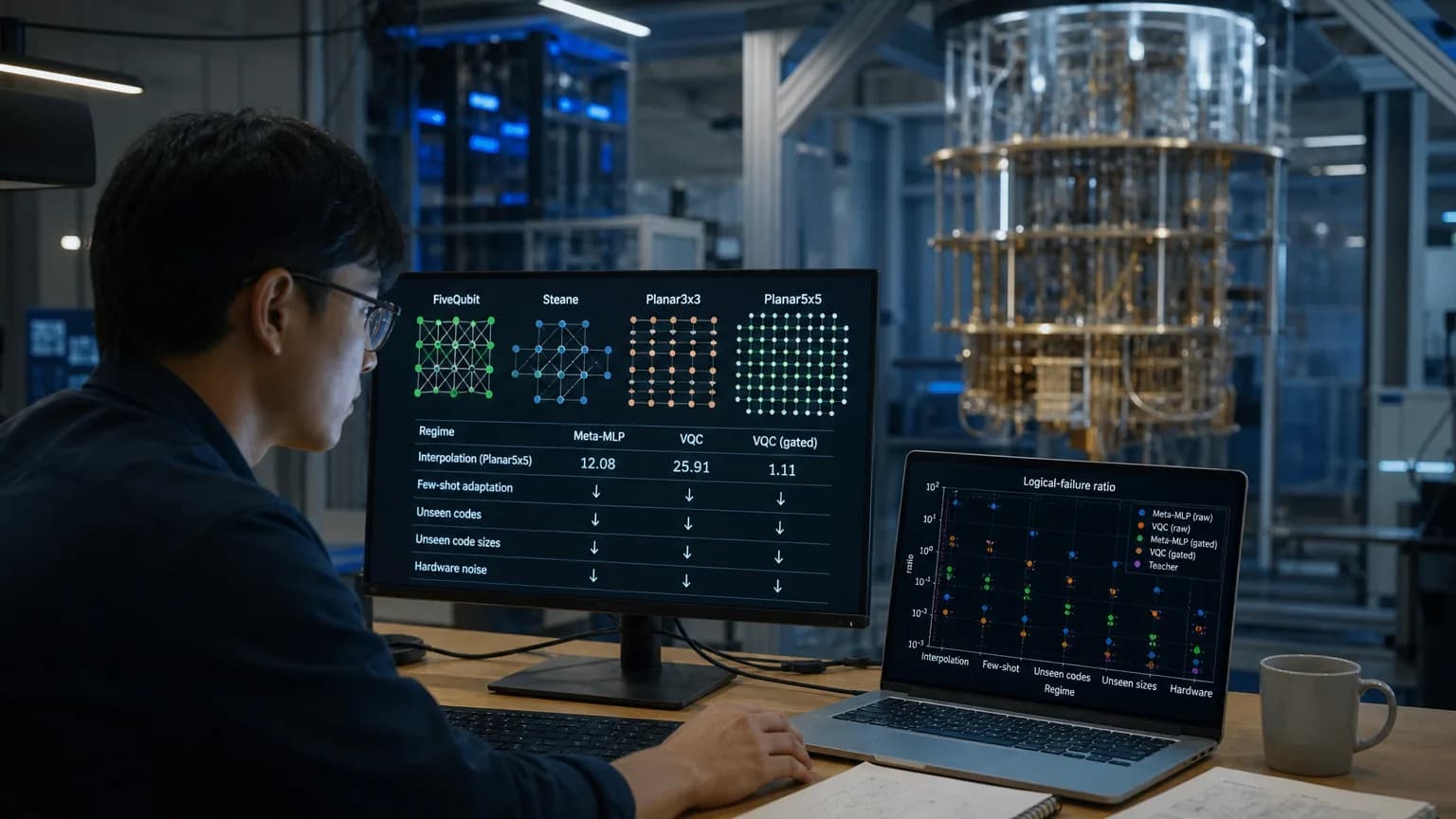
- On Planar5x5 interpolation, raw logical-failure ratios versus a specialized teacher hit 12.08 (Meta-MLP) and 25.91 (VQC).
- Confidence-gated fallback slashed those failure ratios to 1.71 and 1.11 respectively, nearly matching teacher-level reliability.
One neural network, four stabilizer codes, five deployment scenarios: that is the pitch behind a new meta-decoding framework for quantum error correction detailed in a paper submitted on July 12, 2026 (arXiv:2607.10707). Instead of training a bespoke decoder for every code, every noise level, and every hardware quirk, the authors built a single system that learns the general mapping from error syndromes to recovery operations, then adapts across FiveQubit, Steane, Planar3x3, and Planar5x5 codes without retraining from scratch.
The core motivation is practical. Quantum devices rarely run one stabilizer code under one fixed noise profile. Error rates drift, qubit layouts change, and new codes get swapped in as hardware matures. Maintaining a separate decoder for each combination is expensive and brittle. The paper tests whether a shared, meta-trained model can generalize across that variability instead.
Two architectures, five stress tests
The team compared two decoder designs: a Meta-MLP and a hardware-aware variational quantum circuit (VQC) decoder. Both were evaluated against a teacher model across five regimes meant to simulate real deployment pressure: straightforward interpolation within known conditions, transfer to unseen physical error rates, transfer to unseen noise models, few-shot adaptation to a completely new code, and few-shot adaptation to a previously unseen code distance.
Meta-MLP posted teacher-label accuracies of 0.9993, 0.9118, 0.9342, 0.6304, and 0.7548 across those five settings, while the VQC decoder scored 0.9400, 0.8495, 0.8415, 0.5678, and 0.7143. The pattern is consistent across both architectures: performance is strongest on interpolation, decent on noise and error-rate transfer, and noticeably weaker on few-shot adaptation to new codes or new code sizes, exactly the conditions where a decoder has the least prior information to lean on.
Where confidence gating changes the picture
Accuracy numbers only tell part of the story. On the Planar5x5 interpolation task, the raw logical-failure ratio relative to the teacher model was 12.08 for Meta-MLP and 25.91 for VQC, meaning both meta-decoders failed substantially more often than the specialized teacher when left to make every call on their own.
Adding a confidence-gated fallback mechanism, where the meta-decoder defers to a backup strategy when its own prediction confidence is low, cut those ratios dramatically: down to 1.71 for Meta-MLP and 1.11 for VQC. That is close to teacher-level reliability, and it suggests the practical value of this approach may lie less in raw accuracy and more in knowing when not to trust the model's own output.
For an industry racing to scale error-corrected qubits, that distinction matters. A unified decoder that knows its own limits could reduce the engineering overhead of maintaining code-specific and noise-specific decoding pipelines, provided the fallback logic is tuned carefully for each hardware target.
Original reporting and research used to synthesize this article.
WAKIB Editorial Team
This review was prepared and summarized by the WAKIB AI intelligence engine and vetted by our editorial board for accuracy and reliability.
Subscribe to Newsletter
Get a weekly summary of the most promising AI research and tools delivered to your inbox.
Telegram Channel
Join our active community on Telegram for real-time tracking of AI models and trends.