
Torvalds credits AI in Linux commit after brutal Xe driver bug hunt
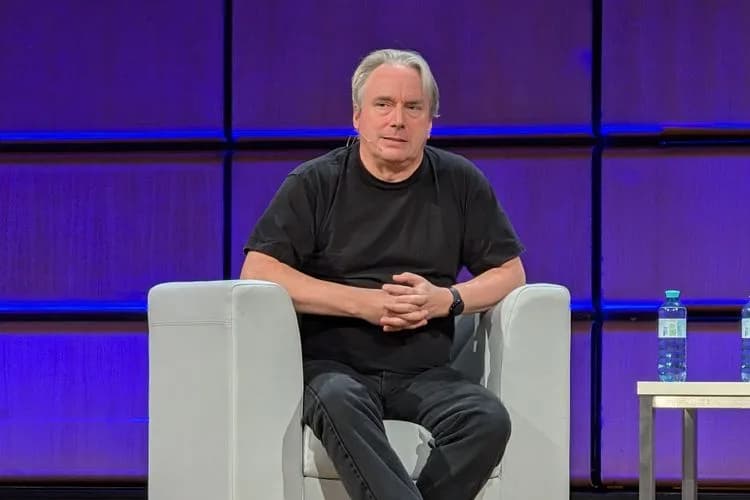
Krd · CC BY-SA 4.0 (via Wikimedia Commons)
The Core · TL;DR
- Linus Torvalds credited an AI tool in a Linux kernel commit message fixing a drm/xe (Intel graphics) driver bug
- The fix required 24 debugging patches and 18 kernel boots before the root cause was isolated
- Torvalds called the problem 'impossible and unsolvable' multiple times even as he said AI 'enormously helped'
- He described rc6 as the biggest in years by commit count, attributing much of it to AI-assisted review, calling it 'the new normal'
Linus Torvalds gave an AI tool commit-message credit in the Linux kernel repository, an unusual gesture from a maintainer known for terse, human-written changelogs. The commit fixes a stubborn bug in the drm/xe driver, Intel's graphics driver stack, and Torvalds let the AI's own summary of the fix stand in the official record.
Getting there was not clean. Torvalds has said the debugging process took 24 separate patches and 18 kernel boots before the root cause was finally isolated, a slog that repeatedly looked like a dead end.
He described the AI as having "enormously helped" during the session, even as he himself declared multiple times that the problem was "impossible and unsolvable." That tension, a maintainer convinced he was stuck while his tooling kept working the problem, is the most striking detail in his account.
Torvalds said the AI tools were "trained by people who may not be quite as stubborn" as he is, but that it "did keep adding debug code and analyzing it faithfully when I pushed."
That framing matters more than it might first appear. Torvalds isn't crediting AI with cracking the bug through some leap of insight. He's describing it as a tireless collaborator willing to keep generating diagnostic code and grinding through analysis long after a human might have shelved the ticket out of frustration.
A pattern, not a one-off
This wasn't an isolated experiment. Torvalds flagged on August 2, 2026, that the rc6 release candidate was "the biggest rc6 we've had in years at least by commit count," attributing much of that volume to fixes surfaced through AI-assisted review.
His own words on the shift were blunt: "it is what it is: the new normal with a lot of fixes, many of them due to review by various AI tools." Coming from the person who has final say over what enters the world's most widely deployed open-source kernel, that's a notable acknowledgment of how code review inside the project is changing.
For a codebase as large, security-sensitive, and heavily scrutinized as Linux, AI involvement in triage and debugging carries weight beyond any single patch. It suggests these tools are shifting from writing boilerplate to sitting alongside maintainers during the hardest, most iterative parts of the job: the unglamorous cycle of reproduce, instrument, boot, and repeat that Torvalds has just walked through in public.
Original reporting and research used to synthesize this article.
WAKIB Editorial Team
This review was prepared and summarized by the WAKIB AI intelligence engine and vetted by our editorial board for accuracy and reliability.
Subscribe to Newsletter
Get a weekly summary of the most promising AI research and tools delivered to your inbox.
Telegram Channel
Join our active community on Telegram for real-time tracking of AI models and trends.