
Do Machines Really Understand Saudi and Gulf Arabic? What the Published Benchmarks Say About the Leading Speech Engines
The Core · TL;DR
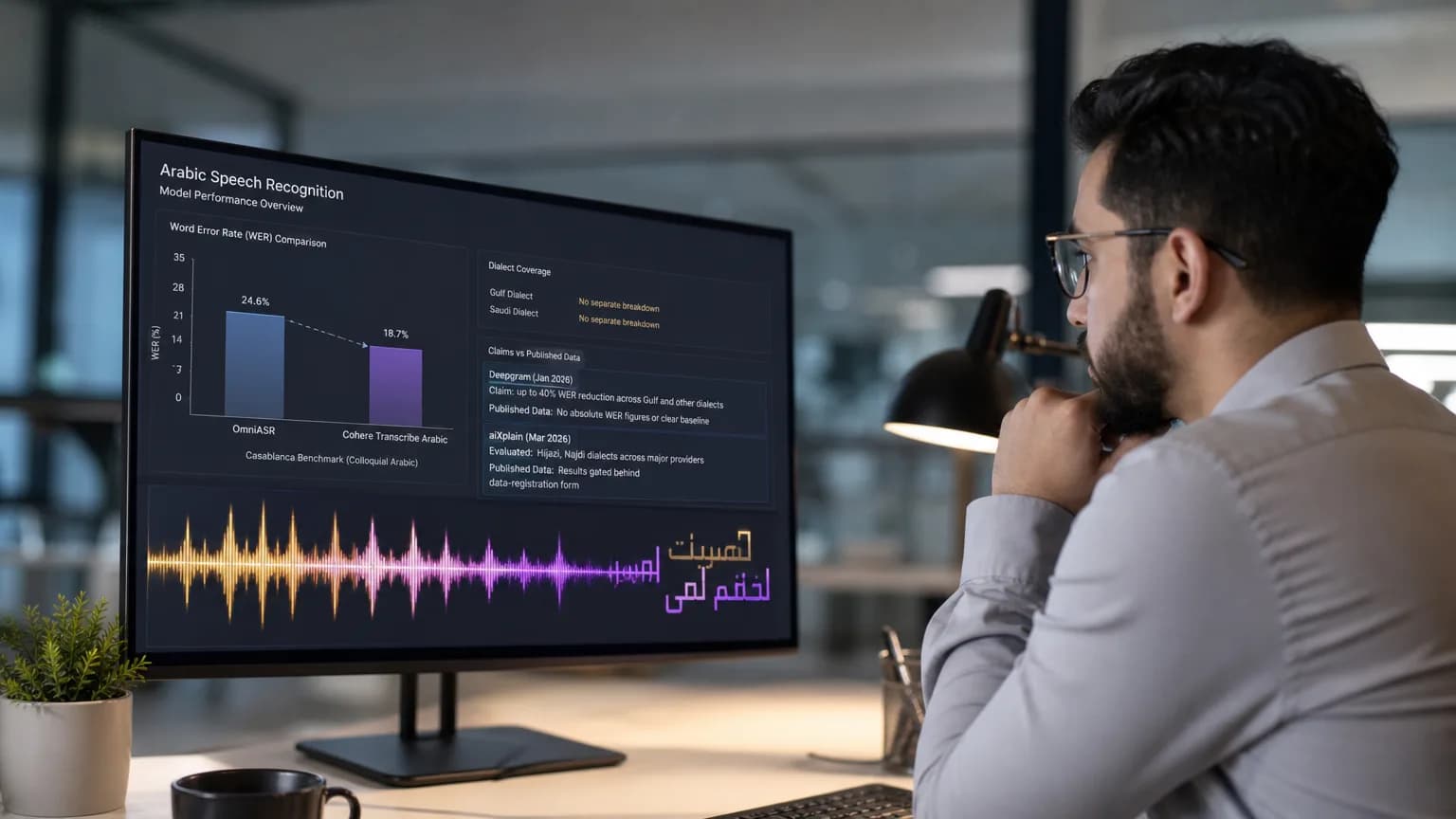
- The Open Universal Arabic ASR leaderboard (updated July 7, 2026) shows Cohere Transcribe Arabic outperforming OmniASR by about six percentage points on the Casablanca colloquial Arabic benchmark, but without a separate numerical breakdown for the Gulf or Saudi dialect.
- Deepgram's January 2026 claim that Nova-3 Arabic cuts word error rate by up to 40% across Gulf and other dialects is not accompanied by published absolute WER figures or a clear baseline, limiting independent verification.
- The aiXplain report (March 2026) is the closest source to explicitly evaluating the Hijazi and Najdi dialects across Google, AWS, Whisper, and Azure, but its quantitative results are gated behind a data-registration form and not publicly accessible.
A growing number of Arab engineers and researchers are searching for a precise answer to a question that sounds simple but is difficult to verify: does the accuracy of Automatic Speech Recognition (ASR) engines actually degrade when handling Gulf and Saudi dialects compared to Modern Standard Arabic (MSA), and by what measured margin? The evidence available in the literature and published benchmarks to date is partial. Most of it does not break out performance specifically at the level of the Gulf or Saudi dialect, even though serious measurement frameworks and leaderboards have begun to close this gap.
The Open Universal Arabic ASR Leaderboard: Overall Superiority Without Fine-Grained Dialectal Breakdown
The most recent systematic evaluation source available is the Open Universal Arabic ASR leaderboard, last updated on July 7, 2026, which measures zero-shot multi-dialect generalization across six test sets covering MSA, Egyptian, Gulf, Levantine, and Maghrebi Arabic.
According to this leaderboard, the Cohere Transcribe Arabic engine achieves the best overall Word Error Rate (WER) and leads in four of the six composite task groups. Notably, this engine outperforms the OmniASR system by nearly six full percentage points on the Casablanca benchmark, a dataset specifically designed to evaluate spoken colloquial Arabic across eight different dialects.
This figure matters because it is the first published, dated quantitative indicator comparing two engines on real dialectal data. But the core methodological problem for the purposes of this analysis is that the leaderboard report does not break out WER figures for the Gulf or Saudi dialect separately from the other dialects within Casablanca or elsewhere. In other words, the aggregate result exists, but the sub-dialect breakdown is absent from currently available sources, which makes any conclusion about Gulf-specific performance an unconfirmed inferential extrapolation rather than a proven figure.
Commercial Vendor Claims: Marketing Numbers Without Sufficient Technical Detail
On the commercial side, Deepgram announced Nova-3 Arabic in January 2026, claiming it achieves the lowest word error rates across Gulf, MSA, Egyptian, and Levantine dialects, outperforming all major competitors, with a reduction of up to roughly 40% in WER compared to rival systems.
This claim deserves critical scrutiny from two technical angles:
- Absence of absolute figures: the percentage improvement (~40%) is relative to a baseline that is not precisely specified in available sources. A 40% improvement on a high baseline WER (say, 45%) produces a radically different final result than the same percentage applied to a low baseline (say, 15%).
- No separation of the Gulf dialect from Saudi dialects specifically: the marketing claim treats "Gulf" as a single category, whereas it is technically well known that the Gulf dialect itself is phonetically and lexically non-homogeneous. Najdi and Hijazi within Saudi Arabia alone differ phonetically in notable ways from coastal Gulf dialects (Kuwaiti, Emirati, Qatari), meaning that lumping them into a single category for measurement introduces a statistical aggregation bias that obscures real performance differences between sub-dialects.
The Arab Voices Framework: Measurement Infrastructure, Not Yet Ready Results
At the research infrastructure level, the Arab Voices framework has emerged as an attempt to standardize the measurement of Automatic Speech Recognition system performance for dialectal Arabic. This framework provides unified access to 31 datasets covering 14 Arabic dialects, along with harmonized metadata and standardized evaluation utilities.
The importance of this framework lies in the fact that it addresses a common methodological problem in Arabic ASR evaluation: the fragmentation of datasets and the inconsistency of measurement protocols across research papers, which makes cross-study comparisons non-apples-to-apples. However, as of the latest available research update, the framework has not published a specific results sample that separates Gulf or Saudi dialect performance from the other 14 dialects in sources dating from the past thirty days. The existence of the framework is a necessary condition for producing reliable comparisons in the future, but it is not a substitute for actually published results.
The Most Telling Gap: The aiXplain Report and Access Restrictions
A report issued by aiXplain in March 2026 pointed to an explicit evaluation of the Hijazi and Najdi dialects, the two sub-dialects most specifically associated with Saudi Arabia, across four major providers: Google, AWS, Whisper (OpenAI), and Azure (Microsoft). This report is the closest published source to a direct answer regarding Saudi dialect performance specifically, with detailed WER figures per provider.
However, the quantitative error-rate details are gated behind a data-registration (download) form and were not accessible directly within the scope of this research. This restriction is itself a significant indication of market reality: the most specific data on Saudi dialect performance exists, but it is commercially proprietary or access-restricted, and is not part of the open, peer-reviewable literature at this stage.
Technical Implications of the Absence of Granular Measurement
Given the above, several practical implications can be drawn for engineers building systems that rely on ASR for the Saudi or Gulf market:
- General marketing claims cannot be relied upon (such as Deepgram's aggregate improvement percentages) for production engineering decisions without independent verification on representative data for the actual target dialect, given the absence of a stated baseline and dialectal breakdown.
- The gap between "Gulf" as a broad classification category and the fine-grained phonetic differences between sub-dialects (Najdi, Hijazi, Northern, Southern within Saudi Arabia alone) means that any aggregated WER for the "Gulf" dialect may obscure substantial variance in actual performance at the level of the specific dialect used by the end user.
- Frameworks such as Arab Voices and leaderboards such as Open Universal Arabic ASR represent the methodologically correct direction, but their maturation into a comprehensive reference source requires the publication of results broken down at the sub-dialect level, which has not yet materialized in the dated sources currently available.
The bottom line of the current state of affairs is that the published evidence allows for a general relative ranking among certain engines (Cohere Transcribe Arabic's lead on the July 2026 leaderboard, for example), but it does not yet allow for a precise quantitative determination of the size of the gap between MSA performance and Gulf or Saudi dialect performance specifically, in directly citable WER figures. Any claim to the contrary, whether from a commercial or non-commercial source, should be treated as unconfirmed until detailed figures and a transparent measurement methodology become available.
WAKIB Editorial Team
This review was prepared and summarized by the WAKIB AI intelligence engine and vetted by our editorial board for accuracy and reliability.
Subscribe to Newsletter
Get a weekly summary of the most promising AI research and tools delivered to your inbox.
Telegram Channel
Join our active community on Telegram for real-time tracking of AI models and trends.