
Inside Lila Sciences' Robot Lab: Where Windows 95 Meets Trillion-Token AI
The Core · TL;DR
- Lila Sciences runs an automated lab designed like an AI data center, with robotics and instruments operating 24/7 across biology, chemistry, drug discovery, and materials science
- CTO Andy Beam and CSO Rafa Gómez-Bombarelli describe treating reinforcement learning as a data-generation loop where physical experiments serve as the verifier, not human labels
- The facility uses vision-language models to operate legacy Windows 95-based lab instruments by reading and clicking through their interfaces like a human would
- The company has generated over 10 trillion experimentally validated scientific reasoning tokens and sped up a gas sorption measurement roughly 2,500x
A gas sorption measurement that once took hours now finishes roughly 2,500 times faster, run entirely by machines that never clock out. That single number captures what Lila Sciences is trying to prove: that a scientific laboratory can be re-engineered with the same relentless throughput logic as an AI data center.
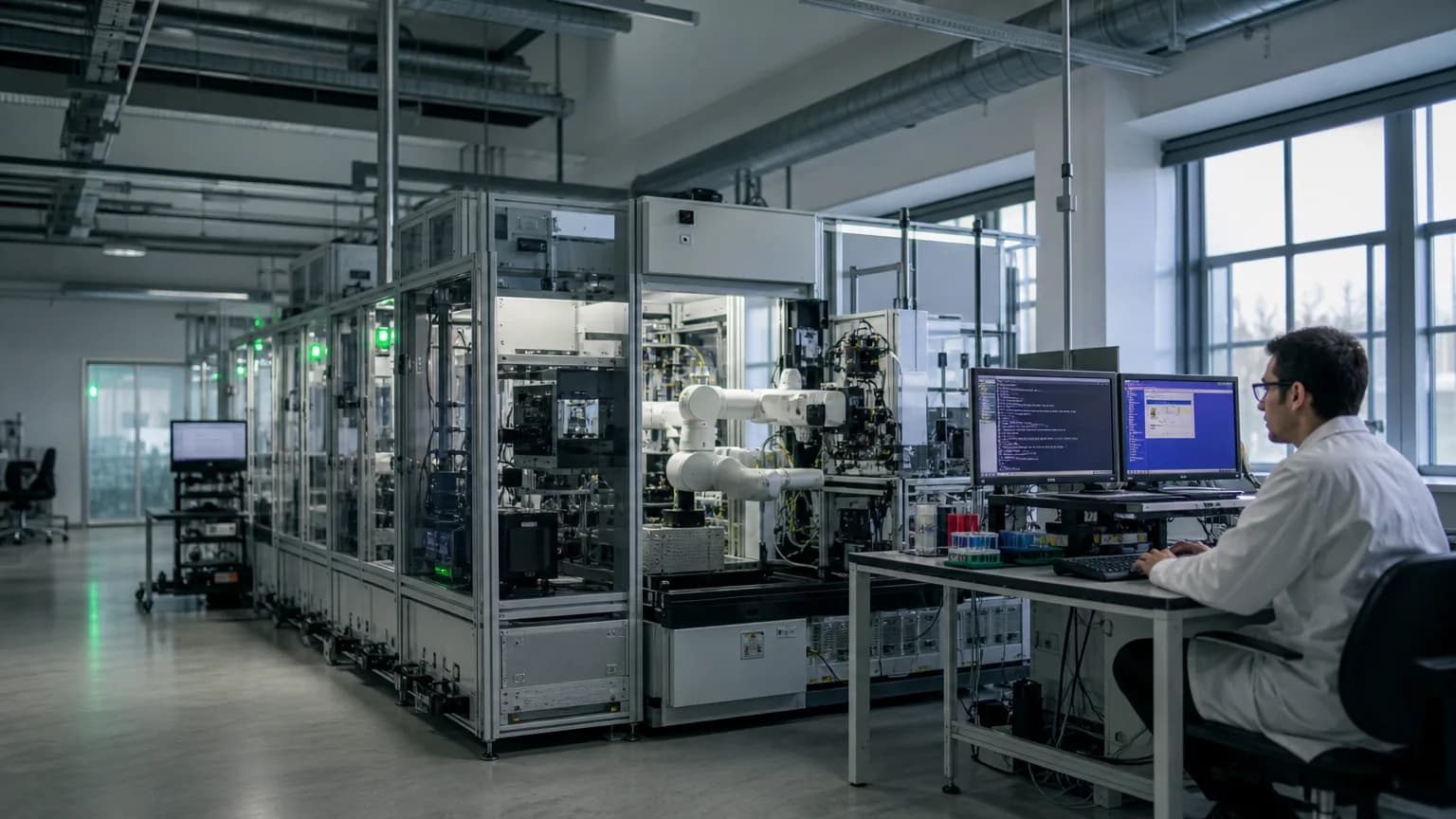
The company's approach was detailed in a conversation with CTO Andy Beam and Rafa Gómez-Bombarelli, who holds the title of Chief Scientific Officer for Physical Sciences. Together they described a facility built less like a traditional wet lab and more like a compute cluster, one where robotic arms, floating sample plates on automated tracks, and instrumentation run continuously, day and night, without waiting on human hands to move a beaker.
What makes the setup unusual isn't just the automation itself but the software layer controlling it. Some of the lab's older instruments run on legacy Windows 95 machines, systems with no modern API or integration hooks. Rather than rip and replace decades-old hardware, Lila Sciences uses vision-language models to literally look at the screen and operate the interface the way a human technician would, clicking through menus and reading dials via computer vision. It's a pragmatic workaround that lets frontier AI drive equipment that predates the modern software stack by nearly thirty years.
Nature as the Verifier
The philosophy underpinning the lab treats reinforcement learning not as a technique for refining chatbot responses but as a mechanism for generating new scientific data. In this framing, the physical world itself becomes the reward signal: an experiment either confirms a hypothesis or it doesn't, and nature supplies the ground truth that would otherwise require human-labeled datasets. That loop, Beam and Gómez-Bombarelli explained, has already produced more than 10 trillion experimentally validated scientific reasoning tokens, a corpus generated not from scraped text but from real, physically verified lab outcomes.
Unlike labs organized around a single scientific discipline, Lila Sciences runs biology, chemistry, drug discovery, and materials science experiments concurrently inside the same automated facility. That convergence is deliberate: cross-domain data, generated at scale and verified against physical reality, is the raw material the company is betting will train more capable scientific AI models than anything derived purely from published literature.
The bet is a significant departure from how AI-for-science efforts have typically operated, layering machine learning on top of human-run experiments after the fact. Lila Sciences is instead trying to make the experiment itself an automated, AI-native process from the start, generating validated data as a byproduct of running the lab rather than as a separate research exercise. Whether that data actually yields models that outperform conventional scientific discovery pipelines is the open question the company's next results will need to answer.
Original reporting and research used to synthesize this article.
WAKIB Editorial Team
This review was prepared and summarized by the WAKIB AI intelligence engine and vetted by our editorial board for accuracy and reliability.
Subscribe to Newsletter
Get a weekly summary of the most promising AI research and tools delivered to your inbox.
Telegram Channel
Join our active community on Telegram for real-time tracking of AI models and trends.