
IBM to Train Tens of Thousands of Staff on OpenAI Tools
The Core · TL;DR
- IBM will train tens of thousands of consultants on OpenAI's Codex, API, and cybersecurity tools via a new dedicated OpenAI practice.
- IBM Consulting Advantage will integrate GPT-5.6, Codex, and ChatGPT Work; a certified 'Forward Deployed Experts' team will lead client rollouts.
- The deal follows IBM's existing Anthropic alliance and a June cybersecurity partnership with OpenAI (Daybreak Cyber Partner Program); terms undisclosed.
- CEO Arvind Krishna says AI is complementing, not replacing, IBM's mainframe business, even as the company cut its 2026 revenue forecast.
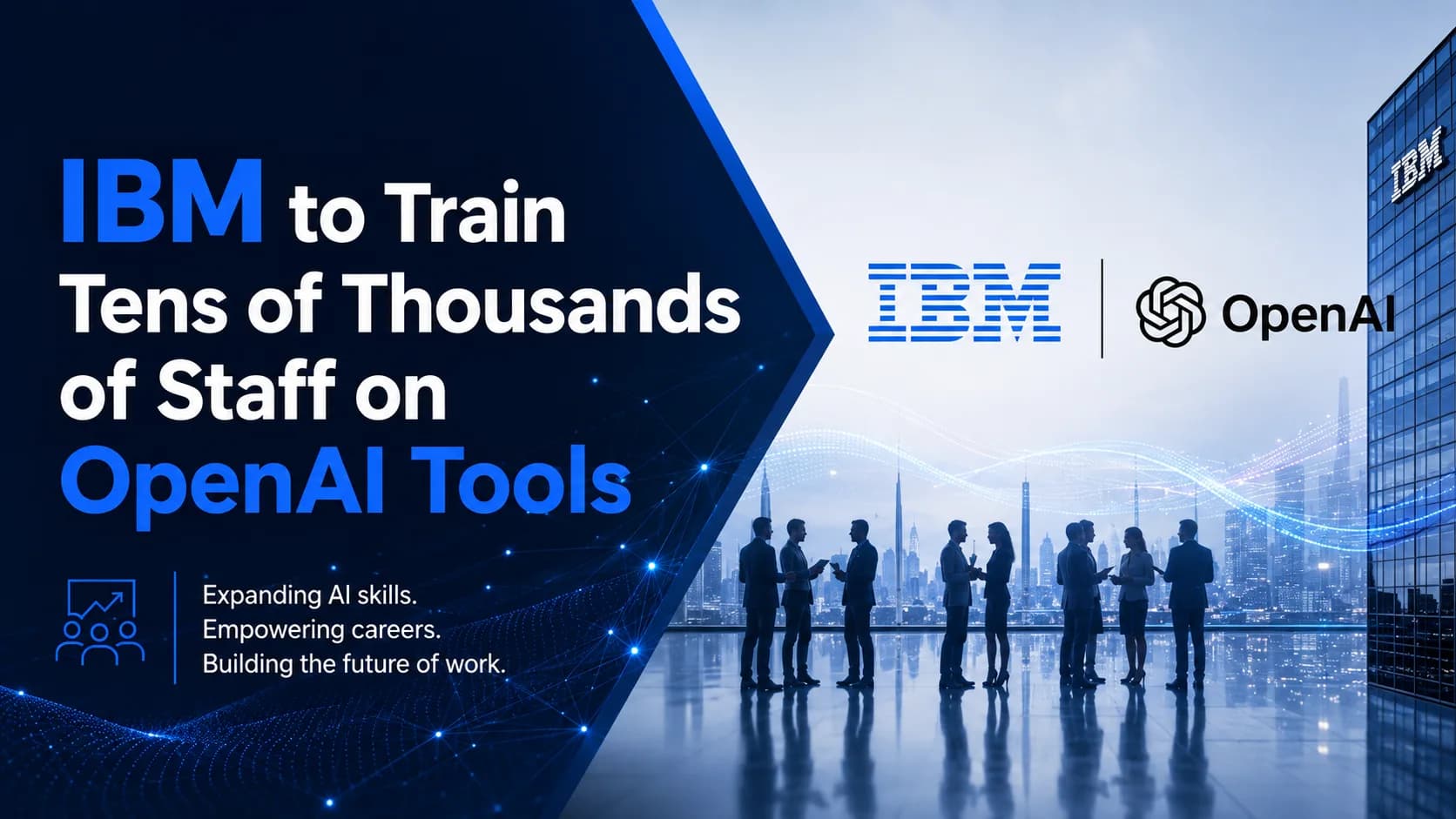
IBM is putting OpenAI at the center of its consulting business, with plans to train tens of thousands of consultants on the company's models and tools over the coming months. The move creates a dedicated OpenAI practice inside IBM Consulting, aimed squarely at enterprise clients trying to move AI projects from pilots into production.
The training will center on OpenAI's Codex coding assistant, its API, cybersecurity capabilities, and consultative solution credentials. IBM is also standing up a specialized group called "Forward Deployed Experts," certified through OpenAI's Partner Network, to lead client deployments.
On the product side, IBM plans to fold OpenAI's newest releases, including GPT-5.6, Codex, and ChatGPT Work, into IBM Consulting Advantage, its internal platform for AI-assisted delivery. The two companies also intend to co-market offerings and build industry-specific solutions for financial services, government, telecommunications, and retail. Mike Healy, managing partner at IBM Consulting, is overseeing the effort. Financial terms of the deal were not disclosed.
Not IBM's first model partner
This is not an exclusive arrangement. IBM struck a similar alliance with Anthropic less than a year ago, and it already partnered with OpenAI in June on the Daybreak Cyber Partner Program, a security-focused initiative that this deal now builds on. OpenAI, for its part, has been stacking up consulting relationships broadly, having previously partnered with IT services giants Infosys and Tata Consultancy Services.
The strategy reflects how the major foundation model makers are competing less on exclusivity and more on reach, embedding themselves inside the consulting firms that sit between them and enterprise budgets. For IBM, aligning with multiple frontier labs hedges against betting the business on any single model provider.
Mainframes and the revenue backdrop
The announcement lands alongside a lowered 2026 revenue forecast from IBM, following quarterly results that came in softer than expected. CEO Arvind Krishna used the moment to push back on a narrative that AI adoption threatens IBM's legacy mainframe business.
Krishna said AI demand is complementing, not replacing, the need for IBM's mainframe systems.
That framing matters for a company trying to convince investors that generative AI is additive to its existing revenue base rather than a threat to it. Training an army of consultants on OpenAI's stack is as much a signal to the market as it is an operational shift, positioning IBM as the implementation layer for enterprise AI regardless of which model happens to sit underneath.
Original reporting and research used to synthesize this article.
WAKIB Editorial Team
This review was prepared and summarized by the WAKIB AI intelligence engine and vetted by our editorial board for accuracy and reliability.
Subscribe to Newsletter
Get a weekly summary of the most promising AI research and tools delivered to your inbox.
Telegram Channel
Join our active community on Telegram for real-time tracking of AI models and trends.