
IBM Research Unveils CUGA: An Open-Source Harness for Production-Ready AI Agents
The Core · TL;DR
- IBM Research has introduced CUGA, an open-source Configurable Generalist Agent harness, designed to streamline AI agent development by automating planning, execution, and state management.
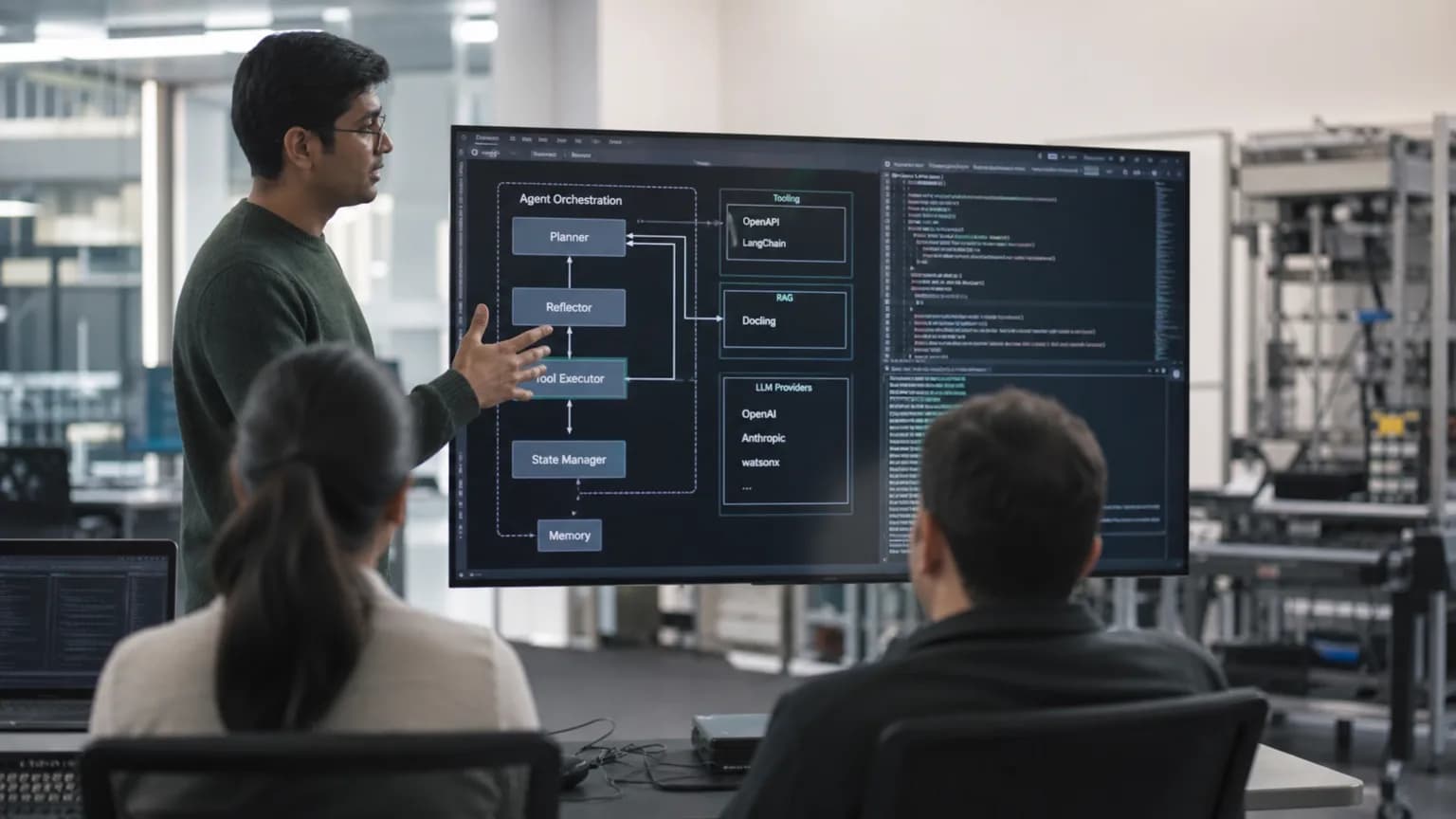
- CUGA simplifies tool integration (OpenAPI, LangChain), supports Docling-powered RAG, and offers flexible LLM provider switching (OpenAI, Anthropic, watsonx, etc.) with configurable reasoning modes.
- The harness has achieved top benchmark performance on AppWorld and WebArena due to its advanced planning, reflection, and variable tracking capabilities.
- It features secure code execution in various sandboxes, long-horizon planning, self-correction, declarative guardrails, and multi-agent delegation over A2A.
IBM Research has launched CUGA, the Configurable Generalist Agent, an open-source agent harness engineered to simplify and accelerate the development of sophisticated AI agent applications. CUGA aims to offload the foundational complexities of agent orchestration, allowing developers to concentrate on domain-specific logic, tool selection, and prompt engineering.
Streamlining Agent Development
CUGA’s core utility lies in its comprehensive machinery for managing crucial agentic functions: planning, executing the agent loop, handling tool calls, and maintaining state plumbing. This abstraction significantly reduces the boilerplate code typically associated with building robust AI agents. Installation is straightforward via pip install cuga, and IBM has provided a suite of two dozen cuga-apps, each encapsulating a CugaAgent within a FastAPI application, serving as practical, single-file reference implementations.
Performance and Extensibility
The harness has demonstrated impressive performance, topping agent benchmarks such as AppWorld (between July 2025 and February 2026) and WebArena (February 2025 to September 2025). This success is attributed to CUGA's sophisticated mechanisms for long-horizon planning, reflective self-correction, and meticulous variable tracking.
CUGA offers substantial flexibility in its ecosystem. It supports interchangeable tools, including those built with OpenAPI, MCP, and LangChain functions. Integration with Retrieval Augmented Generation (RAG) is powered by Docling, enhancing the agent's ability to leverage external knowledge. Developers also benefit from seamless LLM provider switching—supporting OpenAI, watsonx, Ollama, LiteLLM, and Anthropic—managed through a single environment variable. Furthermore, CUGA provides configurable cost/latency tradeoffs via distinct 'Fast', 'Balanced', and 'Accurate' reasoning modes.
Advanced Capabilities and Deployment
For code execution, CUGA supports various sandboxed environments, including local, Docker/Podman, or E2B cloud setups, ensuring secure and controlled operation. Beyond single-agent capabilities, the harness incorporates advanced features like declarative guardrails for behavior constraints and multi-agent delegation through Agent-to-Agent (A2A) communication, fostering more complex cooperative systems. The hosted cuga-apps examples are currently running on the gpt-oss-120b model, showcasing the framework's practical application in a production-like environment.
Original reporting and research used to synthesize this article.
WAKIB Editorial Team
This review was prepared and summarized by the WAKIB AI intelligence engine and vetted by our editorial board for accuracy and reliability.
Subscribe to Newsletter
Get a weekly summary of the most promising AI research and tools delivered to your inbox.
Telegram Channel
Join our active community on Telegram for real-time tracking of AI models and trends.