
Google DeepMind's Gemini Robotics 2 Teaches Humanoids to Screw In Lightbulbs (Sometimes)
The Core · TL;DR
- Google DeepMind unveiled Gemini Robotics 2, a three-model system (Gemini Robotics 2, On-Device 2, and ER 2) enabling whole-body control, dexterity, and multi-step reasoning in robots.
- On-Device 2 runs locally without internet and adapts to new two-arm robot designs with fewer than 200 examples; ER 2 is DeepMind's 'safest robotics model to date' and is live in Google AI Studio.
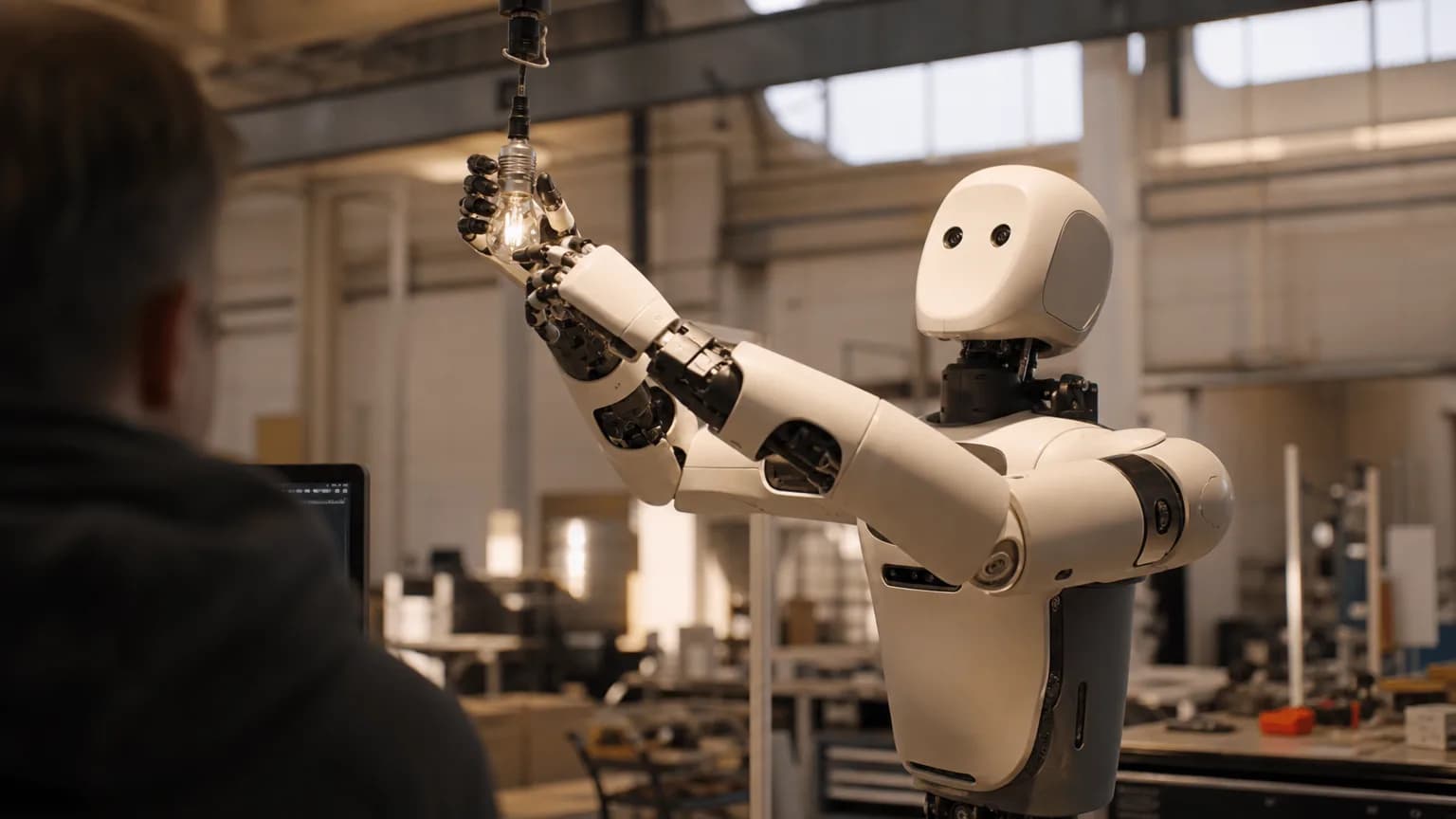
- An Apptronik Apollo 2 humanoid unscrewed a lightbulb successfully 92% of the time but only screwed one in correctly 36% of the time, highlighting uneven dexterity performance.
- A new ASIMOV-Agentic benchmark tests whether robots can reject unsafe commands and ask humans for help; full access to Gemini Robotics 2 requires joining a developer waitlist.
A humanoid robot bending down to pick an object off the floor, then walking across a room to place it on a shelf, sounds simple until you consider that most robotics AI still struggles to generalize across bodies and environments. Google DeepMind's new Gemini Robotics 2 system is built specifically to close that gap.
The release consists of three connected models. Gemini Robotics 2 itself is a vision-language-action model that turns camera input and natural-language instructions directly into motor commands, giving machines what DeepMind calls whole-body control rather than isolated arm or gripper movements.
Sitting alongside it is Gemini Robotics On-Device 2, a version light enough to run locally on a robot with no internet connection required. DeepMind says it can be adapted to new two-armed robot designs using fewer than 200 training examples, a notably small dataset for teaching a new physical form factor.
The third piece, Gemini Robotics ER 2, acts as the reasoning layer and succeeds ER 1.6, which DeepMind shipped in April. It's already accessible through Google AI Studio, while the full Gemini Robotics 2 stack is gated behind a developer waitlist for early access.
Built to Coordinate, and to Stop
One of the more unusual claims is that Gemini Robotics 2 can direct multiple, differently designed robots to collaborate on a single task, a step beyond single-unit autonomy toward mixed robotic fleets working in concert.
Safety is baked into the reasoning layer too. DeepMind describes ER 2 as its "safest robotics model to date," capable of detecting nearby humans, triggering safety tool calls, and halting the robot before contact occurs. A new evaluation, ASIMOV-Agentic, specifically measures whether a robot will refuse an unsafe instruction and ask a person for help instead of proceeding blindly.
Demonstration data, gathered largely from an Apptronik Apollo 2 humanoid, shows both the promise and the current ceiling of the technology. Apollo 2 walked, bent, reached, and shelved objects successfully in DeepMind's showcase runs, and picked items from a shelf 76.3% of the time versus 45.7% from the floor.
Fine motor control remains the weak point.
Apollo 2's five-fingered SharpaWave hand unscrewed a lightbulb correctly 92% of the time, but managed to screw one back in successfully in only 36% of attempts.
On a Franka Duo arm fitted with simpler two-finger grippers, results were more consistent: 74.2% on general pick-and-place, 78.9% on tool kitting, and 89.6% on precision insertion. The gap between dexterous humanoid hands and simpler industrial grippers suggests DeepMind's generalist model still performs unevenly depending on the hardware it's paired with, even as it edges toward robots that can reason, adapt, and collaborate across form factors.
Original reporting and research used to synthesize this article.
WAKIB Editorial Team
This review was prepared and summarized by the WAKIB AI intelligence engine and vetted by our editorial board for accuracy and reliability.
Subscribe to Newsletter
Get a weekly summary of the most promising AI research and tools delivered to your inbox.
Telegram Channel
Join our active community on Telegram for real-time tracking of AI models and trends.