
DeepMind alumni's AI agent beats Claude and GPT-5.5 at redoing science
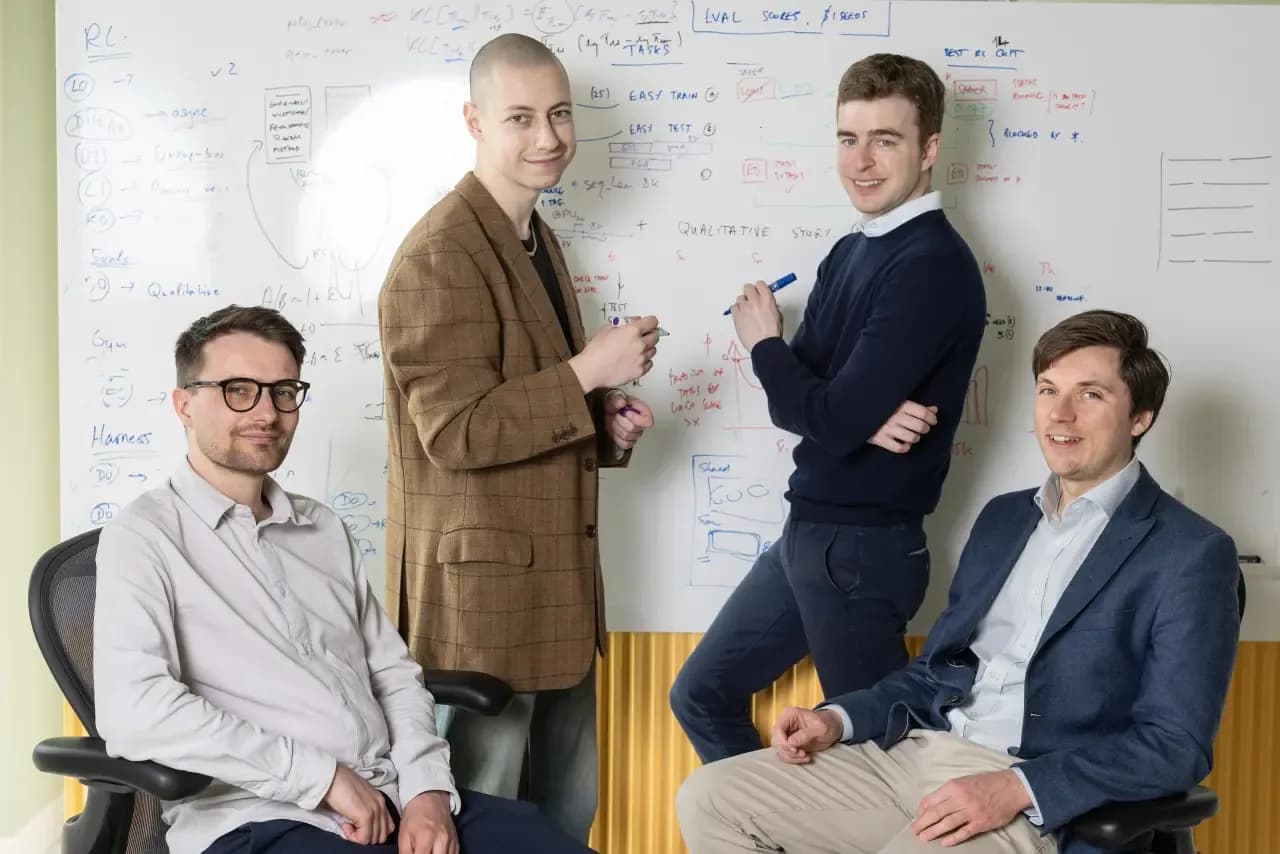
The Core · TL;DR
- Inherent, founded by Google DeepMind alumni, unveiled its AI research agent Faraday after emerging from stealth in August 2026
- Faraday reportedly outperformed Anthropic's Claude Opus 4.8 and OpenAI's GPT-5.5 at independently reproducing published scientific paper findings
- The agent runs on the 27-billion-parameter Qwen 3.6 model, trained via reinforcement learning, and uses GPT-5.5 Codex for coding tasks
- Inherent raised a $50 million seed round and is led by cofounder and chief scientist Edward Hughes
Inherent, a London-based AI lab founded by former Google DeepMind researchers, has emerged from stealth with a bold claim: its research agent, Faraday, can reproduce the findings of published scientific papers more accurately than Anthropic's Claude Opus 4.8 or OpenAI's GPT-5.5.
The company says Faraday independently replicated results from peer-reviewed studies, outperforming both rival frontier models on that specific task. Reproducing scientific findings is a notoriously difficult benchmark, since it requires an agent to understand experimental methodology well enough to rebuild it from scratch rather than simply summarizing or pattern-matching text.
Faraday is built on Qwen 3.6, a 27-billion-parameter open model, and trained using reinforcement learning rather than relying solely on pretraining and fine-tuning. For coding tasks within its research workflow, the agent calls out to OpenAI's GPT-5.5 Codex, meaning Inherent's system layers its own RL-trained core on top of an OpenAI tool rather than competing with it outright.
Edward Hughes, Inherent's cofounder and chief scientist, has framed the project around a concept the company calls "research taste": the ability to judge which experiments are worth running and how to design them so they actually answer the question at hand. That framing sets Faraday apart from agents built mainly to write code or summarize literature, positioning it instead as a tool meant to make judgment calls a human scientist would normally make.
Faraday was designed to demonstrate "research taste," an instinct for what experiments are worth running and how to design them well.
Inherent came out of stealth mode in August 2026 backed by a $50 million seed round, a sizable check for a company with no prior public product. The funding suggests investor appetite for AI systems aimed squarely at accelerating scientific research rather than general-purpose assistance or coding.
Why the benchmark matters
Beating GPT-5.5 and Claude Opus 4.8 on a narrow, well-defined task doesn't automatically mean Faraday is a better general-purpose model. Both competitors are broad frontier systems, while Faraday appears purpose-built and trained specifically for scientific reproduction workflows.
Still, the result gives Inherent an early data point to justify its seed round and its pitch to research labs and pharmaceutical or materials-science companies that need faster, more reliable ways to verify existing findings before building on them. Whether Faraday can extend that edge to genuinely novel discovery, rather than replication, remains the next test the company will have to pass.
Original reporting and research used to synthesize this article.
WAKIB Editorial Team
This review was prepared and summarized by the WAKIB AI intelligence engine and vetted by our editorial board for accuracy and reliability.
Subscribe to Newsletter
Get a weekly summary of the most promising AI research and tools delivered to your inbox.
Telegram Channel
Join our active community on Telegram for real-time tracking of AI models and trends.