
AMI Labs' CEO Explains Why He Refuses to Call World Models "AGI"
The Core · TL;DR
- AMI Labs CEO Alexandre LeBrun says the company avoids using 'AGI' or 'superintelligence' to describe its technology.
- LeBrun argues the industry has simply swapped 'AGI' terminology for 'superintelligence' without real technical justification.
- The startup, founded by Yann LeCun, is building world models that incorporate physics to help AI understand and predict the real world.
- AMI Labs is pre-product but is already engaging robotics, manufacturing, and electronics companies as potential early adopters.
Alexandre LeBrun has a simple rule for talking about AMI Labs: no "AGI," no "superintelligence." Speaking on the sidelines of the International Conference on Machine Learning in Seoul, the CEO of the Yann LeCun-led world model startup drew a sharp line between the language dominating AI marketing today and how his own company describes its work.
LeBrun, who previously built and led the AI health startup Nabla, told TechCrunch that the industry's vocabulary has simply shifted rather than matured. Where companies once reached for "AGI" to describe their ambitions, he argues, many have now swapped in "superintelligence" as the buzzword of choice. AMI Labs, he said, wants no part of either term, viewing both as more useful for headlines than for describing actual technical progress.
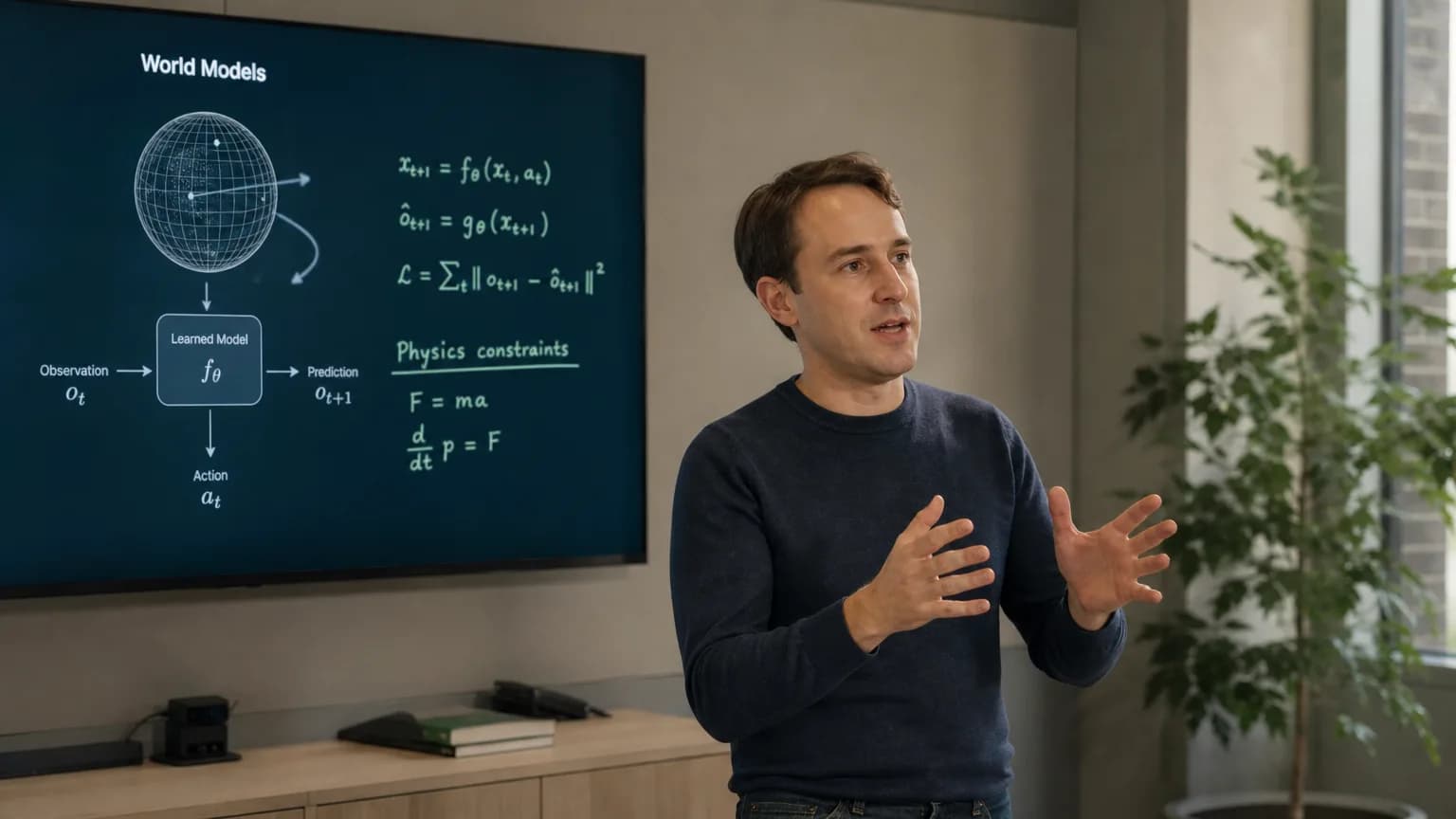
That restraint is notable given the company's pedigree. AMI Labs was founded by LeCun, Meta's former chief AI scientist and one of the most prominent skeptics of pure large language model scaling as a path to general intelligence. The startup is betting instead on world models: systems built to internalize the physical rules governing objects, space, and cause and effect, so that an AI can anticipate how the real world behaves rather than just predict the next word in a sentence.
LeBrun was careful to frame this as an addition to existing AI approaches, not a rejection of them. He described LLMs and world models as complementary rather than competing technologies, suggesting that systems capable of genuinely understanding and acting in the physical world will likely need both: language models for reasoning and communication, world models for grounding that reasoning in physical reality.
That framing lines up with where AMI Labs is looking for early traction. LeBrun said the company is in conversation with robotics firms, manufacturers, and electronics companies, along with researchers in those fields, all sectors where a model's ability to reason about physics, motion, and material behavior could translate directly into practical value. Warehouse robots, industrial automation, and precision manufacturing all depend on exactly the kind of physical-world prediction that world models aim to provide.
Despite the high-profile founder and the growing interest from industrial partners, AMI Labs remains pre-product. There is no shipping tool, API, or commercial deployment yet to point to as evidence the approach works at scale. LeBrun's comments in Seoul function less as a product announcement and more as an attempt to set expectations early, positioning the company's technical bet and its restrained language as a deliberate contrast to competitors who have leaned heavily into AGI and superintelligence framing to generate attention and investor interest.
Whether that discipline holds once AMI Labs has something to actually launch is a separate question from whether the underlying world model thesis proves out technically.
Original reporting and research used to synthesize this article.
WAKIB Editorial Team
This review was prepared and summarized by the WAKIB AI intelligence engine and vetted by our editorial board for accuracy and reliability.
Subscribe to Newsletter
Get a weekly summary of the most promising AI research and tools delivered to your inbox.
Telegram Channel
Join our active community on Telegram for real-time tracking of AI models and trends.