
AI Trained on 2 Million Seismic Records Maps Hidden Mantle Belts
The Core · TL;DR
- Chinese Academy of Sciences researchers used a neural network to detect weak PKP seismic signals near the core-mantle boundary, ~2,900 km deep
- The AI found 174,929 high-quality signals from 2 million+ records spanning 1990-2024, about 10x more than prior manual methods
- Results reveal previously isolated mantle anomalies are actually connected, forming large coherent belts of distinct rock
- Scientists suspect the structures are subducted oceanic crust or possibly remnants of the ancient planet Theia
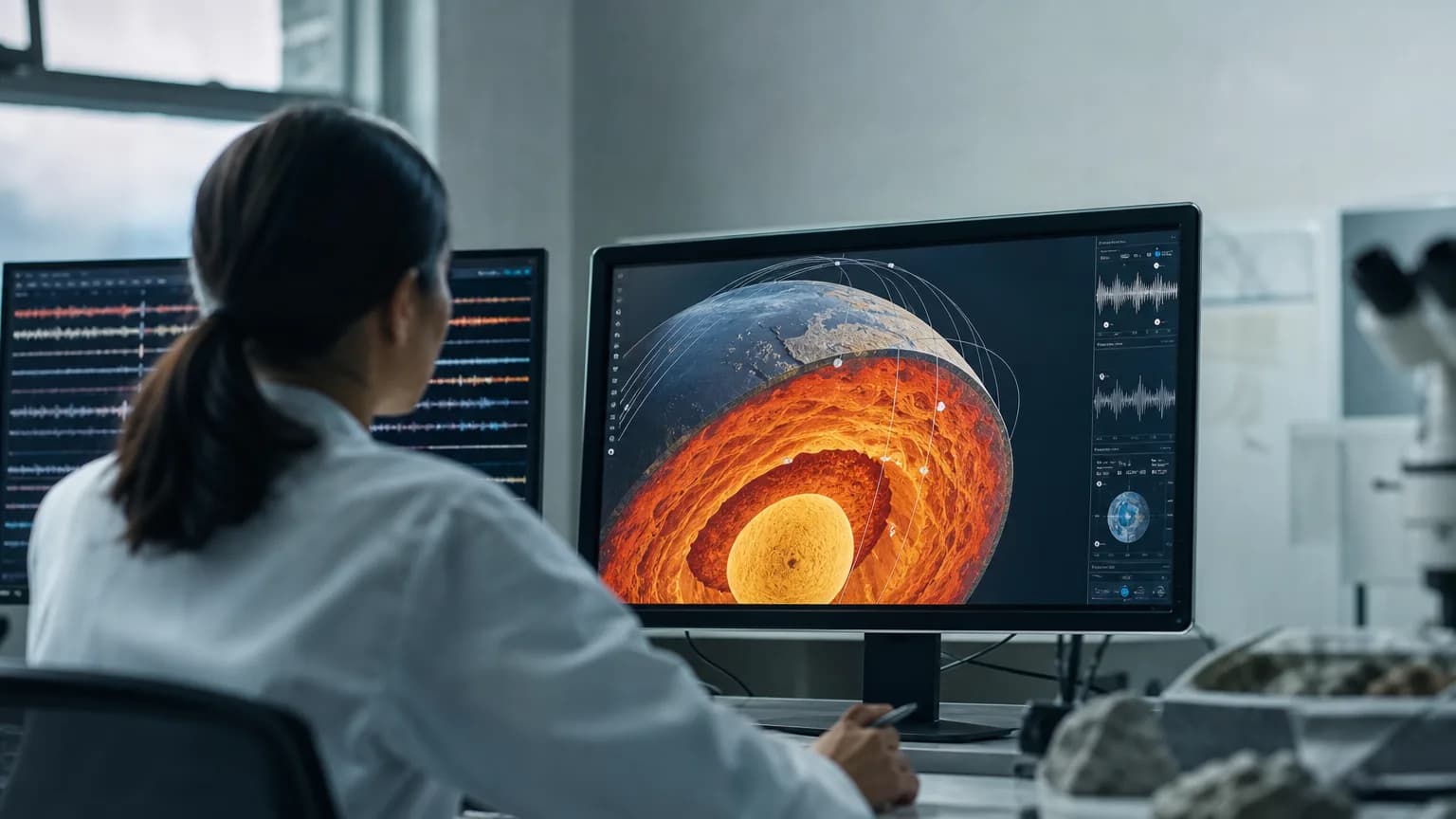
A neural network built to catch faint seismic echoes has uncovered something geologists had missed for decades: vast, connected belts of unusual rock sitting near the boundary between Earth's core and mantle. Researchers at the Chinese Academy of Sciences trained the model to pick out weak PKP precursor signals, seismic waves that scatter off dense structures roughly 2,900 kilometers underground.
Those signals are notoriously hard to isolate from background noise using conventional methods. The team's deep learning model changed that math directly, identifying 174,929 high-quality weak signals from more than two million seismic records collected between 1990 and 2024. That is roughly ten times the number of usable detections earlier studies managed to extract from similar data.
The model didn't get there in one pass. Researchers manually reviewed its output, corrected misclassified signals, and fed those corrected examples back into training, a cycle that sharpened detection accuracy over successive iterations.
Isolated anomalies turn out to be connected
The payoff was a far more detailed map of the lower mantle's chemical and thermal structure than seismologists previously had. Anomalies once treated as separate, localized features turned out to be pieces of the same picture.
When stitched together at this new resolution, the data show these anomalies forming extended, coherent belts rather than scattered pockets, indicating shared origins and structural continuity across large stretches of the deep Earth.
What created these belts remains an open question, but the team has two working hypotheses. One points to slabs of oceanic crust that tectonic plate movement has dragged down into the deep mantle over geological time.
The other is more speculative: some of this material could be debris from Theia, the hypothesized planet-sized body thought to have collided with early Earth and, in the process, produced the Moon. Distinguishing between these explanations will likely require further modeling and additional seismic surveys, but the higher-resolution signal detection this AI system provides gives researchers a substantially better dataset to test either theory against.
Original reporting and research used to synthesize this article.
WAKIB Editorial Team
This review was prepared and summarized by the WAKIB AI intelligence engine and vetted by our editorial board for accuracy and reliability.
Subscribe to Newsletter
Get a weekly summary of the most promising AI research and tools delivered to your inbox.
Telegram Channel
Join our active community on Telegram for real-time tracking of AI models and trends.