
A Shoestring Budget and a Printer-Sized Quantum Computer Just Improved Drug Discovery AI
The Core · TL;DR
- DTU researchers paired a generative AI model with a compact quantum computer from ORCA Computing to design peptides that bind therapeutic protein targets
- The hybrid system outperformed classical AI alone, with the biggest gains on targets where training data was scarce, addressing a long-standing bias toward Western patient data
- The self-funded project, backed partly by the Novo Nordisk Foundation, targeted peptides for rare diseases and underrepresented populations
- Researchers caution current quantum computers are still too small to run full-scale generative AI models, limiting near-term applications
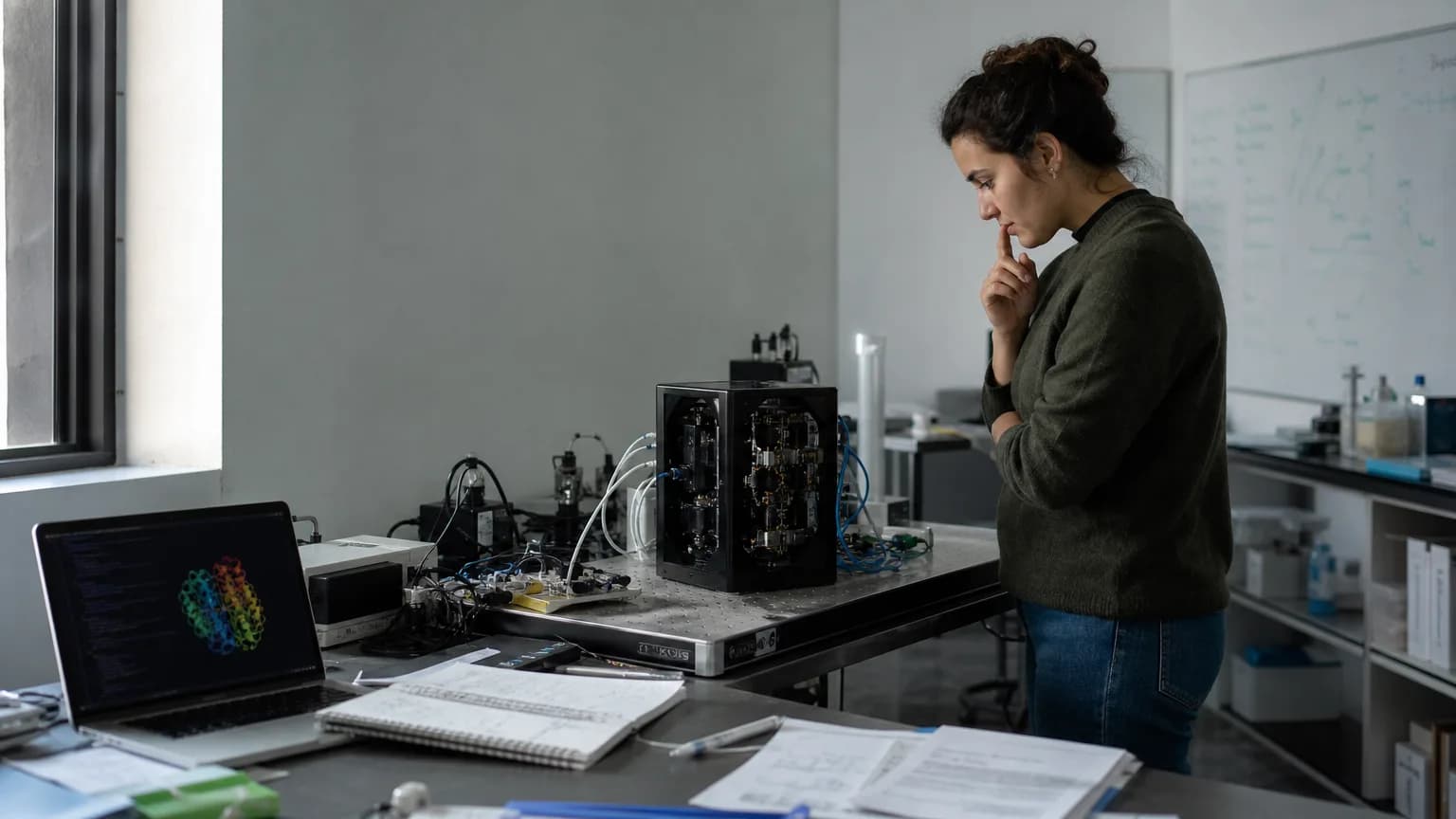
Researchers at the Technical University of Denmark didn't have a dedicated grant or a supercomputing cluster for this project. What they had was leftover funding scraped together from other budgets and evenings spent tinkering after hours. Out of that improvised setup came a demonstration that a quantum computer, small enough to fit where a large office printer would sit, can measurably sharpen the output of a generative AI model used to design new peptides.
The project was led by DTU professor Timothy Patrick Jenkins, with PhD student Jonathan Funk among the contributors. Their goal was pointed: build peptides, short chains of amino acids that can bind to specific proteins in the body, for populations and diseases that mainstream drug discovery tends to skip. Rare conditions and non-Western genetic groups are chronically underrepresented in the datasets that train today's biomedical AI models, since most clinical research has historically centered on Western patient populations. That data gap makes it harder for standard generative models to propose viable peptide candidates when working outside their comfort zone.
Pairing a classical model with quantum hardware
The DTU team's answer was a hybrid pipeline: a generative AI model working in tandem with a compact quantum computer built by ORCA Computing, a British quantum hardware startup. The underlying hypothesis was that quantum processing could inject more diversity into the pool of candidate peptides the AI generates, an effect the researchers expected to matter most precisely where training data is thin.
That hypothesis held up. Peptides binding to specific target proteins are a foundational step in vaccine and immunotherapy development, and the hybrid quantum-AI system generated more viable candidates than the same generative model running on classical hardware alone. Crucially, the gains were largest for the toughest cases: targets where historical data was sparse to begin with, which is exactly the scenario the team set out to address for underserved populations and rare diseases.
Real result, real limits
The Novo Nordisk Foundation has backed much of this line of work, supporting DTU's broader search for proteins that could open doors to new immunotherapies. That funding context matters, because it underscores that this isn't a speculative side project. It's part of an active pipeline aimed at real therapeutic targets.
Even so, the researchers are clear-eyed about where the technology stands. Quantum computers today remain far too limited in scale to run the large, state-of-the-art generative models that define the current frontier of AI-driven drug discovery. The ORCA machine used here is a modest, early-stage device, not a stand-in for the massive neural networks used in industry-leading pipelines. What DTU has shown is narrower but still notable: quantum hardware, even at today's small scale, can already improve the accuracy and reach of a generative model, particularly in the low-data regime where classical AI tends to struggle most. Whether that improvement scales alongside quantum hardware itself is the open question the DTU team's next round of experiments will need to answer.
Original reporting and research used to synthesize this article.
WAKIB Editorial Team
This review was prepared and summarized by the WAKIB AI intelligence engine and vetted by our editorial board for accuracy and reliability.
Subscribe to Newsletter
Get a weekly summary of the most promising AI research and tools delivered to your inbox.
Telegram Channel
Join our active community on Telegram for real-time tracking of AI models and trends.